LOS ANGELES, California — November 5, 2026 | WWC ONE MEDIA | US Politics, Elections & World News
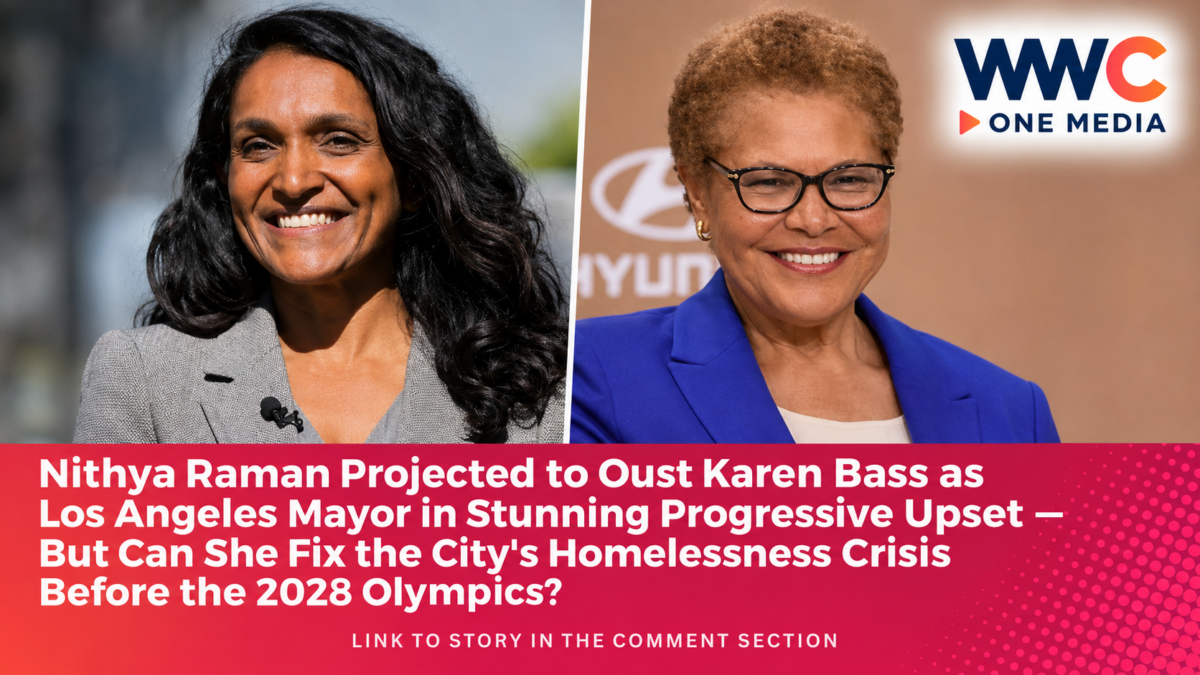
Los Angeles is facing a dramatic political turning point after City Councilmember Nithya Raman was projected by Decision Desk HQ to defeat incumbent Mayor Karen Bass, potentially delivering one of the most consequential progressive victories of the 2026 US election cycle.
Bloomberg reported the projection on November 5, following a closely contested election that exposed deep divisions over homelessness, housing affordability, public safety and the city’s response to the devastating 2025 Palisades Fire.
Raman, 45, entered the mayoral race in February, challenging Bass, 73, despite having supported her reelection earlier in the year.
What followed was an increasingly bitter campaign between two Democrats who had once been political allies.
Early election returns initially favored Bass.
But as more ballots were counted, Raman moved into the lead.
By the early hours of November 4, the Los Angeles County vote count showed Raman with 377,458 votes, compared with 360,864 for Bass.
The initial results gave Raman approximately 51% of counted votes and a lead of more than 16,000.
Election analysts pointed to the likelihood that later-counted ballots would favor younger and more progressive voters.
However, the available early results were not final certified totals, and several major news organizations had not independently called the race at that stage.
The central question now is whether Raman can translate her progressive campaign into measurable improvements in housing, homelessness, public safety and city services before Los Angeles welcomes the world for the 2028 Summer Olympics.
Nithya Raman’s Rise Shakes Los Angeles Politics
Raman’s path to the mayoral contest was unusually dramatic.
In February 2026, she launched a challenge to Bass shortly before the candidate filing deadline.
The decision surprised political observers because Raman had previously endorsed the incumbent mayor.
Raman argued that Los Angeles needed new leadership capable of improving basic city services and delivering more effective responses to long-standing problems.
Her campaign emphasized housing costs, homelessness, public accountability and dissatisfaction with how the city was being managed.
Bass defended her experience and pointed to her record in government, public safety initiatives and efforts to address homelessness.
Their contest became a referendum on the city’s direction rather than a conventional disagreement between political parties.
Both candidates are Democrats.
But they represent different political coalitions, approaches to public spending and ideas about how quickly city government should change.
Who Is Nithya Raman?
Raman is a Los Angeles City Councilmember who was first elected in 2020.
Her political background includes work on urban policy, housing and homelessness.
She became associated with the city’s progressive movement and received support from organizations linked to the Democratic Socialists of America.
Her campaign presented her as an alternative to established political leadership.
Raman argued that Los Angeles needed better coordination between government agencies, improved services and stronger accountability for spending.
Her platform included proposals to reduce unsheltered homelessness, expand street-level healthcare services and change public-safety leadership.
She also criticized the city’s handling of infrastructure projects and other basic operations.
However, the ability to implement these proposals would depend on the authority of the mayor, cooperation with the City Council and the availability of funding.
A projected election victory does not automatically enact campaign promises.
Karen Bass Faces the Biggest Challenge of Her Political Career
Bass entered the election as an experienced political figure.
Before becoming mayor in December 2022, she served in the California Legislature and the US House of Representatives.
She built a political career around social policy, legislative negotiations and Democratic Party leadership.
Her supporters argued that this experience made her well suited to managing a large and complex city.
Bass also received endorsements from prominent Democrats, including California Governor Gavin Newsom, former Vice President Kamala Harris and former House Speaker Nancy Pelosi.
But her administration faced intense scrutiny over homelessness, public spending and the aftermath of the January 2025 Palisades Fire.
Raman turned those issues into central arguments for replacing the incumbent.
Bass responded by questioning Raman’s leadership record and whether her proposals would improve public services.
The contest eventually became one of Los Angeles’ most closely watched local elections in years.
The Palisades Fire Became a Major Election Issue
The devastating January 2025 Palisades Fire played a significant role in reshaping the city’s political environment.
The disaster destroyed thousands of properties and killed residents, leaving affected communities confronting enormous personal and financial losses.
Bass faced criticism for traveling to Ghana shortly before the wildfire emergency.
She later acknowledged that leaving Los Angeles at that time had been a mistake.
The administration also faced questions about emergency preparedness, resources and communication during the crisis.
However, criticism of a public official’s crisis management should be distinguished from legally established responsibility for the disaster itself.
The wildfire involved multiple emergency agencies and complex conditions.
For voters, the broader issue was whether city leadership had demonstrated sufficient preparation and accountability.
Raman used the controversy to argue for a different approach to city management.
If her projected victory holds, wildfire recovery and preparedness will remain important responsibilities for the incoming administration.
Homelessness Could Become Raman’s Biggest Test
Los Angeles has struggled for years with homelessness, high housing costs and insufficient affordable accommodation.
These issues dominated the mayoral campaign.
Raman proposed expanding street-based medical teams and reducing the number of people living in tents and encampments.
According to the Associated Press, her campaign included a goal of reducing unsheltered homelessness by at least half by 2028.
Bass defended her administration’s housing and homelessness initiatives, including Inside Safe.
That program sought to move people from encampments into temporary accommodation and longer-term housing pathways.
Critics questioned its cost, implementation and effectiveness.
The Los Angeles Times also reported that unsheltered homelessness had fallen significantly in Raman’s council district, although the relationship between local policy measures and broader changes in homelessness requires careful examination.
A citywide reduction would present a much larger challenge.
It would require coordination involving housing development, healthcare, emergency accommodation, support services and financing.
Housing Affordability Divides the Candidates
Los Angeles remains one of the most expensive major housing markets in the United States.
High rents and home prices place financial pressure on working households.
Housing policy therefore became an important dividing line between Bass and Raman.
Raman advocated stronger action to address affordability and improve the delivery of city services.
Bass emphasized her existing initiatives and the importance of continuing housing development.
Their differences included the pace of reform, planning requirements and accountability.
But housing construction depends on more than mayoral decisions.
Zoning, financing, environmental reviews, state law and market conditions can all affect development.
Even ambitious policies may take years to produce substantial new housing supply.
If Raman becomes mayor, her administration will need to show how proposed changes can deliver homes, reduce costs and improve neighborhood conditions.
Policing Became One of the Campaign’s Sharpest Disputes
Public safety was another central issue.
Bass defended her work with the Los Angeles Police Department and emphasized reductions in serious crime.
Raman argued that the city needed a different approach to policing and police leadership.
She said she wanted to replace LAPD Chief Jim McDonnell, although her stated timetable changed during the campaign.
The disagreement became particularly intense following controversies surrounding federal immigration enforcement and the police response to demonstrations.
Raman criticized aspects of the department’s conduct.
Bass and her supporters argued that leadership instability could create additional risks.
The election highlighted competing concerns involving public safety, civil liberties and government accountability.
But replacing a police chief or changing department policy involves legal and administrative processes.
It is not an action automatically completed by winning an election.
The 2028 Olympics Make the Stakes Even Higher
Los Angeles is preparing to host the 2028 Summer Olympics.
The event will place enormous attention on the city’s transportation, public safety, housing, visitor services and infrastructure.
Whoever occupies the mayor’s office will play an important role in coordinating the city’s preparations.
The election therefore carries consequences beyond local political disputes.
Olympic planning involves multiple levels of government, event organizers, transportation agencies and private partners.
Raman has criticized delays and rising costs associated with major city infrastructure projects, including the airport’s automated people mover.
Bass emphasized the importance of maintaining stability and completing preparations.
The next mayor must manage these obligations while also addressing everyday problems affecting residents.
The international event creates an unusually visible deadline for demonstrating progress.
However, responsibility for Olympic preparations is spread across several organizations and cannot be attributed entirely to the mayor.
A Battle Between Democratic Establishment and Progressive Reformers
The Raman–Bass contest also reflects a broader debate within the Democratic Party.
Bass received extensive support from established political figures and organizations.
Raman attracted backing from progressive groups, housing advocates and younger political activists.
Her candidacy became associated with a movement seeking more aggressive reforms in city government.
The political divide resembles debates taking place in other major American cities.
In New York, Mayor Zohran Mamdani has helped strengthen a progressive electoral coalition.
But local political outcomes should not be treated as evidence that all Democratic voters share the same ideology.
Some voters may support a progressive candidate because of dissatisfaction with a particular incumbent rather than broad agreement with every policy proposal.
Raman’s campaign combined ideological arguments with a practical promise to improve city services.
Whether that coalition remains united will depend on her performance in office.
Los Angeles’ Election Betting Controversy Provides Another Lesson
The mayoral election also attracted extraordinary attention from political prediction markets.
During the June primary, former reality television personality Spencer Pratt became a strong favorite on some betting platforms.
Yet he ultimately finished behind Bass and Raman and failed to advance to the November runoff.
WWC ONE MEDIA previously examined the controversy in Election Betting Under Fire as 88% of Prediction Markets Prove Easy to Move — But Could Traders Be Shaping Democracy Before Votes Are Counted?.
The article examined how trading activity could produce dramatic changes in perceived election probabilities.
The key lesson is that a prediction-market price is not an official election result.
A political contract reflects market participants’ expectations and financial positions.
It does not replace counted votes, recognized election projections or certification.
The distinction remains relevant as Los Angeles processes outstanding ballots.
California Election Procedures Explain the Delayed Results
California’s reliance on vote-by-mail creates a longer counting process than some voters may expect.
Ballots postmarked by Election Day may be accepted if they arrive within the statutory period.
Election officials must also complete required verification and processing procedures.
Those practices can result in vote totals changing over several days or weeks.
The Los Angeles Times reported that analysts expected later-counted ballots to favor Raman based on previous electoral patterns and the demographics of her supporters.
However, that expectation is not equivalent to a confirmed result for every outstanding ballot.
The Los Angeles County Registrar-Recorder remains responsible for counting and certifying the official local election results.
A projection by Decision Desk HQ is a media race call, not the government’s final certification.
The Election Has No Direct Effect on Congressional Control
The Los Angeles mayoral race occurred during the November 3 US midterm elections.
The national contest also determined congressional representation and numerous state offices.
WWC ONE MEDIA examined those wider stakes in US Midterms 2026: Six Things That Could Decide Control of Congress — Is Trump Facing a Political Turning Point?.
The report explored how the election could affect the presidency, congressional oversight and national policy.
However, Los Angeles’ mayoral election is a local contest.
Both Raman and Bass are Democrats.
The result does not directly increase or decrease the number of Democratic seats in the House or Senate.
It may influence the future direction of progressive politics, but it should not be counted as a partisan congressional pickup.
California’s Election Administration Remains Under Scrutiny
The November election also involved legal disputes about voting procedures.
WWC ONE MEDIA previously covered Trump’s unsuccessful Supreme Court effort involving the processing of more than 20,000 California voter records.
That legal dispute was separate from the Los Angeles mayoral contest.
It does not establish irregularities in the Raman–Bass vote.
Nevertheless, it underscores the importance of distinguishing allegations, legal rulings and actual election administration.
For the mayoral race, the appropriate approach is to follow official ballot updates and clearly attribute media projections.
Hollywood Jobs and the Local Economy Also Matter
The next mayor will also inherit concerns about the health of the region’s entertainment economy.
Film and television production has faced challenges as companies move projects to other locations and assess rising production costs.
California officials are proposing additional financial incentives to retain entertainment activity.
WWC ONE MEDIA examined the issue in Newsom Pushes $1-Billion Hollywood Rescue as Los Angeles Film Shoots Decline.
That report discussed Governor Gavin Newsom’s proposal to expand the state’s film and television tax credit program.
The proposal is a state-level initiative, not a policy Raman has already enacted.
But preserving entertainment employment is an important issue for Los Angeles’ economy.
The city’s next mayor will need to work with industry representatives, workers and state officials while addressing the cost of doing business locally.
What Independent News Outlets Confirm
Bloomberg’s November 5 headline attributes a Raman victory projection to Decision Desk HQ.
The Associated Press independently documented the close contest and Raman’s early lead over Bass.
NBC Los Angeles reported Raman ahead by approximately 16,600 votes in its early November 4 snapshot, while still describing its own race call as pending.
The Los Angeles Times examined the expected effect of late-counted ballots and the political differences between the candidates.
LAist explained the local ballot-counting schedule and the major issues facing the next mayor.
These sources corroborate the identity of the candidates, the competitiveness of the election and the political significance of a Raman victory.
However, their earlier reports did not independently confirm the later Bloomberg/DDHQ projection.
That limitation matters when describing the status of the result.
The Bottom Line: A Political Breakthrough Facing a Difficult Reality
Nithya Raman’s projected victory would mark a major change in Los Angeles leadership.
The result would unseat Karen Bass and bring a younger, more progressive political figure into one of America’s most prominent municipal offices.
Raman built her campaign around dissatisfaction with homelessness, housing affordability, city services and accountability.
But those problems will not disappear simply because voters choose a new mayor.
The next administration will inherit complicated financial, legal and operational challenges.
It must also prepare Los Angeles for the 2028 Olympics while addressing the daily needs of millions of residents.
Raman’s projected election represents a powerful political message. Delivering affordable housing, reliable services and measurable reductions in homelessness will be a much harder task.
As Los Angeles prepares for a potentially historic change in leadership, can Nithya Raman deliver the sweeping reforms her supporters expect—or will the city’s enormous financial pressures and deeply rooted problems test the limits of progressive government before the world arrives for the 2028 Olympics?