
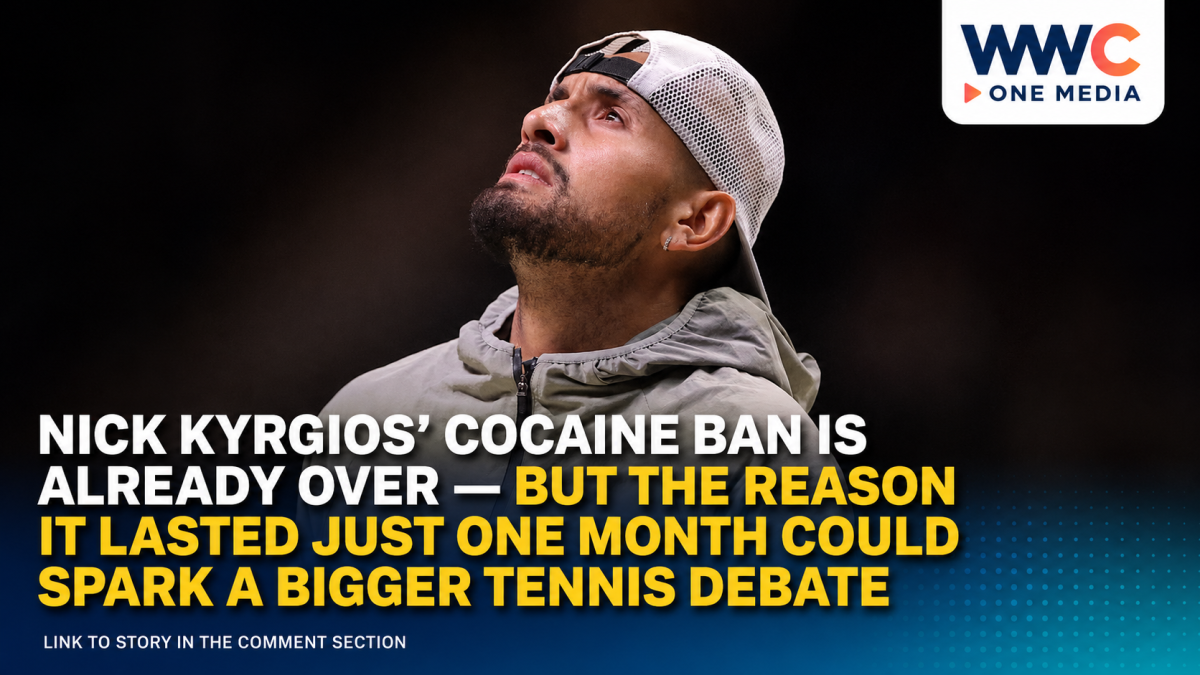
Australian tennis star Nick Kyrgios is eligible to return to the sport after serving a reduced one-month suspension for a positive cocaine test, bringing a dramatic anti-doping case to an unusually swift conclusion — but raising fresh questions about how tennis treats recreational drug use.
The 31-year-old former Wimbledon finalist had been provisionally suspended since August 4, 2026, after a sample collected during the ATP 250 tournament in Mallorca, Spain, on June 22 tested positive for benzoylecgonine, a metabolite of cocaine.
The International Tennis Integrity Agency initially confirmed the positive result in August. A World Anti-Doping Agency-accredited laboratory had detected the substance on July 17.
Now, the case has taken a significant turn.
According to the ITIA account reported by Reuters and Channel NewsAsia, Kyrgios told investigators that he had used cocaine socially during a night out before he was due to compete in Mallorca.
The ITIA consulted an independent scientific expert from a WADA-accredited laboratory, who concluded that Kyrgios’ explanation was consistent with the concentration detected in his sample.
That finding allowed anti-doping officials to accept that the cocaine had been taken outside competition rather than for sporting performance.
Why Kyrgios Received Only a One-Month Ban
At first glance, a one-month suspension following a positive cocaine test may appear unusually light.
But the distinction is important under anti-doping rules.
Cocaine is classified by WADA as both a stimulant and a “substance of abuse.” It is prohibited in competition, but the rules allow substantially reduced sanctions when an athlete can establish that the drug was consumed outside competition and was unrelated to improving performance.
Under that framework, an athlete who meets the requirements can face a three-month suspension. That sanction can be reduced to one month if the athlete completes an approved treatment program.
Kyrgios entered an ITIA-approved treatment program, allowing his default three-month penalty to be reduced.
His suspension ran from August 4 through September 3, meaning the Australian has effectively served the ban and can become eligible to return, subject to the program requirements outlined in the sanction.
There is another consequence: Kyrgios will lose the ranking points and prize money he earned at the Mallorca tournament.
Kyrgios Had Already Admitted He Made a ‘Huge Mistake’
When the positive test became public on August 19, Kyrgios did not deny responsibility.
He apologized to his family, fans, sponsors and young supporters, describing the incident as a major mistake and saying the failed test had become a wake-up call.
The Australian also announced that he would step away from social media and public life for 28 days while focusing on himself.
His explanation came against the backdrop of several difficult seasons.
Kyrgios has struggled repeatedly with wrist and knee problems since reaching the 2022 Wimbledon singles final, where he lost to Novak Djokovic. Injuries have severely restricted his appearances on the ATP Tour, preventing him from rebuilding the momentum that once took him to a career-high singles ranking of No. 13.
He has played only a fraction of a normal tour schedule since his breakthrough 2022 season.
At Wimbledon this year, Kyrgios also suggested that the tournament may have marked his final appearance at the All England Club, admitting that returning to the level that carried him to the 2022 final appeared increasingly difficult.
That makes the biggest question surrounding Kyrgios considerably larger than the drug suspension itself:
Does he still intend to build another comeback — or has one of tennis’ most unpredictable careers entered its closing chapter?
The Case Is Also Awkward Because of Kyrgios’ Past Doping Criticism
There is another layer that could keep the story alive inside tennis.
Kyrgios has previously been an outspoken critic of the sport’s handling of high-profile anti-doping cases and argued that tennis authorities had been too lenient in other cases.
BBC Sport noted that Kyrgios had publicly criticized the anti-doping system following sanctions involving leading players including Jannik Sinner and Iga Swiatek.
That history means his own one-month sanction is likely to invite scrutiny — even though the circumstances and applicable anti-doping provisions differ substantially from those other cases.
The Kyrgios ruling revolves specifically around WADA’s rules governing substances of abuse consumed outside competition, rather than a finding that cocaine was deliberately taken to enhance performance.
That distinction is critical.
A short suspension does not mean the positive test was ignored. It means the anti-doping framework treats certain recreational substances differently when authorities are satisfied that their consumption was unrelated to competition and when the athlete completes an approved treatment process.
Tsitsipas Had Already Added Fuel to the Story
Before Kyrgios’ final sanction was announced, fellow tennis star Stefanos Tsitsipas attracted attention by saying the Australian’s situation was not entirely surprising to him.
Speaking during the US Open, Tsitsipas said he had previously heard about Kyrgios’ off-court behavior and indicated that news of the positive test was something he had expected could eventually emerge.
The comments added another layer to a story already drawing considerable attention because of the history between the two players, including their explosive meeting at Wimbledon in 2022.
Still, the ITIA’s final determination rests on scientific evidence and anti-doping regulations rather than locker-room speculation.
What Happens to Nick Kyrgios Now?
From a disciplinary standpoint, the immediate obstacle has largely disappeared.
Kyrgios’ one-month suspension has been served, and the four-year punishment that had been mentioned as a theoretical possibility when his provisional suspension was first announced is no longer the central issue.
Instead, his future now comes down to something less predictable: whether his body — and his motivation — will allow him to mount another serious return to professional tennis.
Kyrgios remains one of the sport’s most recognizable personalities. He is a seven-time ATP singles champion, a former world No. 13, a Wimbledon finalist and a 2022 Australian Open doubles champion alongside Thanasi Kokkinakis.
At his best, his serve, improvisation and shot-making have allowed him to challenge virtually anyone.
But injuries have taken away years from what should have been his athletic prime.
Now the suspension that threatened to complicate his comeback has ended almost as quickly as it began.
The ban lasted only a month. The much bigger question is whether Nick Kyrgios still has another chapter of tennis left to write.




Leave a Reply