
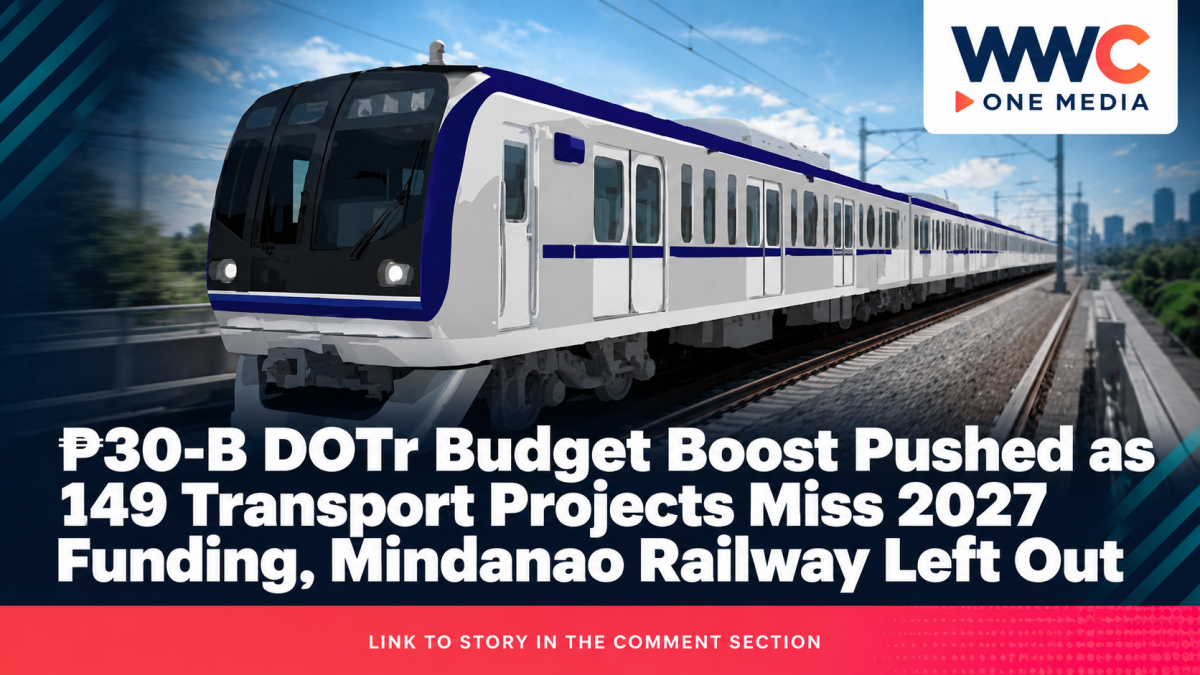
MANILA, Philippines — A lawmaker is pushing Congress to add another ₱30 billion to the Department of Transportation’s proposed 2027 budget, arguing that dozens of major transport projects — including the long-delayed Mindanao Railway Project — could remain stalled unless lawmakers restore funding left out of the government’s spending plan.
Cagayan de Oro 2nd District Rep. Rufus Rodriguez made the proposal during the House Committee on Appropriations’ deliberations on the DOTr budget, calling for the additional money on top of the department’s proposed ₱300.96-billion allocation for 2027.
If Congress approves the full increase without corresponding reductions elsewhere in the department’s allocation, DOTr funding could effectively rise to roughly ₱330.96 billion.
Rodriguez said part of the proposed additional funding should be reserved for the government’s local counterpart in the Mindanao Railway Project, particularly once the Philippines secures a foreign financing partner for the massive infrastructure undertaking.
Bigger DOTr budget — but most projects still unfunded
The push comes despite DOTr already receiving a significantly larger proposed budget for next year.
According to figures presented during the House hearing, the department’s ₱300.96-billion proposed 2027 budget is 52.52 percent higher than its ₱197.331-billion allocation under the 2026 National Expenditure Program.
But the headline increase masks a much deeper funding problem.
DOTr Assistant Secretary Cecilia Bien told lawmakers that the department submitted 179 proposed projects requiring about ₱624.482 billion, yet only 30 projects worth roughly ₱237.349 billion were included in the 2027 National Expenditure Program.
That means 149 proposed projects received no allocation under the NEP.
The projects originally proposed by the department covered 94 maritime projects, 42 aviation projects, 22 railway projects, 19 road transport projects and two projects under its infrastructure preparation and innovation facility.
Railways get billions — but several major lines get nothing
Rail remains the biggest beneficiary of the transportation spending plan.
Among the major railway projects receiving proposed funding are the North-South Commuter Railway, with about ₱123.84 billion, and the Metro Manila Subway Project, with around ₱67.44 billion.
Funding is also proposed for the MRT-3 rehabilitation and the LRT-1 Cavite Extension.
The Marcos administration is proposing more than ₱197 billion for the broader rail transport program in 2027, more than triple the amount provided under the 2026 General Appropriations Act, with the North-South Commuter Railway and Metro Manila Subway accounting for the overwhelming majority of that amount.
But several highly anticipated projects did not receive allocations.
Among those left out are the Mindanao Railway Project, MRT Line 4 and the PNR South Long Haul Project, according to DOTr presentations reported by GMA News and the Inquirer.
Mindanao Railway still searching for the money to move
The Mindanao Railway has been discussed for years as one of the country’s most ambitious transport projects outside Luzon.
Its first phase is envisioned as an approximately 100-kilometer railway linking the Tagum-Davao-Digos corridor, with the government saying the line could cut travel between the Tagum and Digos areas from roughly three hours to around one hour.
Transportation Secretary Giovanni “Banoy” Lopez told lawmakers that the government continues to look for partner countries and multilateral institutions that could finance the railway.
Study work is also moving forward, with Lopez saying the project is advancing from pre-feasibility work toward a full feasibility study.
The search for financing has become one of the project’s biggest obstacles.
China had originally been expected to provide official development assistance for the first phase of the railway. The Philippine government later abandoned that financing route after the proposed Chinese funding failed to move forward.
The DOTr has since examined other options.
BusinessWorld reported in May that officials were considering public-private partnerships, while the Japan International Cooperation Agency and Asian Development Bank were among potential financing routes being explored.
ADB Philippines Country Director Andrew Jeffries separately said the multilateral lender would be willing to consider financing the railway if formally asked by the Philippine government, although the country’s debt-management objectives would also have to be considered.
Another commuter issue emerges: EDSA Busway funding
The Mindanao Railway was not the only funding gap questioned during the hearing.
Akbayan Rep. Perci Cendaña also raised concerns over the absence of proposed funding for the EDSA Busway service-contracting program and transport fuel subsidies.
Transportation officials indicated support for restoring funding, pointing out that Congress had also intervened during previous budget deliberations to provide money for service contracting.
The issue could become especially significant for commuters because service contracting has been used to support public transportation operations during periods of elevated fuel prices and heavy passenger demand.
The ₱30-billion question
Rodriguez’s proposal is not yet guaranteed funding.
The ₱300.96-billion DOTr allocation remains part of the proposed 2027 national budget, meaning lawmakers can still amend, restore or realign funding as the spending bill moves through the House, Senate and eventually the bicameral conference committee.
Other lawmakers also signaled support during the hearing for increasing transportation funding, particularly for projects outside Metro Manila.
That leaves Congress facing a much larger question than whether DOTr deserves another ₱30 billion.
The department already has hundreds of billions of pesos earmarked for major rail infrastructure — but with 149 proposed projects excluded from the current spending plan, lawmakers must now decide which projects deserve to be rescued first.
And for the Mindanao Railway, securing money from Congress may solve only half the problem.
The other half is finding the financing partner willing to finally put the long-delayed railway on track.
WWC ONE MEDIA MJE


Leave a Reply