
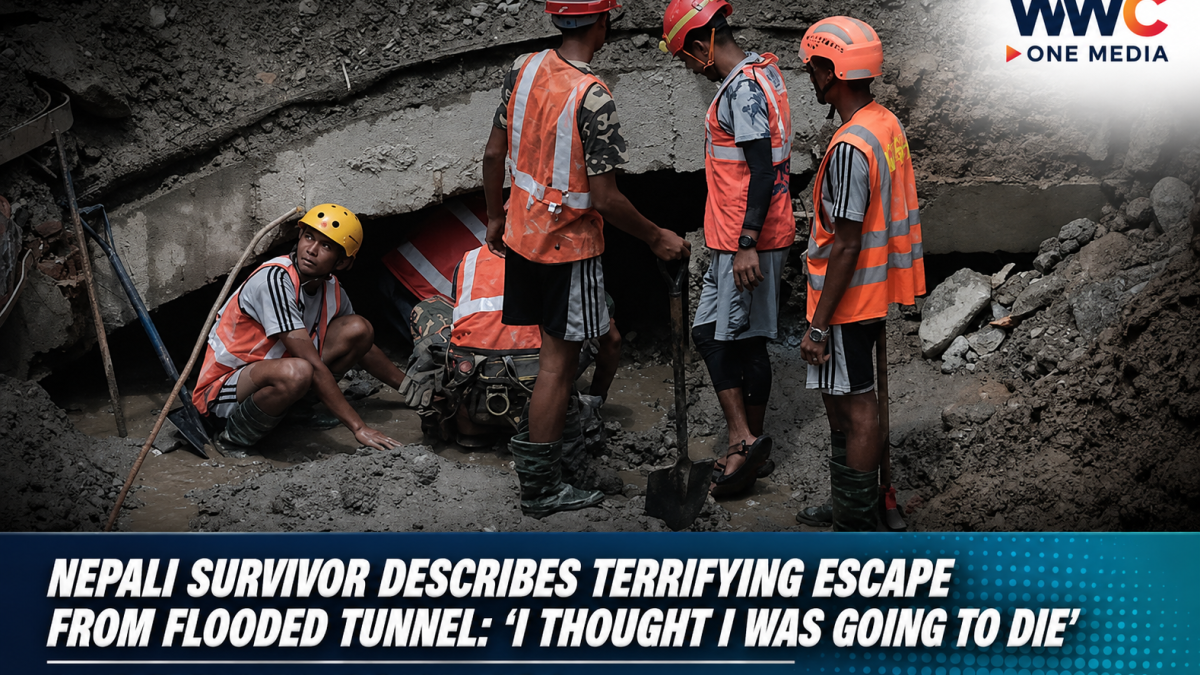
TARKESHWAR, Nepal — A Nepali worker has described a terrifying struggle for survival after a sudden flood wave swept into an underground hydropower tunnel, forcing him and other survivors to fight their way through darkness, debris and bodies before finally reaching daylight.
Dhan Bahadur Tamang, 32, was working at the Upper Trishuli 1 hydropower project near Nepal’s border with China when he noticed something was wrong.
Dust began rising under the tunnel’s industrial lights and the air pressure suddenly changed.
“Something was coming,” Tamang recalled.
Moments later, a powerful wall of floodwater surged into the underground facility.
The disaster was part of the catastrophic flooding that struck northern Nepal on Aug. 26 after a glacier collapse unleashed enormous quantities of water, rock and mud into valleys along the Nepal-China border. The resulting destruction has killed more than 1,250 people in Nepal and left thousands missing, according to the latest reports.
‘I felt again and again that I was going to die’
Tamang said workers suddenly began running, shouting and scrambling for safety as the water rushed through the tunnel.
He was swept onto a tanker truck as the floodwater rose around him.
With nowhere else to go, he grabbed whatever he could — eventually clinging to pipes in an effort to keep his head above the water.
He suffered an injury to one of his legs.
His thoughts turned to his family.
He feared he would never see them again.
When the force of the water eventually weakened, Tamang realized that some other workers had survived as well.
But escaping the tunnel was only the beginning.
The tunnel became a nightmare
The normal route toward the entrance was blocked by debris.
The survivors were forced to search for another way out.
As they moved through the damaged tunnel, they encountered injured people and bodies of workers who had not survived.
There was little light.
The group had only one flashlight, and survivors held hands as they attempted to stay together while navigating the wreckage.
Tamang described the ordeal as a prolonged struggle through darkness, water and debris.
Eventually, after making their way through the tunnel system, the survivors saw daylight.
For Tamang, the brightness outside was almost unbelievable after the darkness underground.
Locals then helped the survivors, providing dry clothes and assistance.
But rescue operations were slowed by thick fog, which prevented helicopters from operating normally. Tamang was eventually helped toward safety and later taken for medical treatment.
He says he will never work in a tunnel again
After returning home and reuniting with his wife, Tamang said the experience continues to haunt him.
He has experienced nightmares since escaping and remains troubled by memories of colleagues who died inside the tunnel.
His conclusion is stark: he does not intend to return to underground hydropower work.
“I will not work inside hydropower tunnels again,” he said, according to Reuters.
Hundreds remain missing from Nepal’s hydropower projects
Tamang’s survival comes as rescuers continue searching for people believed to be trapped inside hydropower tunnels across the disaster zone.
The tunnels have become a major focus of the rescue effort because some underground areas may still contain pockets of air where workers could have survived.
At the Rasuwagadhi hydropower project, officials said there was a possibility that dozens of workers could still be alive inside an underground chamber. Rescue teams have also been working at other hydropower facilities, including Upper Trishuli 3A.
The scale of the disaster is enormous. Reuters reported that around 900 people were believed to be trapped or missing across six hydroelectric power plants, while AP reported that rescue teams from Nepal and other countries were working to reach workers trapped underground.
International assistance has also expanded. India has deployed specialized teams, including personnel experienced in tunnel rescue, while Chinese and other international experts have joined efforts to search damaged facilities.
A disaster still unfolding
The Aug. 26 floods have devastated communities along the Trishuli River and other valleys near the Nepal-China border.
Entire settlements have been destroyed, roads and bridges swept away and enormous quantities of mud and debris left behind. Reuters reported that preliminary estimates put the amount of debris at about 2.2 million tonnes.
The tragedy has also left families across Nepal waiting for news of missing relatives.
For Tamang, however, the immediate priority was simply making it out alive.
He survived the flood, the darkness and the wreckage — but says the experience has permanently changed his view of working underground.
WWC ONE MEDIA J.M.D

Leave a Reply