
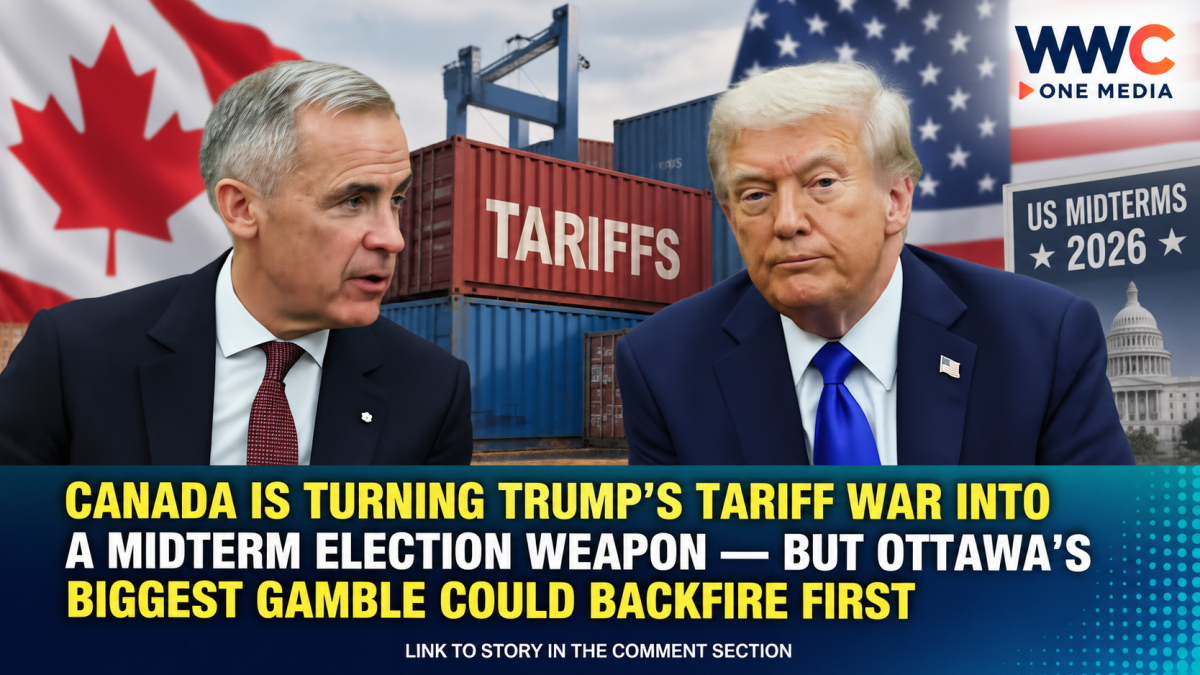
The relationship between the United States and Canada — two countries tied together by one of the world’s deepest trading relationships — has entered territory that would have seemed almost unimaginable only a few years ago.
After trade negotiations broke down in August, the Trump administration moved ahead with additional tariffs of up to 50% on selected Canadian imports.
Canada responded with a promise to hit back dollar for dollar.
Ottawa says its new counter-tariffs, scheduled to take effect on September 8, will cover approximately C$27.6 billion worth of US imports, targeting products including steel, dairy goods, agricultural equipment, appliances, electronics and pulp and paper. The rates range from 15% to 50%, depending on the product and corresponding US tariff.
But the emerging fight is about much more than who can impose the biggest tariff.
With the November US midterm elections approaching, Canada may be trying to turn America’s own political calendar into leverage.
Canada’s Tariff Strategy Has a Political Dimension
The central argument raised in a new commentary published by Channel NewsAsia is that Ottawa can use carefully targeted retaliation to increase economic discomfort in politically important parts of the United States.
The strategy is straightforward.
Canada cannot match the United States in raw economic size. But it does not necessarily need to.
If Canadian retaliation raises costs for industries, workers or consumers in states where congressional races are extremely competitive, economic pressure could become political pressure on the White House.
Michigan is particularly important.
Its automobile industry operates through an intensely integrated North American supply chain in which parts and vehicles can cross the US-Canada border multiple times before a finished vehicle reaches a customer.
That means tariffs imposed at the border do not necessarily punish only the other country. They can ricochet through factories, suppliers and consumers on both sides.
CNA’s analysis argues that politically sensitive states such as Michigan and Maine could therefore become part of Ottawa’s leverage as the November elections approach.
That calculation comes as Trump’s Canada policy is already facing substantial opposition among American voters.
A Reuters/Ipsos survey conducted ahead of the midterms found that only about 20% of US adults supported Trump’s latest tariffs on Canada, while 57% opposed them. Cost of living remains one of the dominant concerns among voters.
That creates an obvious political risk for Republicans if tariffs translate into higher prices or problems for major employers in competitive states.
But Trump Says Canada Has Been Treating America Unfairly
Washington tells a very different story.
The Trump administration argues that Canada’s policies have discriminated against American businesses in sectors including dairy, automobiles and alcoholic beverages.
The White House has invoked Section 338 of the Tariff Act of 1930, an obscure provision giving the president authority to impose additional duties when another country is deemed to discriminate against US commerce.
Trump used that authority to announce tariffs of up to 50% on selected Canadian products.
The administration argues, among other complaints, that Canadian dairy policies restrict American access, that Canadian automotive measures disadvantage US products, and that provincial restrictions on American alcohol discriminate against US exporters.
Canada disputes the broader US characterization of the relationship and says Washington introduced demands during negotiations that Ottawa could not accept without sacrificing important economic and sovereign interests.
There is also uncertainty over the legal durability of Trump’s latest tariff mechanism.
Associated Press reported that Section 338 has effectively never been tested in this way in modern US courts, with trade-law experts questioning how the nearly century-old provision interacts with newer trade legislation.
That means the battle may ultimately move into courtrooms as well as negotiating rooms.
Carney Says Canada Still Wants a Deal — But Not at Any Price
Despite the hostile rhetoric, Carney has not closed the door on negotiations.
Speaking on September 3, the Canadian prime minister said his government remained prepared to reach an agreement that benefits both countries.
But he emphasized that any deal must provide something increasingly important to businesses: stability and credibility.
Carney has argued that Canada cannot build long-term industrial policy around an agreement if tariff rates or key terms can suddenly be changed again.
Reuters reported that Canadian officials saw some recent signs of flexibility from Washington, raising the possibility that negotiations could eventually restart. Trump, however, has accused Carney of politicizing the dispute.
The clash therefore contains a major contradiction.
Both governments continue to say a mutually beneficial trade agreement is possible.
At the same time, both are preparing for a much longer confrontation.
Canada Is Already Trying to Reduce Its Dependence on America
Ottawa’s response is increasingly about something bigger than retaliation.
It is about reducing vulnerability.
On September 3, Carney announced C$4.7 billion in funding to build and maintain new VIA Rail passenger cars in Canada, shifting production that previously occurred in the United States to Alstom’s facility in Thunder Bay.
The project is expected to involve 313 new passenger cars and support nearly 700 jobs in Ontario and Quebec.
It is a small example of a much larger change in Canadian economic thinking: buy more at home, manufacture more at home and build stronger trading relationships outside the United States.
The problem is that diversification cannot happen overnight.
Official Statistics Canada figures show just how dependent the Canadian economy remains on its southern neighbor.
In 2025, 71.7% of Canada’s merchandise exports went to the United States, although that was down from 75.9% a year earlier. Canadian exports to non-US destinations increased 17.2% during the same year.
Recent figures show the shift continuing, but only gradually.
Reuters reported that Canada’s exports to the United States fell 6.6% in July while exports to non-US markets increased 7.4%. Yet roughly two-thirds of Canadian exports still went south of the border.
That dependence is Canada’s biggest weakness in a prolonged trade war.
Canada Could Hurt America — But America Can Hurt Canada More
Economic retaliation may inflict highly visible pain on particular American industries.
But the overall economic imbalance favors Washington.
The Bank of Canada has repeatedly warned that US tariffs and trade uncertainty are already weighing on investment, exports and economic growth.
Its analysis found substantial declines in tariff-exposed industries including steel, lumber, aluminum and motor vehicles. Canadian steel exports, for example, had fallen sharply after steep US duties were introduced.
The central bank has also estimated that Canada’s economy is operating on a lower trajectory than it would have without the trade restrictions.
Earlier projections suggested that by the end of 2026, Canadian GDP could be roughly 1.5% below the level projected before the tariff shock began, although the eventual effect will depend heavily on how trade policy evolves.
Retaliatory tariffs create costs inside Canada as well.
Bank of Canada research examining earlier Canadian counter-tariffs found that prices of affected goods gradually increased, reaching about 6% above comparable products after three months in its study.
In other words, tariffs may punish foreign exporters — but domestic consumers frequently pay part of the bill.
The November Midterms Could Become the Real Deadline
That is why Canada’s political timing matters.
Ottawa may not need to win a multiyear trade war.
It may simply need to generate enough political discomfort before Americans vote.
If tariffs begin affecting prices, factories or employment in politically competitive states, Republican lawmakers could increasingly pressure the White House to compromise.
Michigan is already central to the Republican campaign.
Reuters reported this week that Vice President JD Vance was campaigning there as Republicans fight to win a closely watched Senate contest.
That makes the next several weeks potentially crucial.
But Canada’s strategy carries a dangerous assumption: that political pressure will produce compromise rather than escalation.
Trump could instead respond with additional tariffs.
And even if Ottawa wins concessions before the midterms, there is no guarantee that another trade confrontation will not erupt later.
That uncertainty is precisely why Carney has increasingly argued that Canada can no longer treat unrestricted access to the American market as something permanent.
A Trade War That Could Permanently Change North America
For decades, the United States and Canada built industries around the assumption that goods, components, energy and capital could flow relatively freely across their border.
That assumption is now being tested.
Canada’s immediate objective may be to convince Washington that punishing Canadian exports carries a political price inside the United States.
Its longer-term objective appears far more ambitious: becoming less vulnerable to any future American government willing to use market access as leverage.
Trump, meanwhile, is betting on the opposite calculation — that Canada’s dependence on the American economy will ultimately force Ottawa to concede.
Both sides therefore believe the other has more reason to blink.
The numbers suggest Canada would suffer more from a prolonged economic rupture.
But elections are not decided by national trade statistics alone.
They are decided state by state, district by district and voter by voter.
And that may be Canada’s biggest weapon.
The trade war’s most important battlefield may no longer be the border. It could be the American ballot box.




Leave a Reply