
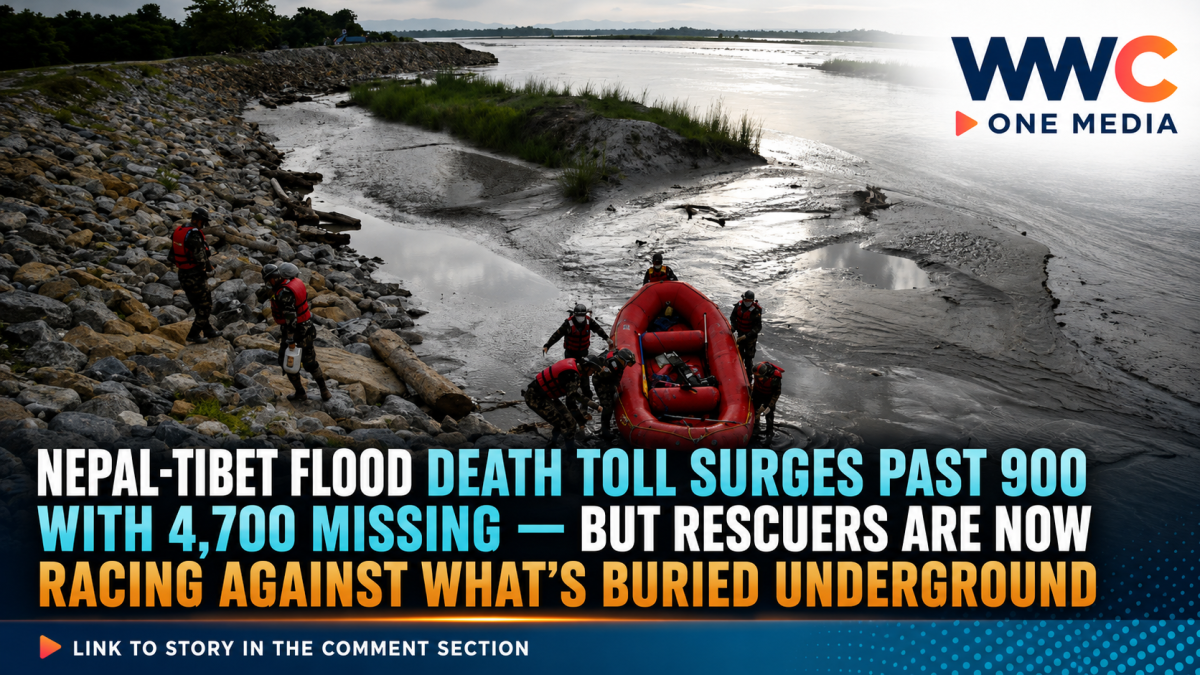
KATHMANDU, Nepal — Aug. 31, 2026: The scale of the Nepal-Tibet flood disaster has grown dramatically, with the latest figures indicating that more than 900 people have died and more than 4,700 remain missing after a massive high-altitude slope failure involving a glacier unleashed a devastating torrent through the Himalayas.
Associated Press reported later on Monday that Nepal’s disaster agency had counted 903 deaths and 4,247 missing people in Nepal alone, including 592 foreigners. Chinese authorities had separately reported 16 deaths and 546 people missing in Tibet, bringing the combined reported totals to at least 919 dead and 4,793 missing.
Those numbers are substantially higher than the figures in the original Channel NewsAsia report and in Reuters reporting earlier Monday, illustrating how rapidly the accounting of victims is changing as rescue teams reach previously inaccessible areas. CNA had reported at least 797 deaths and 3,048 people missing, while Reuters subsequently cited 788 deaths and about 2,500 missing in Nepal, plus 16 dead and 546 missing in Tibet.
A disaster that travelled nearly 100 kilometres
The catastrophe began on the morning of Aug. 26, high in the Himalayan mountains near the Nepal-China border.
The US Geological Survey said preliminary evidence indicates a rapid slope failure involving part of a glacier in Nepal’s Langtang National Park triggered an enormous debris flow and flood.
The event generated seismic energy equivalent to approximately a magnitude-5.2 earthquake, according to the USGS. Water, ice, rock and other debris then raced downstream through the Lende Khola and Trishuli river systems for almost 100km, hitting populated communities and critical infrastructure along the way.
Scientists are still refining exactly what happened. The USGS cautioned that it remains unclear whether the initial failure should technically be classified as a landslide that incorporated glacier ice or a glacier collapse itself.
But the consequences were unmistakable.
Buildings were buried, roads disappeared, bridges were destroyed and entire riverside settlements were overwhelmed by a surge of mud, boulders, ice and water.
Now the rescue operation is moving underground
One of the most urgent rescue efforts is taking place at Nepal’s hydropower projects.
Reuters reported that 933 workers from hydropower sites remain listed as missing, while rescue teams supported by Chinese and Indian specialists have been trying to break through tunnels blocked by enormous deposits of rock and mud.
AP reported Monday that officials believe at least 90 people are trapped inside multiple hydropower tunnels.
At the Trishuli 3A hydroelectric project, rescuers had previously managed to insert a pipe through debris into a blocked passage, allowing air to be pumped inside as excavation continued.
The distinction is important: the 933 figure refers to hydropower workers still listed as missing across the affected region, not necessarily 933 people confirmed to be trapped underground.
Nearly 21,000 Nepalese security personnel, in addition to civilian rescuers and volunteers, have been involved in the wider operation, Reuters reported. China has deployed more than 2,100 rescuers on its side of the border.
Families are searching morgues while Nepal buries unidentified victims
The disaster has also created a grim identification crisis.
CNA reported that Nepalese authorities were forced to begin burying unidentified victims because mortuaries lacked sufficient refrigeration capacity and bodies recovered from floodwaters were deteriorating rapidly.
DNA samples were being collected before burial so relatives may eventually be able to identify and reclaim the remains for traditional funeral ceremonies.
Families have gathered at hospitals and identification centres, searching photographs of recovered victims and lists of survivors.
Some bodies may have been carried enormous distances downstream. Officials have said victims believed to have come from Nepal have even been recovered from rivers in India.
Hundreds of foreigners and Mount Kailash pilgrims are missing
The catastrophe struck an area heavily travelled by tourists and pilgrims heading towards Mount Kailash, one of Asia’s most important religious pilgrimage destinations.
The mountain is sacred in Hinduism, Buddhism, Jainism and the Bon tradition.
AP’s latest figures say 592 foreigners are among those missing in Nepal, while Chinese state media has said 261 foreign nationals are among the missing in Tibet.
For Singapore, the disaster has a direct connection.
Nine Singaporeans were previously identified by Nepali authorities as missing, several of them travelling with organised tour groups. A Straits Times report on Aug. 31 said the nine remained unaccounted for.
Singapore’s Ministry of Foreign Affairs has advised Singaporeans in Nepal to avoid affected areas including Rasuwa, Nuwakot, Dhading, Gorkha and Chitwan, as well as rivers, riverbanks, bridges and other low-lying locations.
The danger did not end when the first flood passed
Rescuers have repeatedly faced another threat: further flooding.
The original debris flow created or altered lakes and natural barriers upstream. Rising water and fears that those barriers could fail have forced rescue operations to pause at times.
AP reported on Sunday that Nepal had issued fresh warnings after water levels in the Bhotekoshi River rose again.
Reuters said operations had also been disrupted since Friday by bad weather and fears that a lake formed near the Nepal-China border could send another surge downstream.
That means rescuers are not simply digging through the aftermath of one disaster. They are working inside a landscape that remains unstable.
Climate change is becoming part of the investigation
Scientists are cautious about attributing any individual disaster solely to climate change without detailed analysis.
What is much clearer is that the Himalayan cryosphere — glaciers, snow and permanently frozen terrain — is undergoing major changes as temperatures rise.
Chinese state broadcaster CCTV attributed the disaster to glacier instability associated with the long-term effects of global warming, Reuters reported. The USGS, however, has so far been more cautious about the precise trigger, describing the event as a slope failure involving a glacier while its investigation continues.
That distinction matters.
Climate change can increase the underlying instability of mountain environments, but scientists still need to determine exactly why this particular section of rock and ice collapsed on Aug. 26.
Nepal could face a multibillion-dollar rebuilding bill
The immediate priority remains finding survivors.
But attention is already turning to what comes next.
Nepalese Foreign Minister Shisir Khanal has warned that reconstruction could cost billions of dollars, with homes, highways, bridges, hydropower infrastructure and entire communities damaged or destroyed.
The disaster also exposes a longer-term vulnerability for Nepal: its economy depends heavily on infrastructure built through steep river valleys that are simultaneously crucial for transport and hydropower — and extremely exposed to floods, landslides and glacial hazards.
For thousands of families, however, questions about rebuilding remain secondary.
Their immediate question is much simpler: Who is still alive beneath the mud, rock and collapsed tunnels — and can rescuers reach them in time?




Leave a Reply