
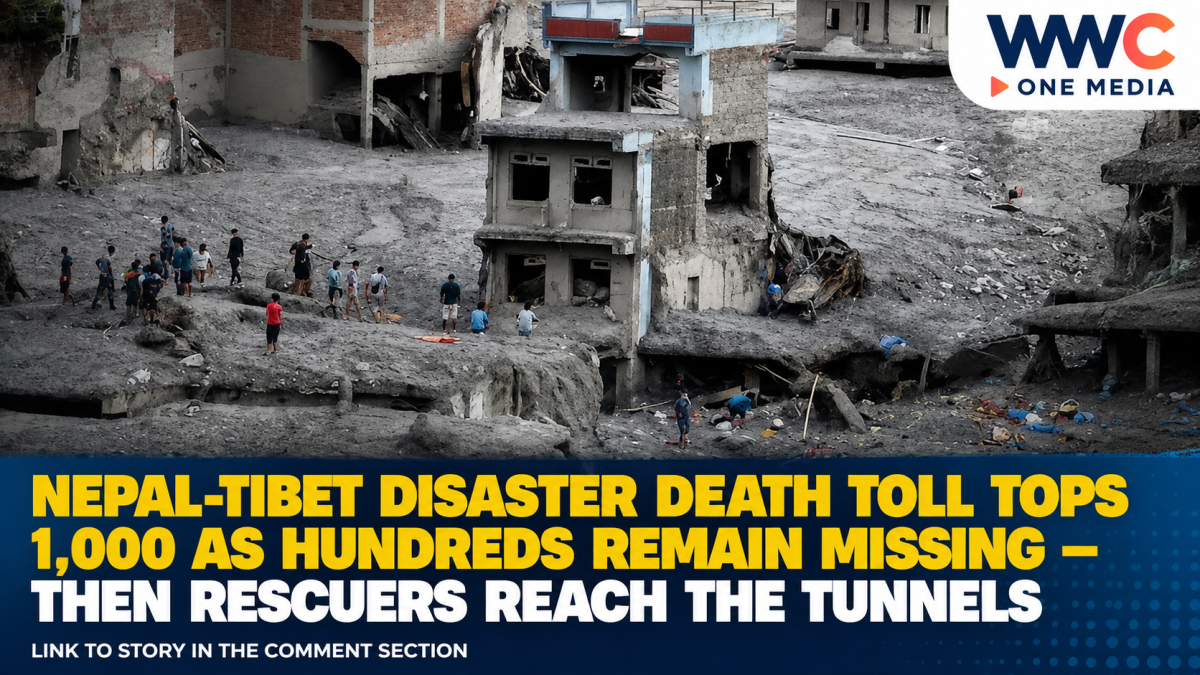
NEPAL — The death toll from a devastating glacial-collapse disaster that sent torrents of water, ice, rock and mud through parts of Tibet and Nepal has surpassed 1,000, while thousands remain missing and rescue teams continue a desperate search for people believed to be trapped inside hydropower tunnels.
Nepal reported 1,003 deaths and 3,916 people missing, while Chinese state media reported 16 deaths and 546 missing in Tibet. Combined, the reported toll stands at 1,019 dead and 4,462 missing, according to the latest figures cited by Channel News Asia.
The disaster began on Aug. 26, when a high-altitude glacial collapse triggered a massive surge of water and debris. The resulting floods tore through communities and critical infrastructure along the Himalayan region, destroying roads, bridges, homes and hydropower facilities.
Rescue crews race against time
Among the most urgent rescue operations is the search for workers at hydropower projects in Nepal.
The Nepal Army and other rescue teams are digging, drilling and using heavy machinery to penetrate tunnels buried beneath enormous quantities of mud and debris. Officials have described the underground searches as particularly difficult because some tunnels have been completely filled.
The scale of the missing-worker crisis is broader than the number currently believed to be trapped underground. The Associated Press reported that at least 900 hydropower workers were still missing from 12 projects, with about 500 believed to be inside tunnels.
Reuters reported that 279 workers had been rescued from hydropower projects, while joint teams from Nepal, India and China continued working to reach those still missing. Rescue crews have been draining water, breaking through rock and debris and attempting to create access routes into damaged tunnels.
But conditions remain extremely dangerous.
Drone pilot Manish Maharjan, who has assisted the Nepalese Army, told AP that some tunnels were so heavily packed with mud and debris that there was effectively no open space for drones to search. Straight sections can sometimes be examined remotely, but bends and turns make underground drone operations much harder.
Families wait for answers
As rescue operations continue, families across Nepal are still searching for missing relatives.
In Kathmandu, relatives have gathered around hospitals and identification centers, posting photographs of loved ones who disappeared when the floodwaters swept through towns and villages.
Authorities have also begun dealing with the enormous number of unidentified bodies. DNA samples are being collected, while some unidentified victims have been buried as morgues reach capacity. Bodies have also been recovered far downstream, including in India’s rivers.
More than 11,800 people have reportedly been rescued, while helicopters have been used to deliver assistance to isolated communities cut off by destroyed infrastructure.
Tibet faces its own rescue crisis
Across the border in Tibet, Chinese authorities say 16 people have died and 546 remain missing.
China has deployed more than 2,000 people in rescue and recovery operations, including soldiers, while teams work to restore roads, electricity and communications.
Reuters reported that the disaster severely damaged National Highway G216, a critical route toward the Gyirong border crossing with Nepal. Rescue crews have been working in a narrow and unstable mountain corridor where powerful river currents and damaged terrain have repeatedly complicated road repairs.
Chinese authorities have also warned that the danger may not be over. The original glacial collapse left behind a large crater containing a substantial volume of water, while unstable slopes, landslides and additional rainfall could potentially trigger further flooding or river blockages.
A disaster amplified by a warming Himalayas
The catastrophe has also renewed concern about the growing risks facing communities in the Himalayan region as temperatures rise.
Nepal’s Prime Minister Balendra Shah has urged the international community to pay greater attention to climate-related disasters, arguing that Nepal is experiencing consequences despite contributing relatively little to global greenhouse-gas emissions.
Scientists have warned that warming is accelerating changes across the Himalayas, increasing risks associated with melting glaciers, unstable ice and rock formations and glacial lake outburst floods.
For now, however, the immediate priority remains the search for survivors.
Rescue crews are still working through unstable terrain, destroyed roads and tunnels packed with mud and rock. Every hour matters for workers who may still be underground.
And as the death toll continues to rise, the question haunting families across Nepal is becoming increasingly urgent:
How many people are still alive beneath the debris — and can rescuers reach them in time?




Leave a Reply