
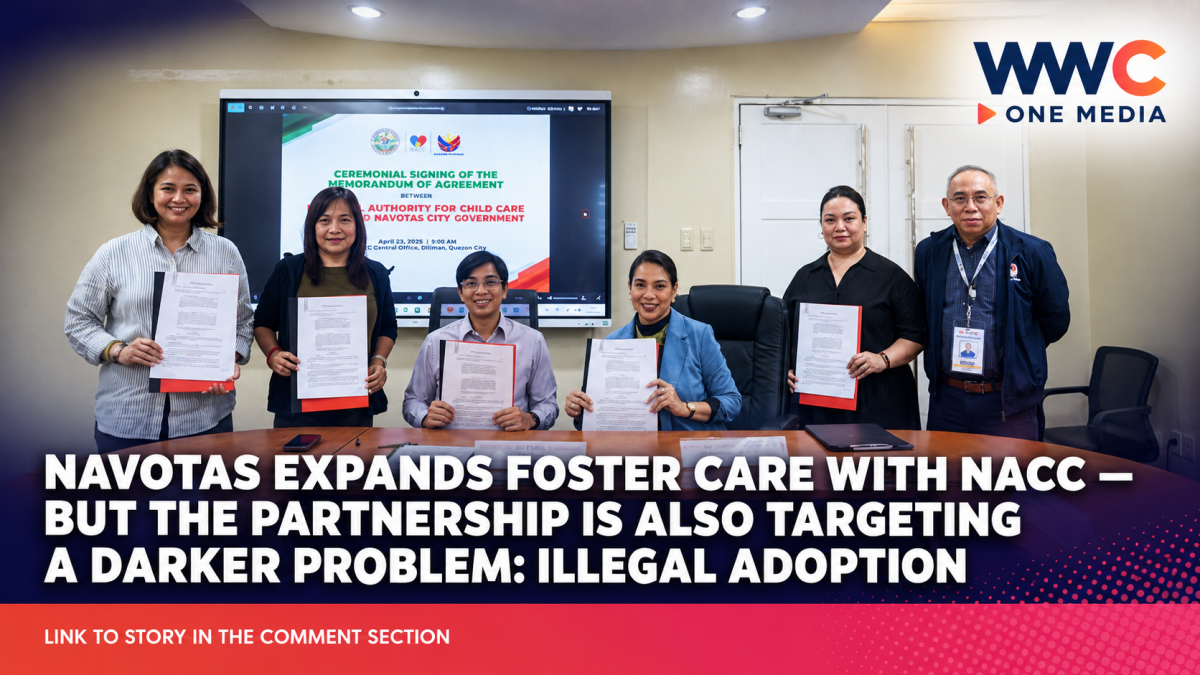
NAVOTAS CITY, Philippines — A new agreement between the National Authority for Child Care and the Navotas City government is designed to put more vulnerable children into safe, licensed family environments—but behind the foster-care push is another increasingly urgent concern: illegal adoption and child-selling schemes that authorities say continue to exploit children and desperate families.
NACC and Navotas signed a Memorandum of Agreement on Friday, August 28, to strengthen foster care and domestic adoption services for children who have been abandoned, neglected, orphaned, surrendered, abused or exploited.
The agreement did not emerge overnight. Navotas City records show that as early as June 12, the city council had approved Resolution No. 2026-66 authorizing the mayor to enter into an agreement with the NACC for the promotion of administrative adoption and alternative child care.
Now, the partnership is moving from authorization to implementation.
Navotas to Recruit More Licensed Foster Parents
Under the agreement, the Navotas Local Social Welfare and Development Office will work to build a larger pool of properly licensed foster parents.
The city will also help facilitate Parenting Capability Assessment Reports and assist families with the preparation and filing of adoption petitions and applications involving the legal availability of children for adoption.
NACC, through its Regional Alternative Child Care Office for the National Capital Region, will provide technical assistance, training and oversight aimed at ensuring that cases are processed according to government standards and prescribed timelines.
RACCO-NCR Regional Director Danilo Gatmaitan said officials hope the partnership will produce more qualified foster parents and eventually allow more children to grow up in stable family environments.
That goal matters because foster care is not simply an informal arrangement in which a child is temporarily taken in by another household.
Under the Philippine Foster Care Act, foster families operate within a regulated system. Foster parents must be assessed and licensed, while children placed in foster homes remain subject to government supervision and safeguards intended to protect their welfare. Children eligible for foster care can include those who are abandoned, surrendered, neglected, orphaned, abused or exploited, as well as children whose biological families are temporarily unable to provide adequate care.
Why Illegal Adoption Is Part of the Story
The Navotas agreement comes as NACC continues a broader nationwide campaign against illegal adoption, including the online selling of infants through social media.
Earlier this year, the Philippine National Police-Women and Children’s Protection Center reported that, from 2024 through February 7, 2026, authorities had conducted 19 operations connected to illegal adoption or online child selling. Those operations led to the arrest of 30 people and the rescue of 21 victims, according to PNP figures reported by the Philippine News Agency and Daily Tribune.
The numbers later continued to develop. DSWD reported in February that coordinated enforcement operations had reached 20 successful entrapments, with 22 minors rescued and 32 alleged perpetrators arrested at that point. One case had already resulted in a conviction, according to the agency.
Financial hardship has also emerged as one recurring factor in some cases. BusinessMirror reported in March that authorities had encountered infants being offered online for amounts ranging from thousands to more than ₱100,000, with economic problems cited in several cases investigated by authorities.
These figures are snapshots from earlier in 2026 rather than a September cumulative total, but they show why government agencies have been pushing legal adoption and foster-care channels more aggressively.
NACC Chief: Laws Exist, Enforcement Is the Challenge
The issue is not necessarily the absence of legislation.
In June, NACC Executive Director Undersecretary Maria Gabriela “Gaby” Concepcion said the Philippines already has substantial child-protection laws, but stronger implementation and closer coordination among agencies are still needed to fight online baby selling, illegal adoption and other forms of exploitation.
Her message was straightforward: enforcement has become one of the central challenges.
That makes partnerships such as the one in Navotas important.
Instead of expecting families to navigate the adoption and foster-care bureaucracy largely from national or regional offices, the agreement gives the local government a more direct role in identifying prospective foster families, preparing assessments and helping legitimate adoption cases move through the system.
For vulnerable parents, it also creates another legal route at the community level before desperation turns into abandonment, an unofficial placement or an illegal transaction.
Legal Adoption Is Now Administrative
Republic Act No. 11642, or the Domestic Administrative Adoption and Alternative Child Care Act, significantly changed adoption in the Philippines by transferring domestic adoption proceedings away from the old court-centered system and placing them under an administrative process overseen by NACC and its regional offices.
NACC now has jurisdiction over domestic administrative adoption, foster care and other alternative child-care arrangements.
Applicants seeking regular domestic adoption are required to undergo the proper process, including an initial assessment, a pre-adoption forum, documentary requirements, social-worker assessments and filing of the petition with the appropriate RACCO.
Government officials have repeatedly stressed that bypassing those safeguards can put children at risk.
NACC has also warned against simulated birth records—cases in which civil registry documents are altered to make it appear that someone other than the biological parents gave birth to the child. The agency continues to encourage eligible families to use the legal rectification mechanism under Republic Act No. 11222, with the amnesty period currently running until March 29, 2029.
Trauma-Informed Care Will Be Part of Navotas Program
Another significant element of the Navotas-NACC agreement is the planned use of Trust-Based Relational Intervention, or TBRI.
The trauma-informed caregiving approach is intended for children who may have experienced abuse, neglect or early trauma. Instead of treating placement as simply finding an available household, the approach recognizes that vulnerable children may require caregivers trained to respond to emotional, behavioral and attachment-related difficulties.
Similar NACC agreements with other local governments have also incorporated foster-parent recruitment, parenting assessments, adoption assistance and TBRI training, suggesting that Navotas is becoming part of a wider national strategy to bring alternative child-care services closer to LGUs.
More Than 2,300 Domestic Adoption Orders Issued
According to NACC figures cited by PIA on September 1, the authority has issued 2,310 Orders of Adoption for domestic adoption since its establishment in 2022.
It has also provided care to 1,079 children under the Philippine Foster Care Program.
Those numbers show that legal channels are being used—but the continuing enforcement cases involving online child selling demonstrate why accessibility at the local level still matters.
The government has also tied adoption and alternative child care to its Child-Friendly Local Governance framework. Under the 2026 audit, cities and municipalities are assessed on areas that include child protection, development, participation and governance, reinforcing the expectation that child welfare should not be handled by national agencies alone.
The Bigger Test Comes After the Signing
For Navotas, signing the agreement is the easy part.
The harder test will be whether the city can actually recruit enough qualified foster parents, guide vulnerable families toward legal options, identify children who need intervention early and ensure that cases do not stall inside the system.
The stakes go beyond paperwork.
Every legal foster placement potentially gives a vulnerable child a safer temporary home. Every properly processed adoption protects that child’s identity, rights and permanent family relationship. And every family reached before resorting to an illegal arrangement represents one less opportunity for traffickers or underground adoption networks to take advantage of desperation.
The Navotas-NACC partnership therefore carries a much larger challenge than expanding foster care.
Can local governments make the legal system accessible enough that families no longer see illegal adoption as the faster way out?
That may ultimately determine whether agreements like this become ceremonial documents—or a genuine frontline defense for vulnerable Filipino children.
WWC ONE MEDIA MJE



Leave a Reply