
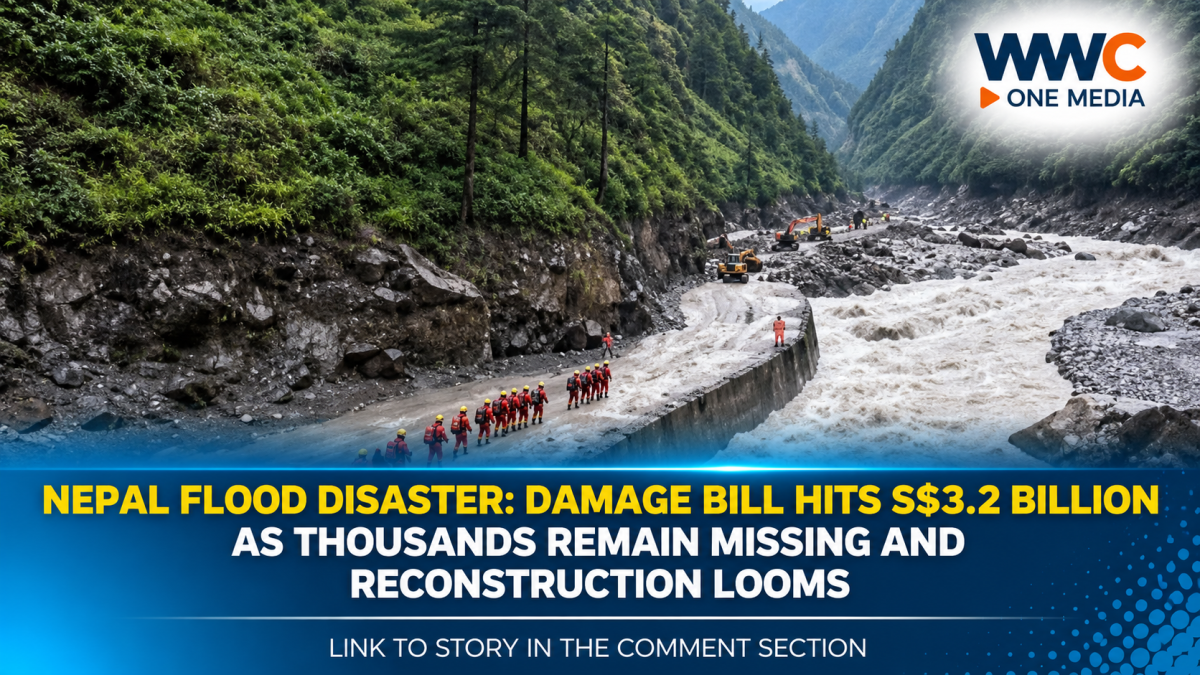
Nepal is facing a staggering reconstruction challenge after the catastrophic Bhotekoshi-Trishuli floods, with preliminary government estimates putting damage to property, homes and infrastructure at 387.5 billion Nepalese rupees — about US$2.56 billion or S$3.2 billion.
The figure was disclosed by Dharma Raj Upreti, chief of Nepal’s National Disaster Risk Reduction and Management Authority (NDRRMA), as rescue teams continue searching for people missing after the Aug. 26 disaster. The assessment remains preliminary, with a more detailed evaluation still to come.
The scale of the destruction is becoming clearer by the day — and officials now face the enormous task of restoring roads, electricity, homes and other critical infrastructure while rescue operations are still underway.
S$3.2 billion in damage — and counting
The latest estimate covers damage to property, housing and infrastructure across the disaster-hit areas.
Upreti said the government calculated the preliminary figure in coordination with relevant agencies and departments, but stressed that a comprehensive assessment would follow.
That distinction matters.
The S$3.2 billion figure is an estimate of damage, not the final bill for rebuilding Nepal.
In fact, Nepal’s Finance Minister Swarnim Wagle had previously warned that total reconstruction and rehabilitation requirements could reach US$4 billion to US$5 billion, depending on the findings of the government’s full post-disaster needs assessment.
The two figures therefore should not be treated as contradictory: one is a preliminary assessment of damage, while the other was an earlier projection of potential reconstruction and rehabilitation needs.
Another S$69 million needed for early recovery
The immediate recovery bill is also substantial.
Officials estimate that approximately US$52.6 million, or about 7.95 billion Nepalese rupees, will be needed during the first four months for emergency recovery.
That money is expected to help with:
- Rebuilding damaged roads
- Constructing temporary shelters
- Restoring drinking-water supplies
- Re-establishing electricity
- Other urgent rehabilitation work
Officials emphasise that these are preliminary estimates and could change as assessments continue.
Around 20,000 homes may need rebuilding
The disaster has destroyed far more than roads and bridges.
Upreti said Nepal expects to rebuild approximately 20,000 houses, including at least 7,500 homes that were completely destroyed.
Thousands of families have therefore been left facing not only the loss of possessions and livelihoods, but also the prospect of rebuilding their homes from scratch.
The Kathmandu Post previously reported that preliminary government figures suggested about 15,000 houses had been completely damaged, showing how rapidly the damage picture has been evolving as authorities collect information from affected communities.
The power sector has also taken a major hit
Nepal’s energy infrastructure has suffered serious damage.
The flood affected 11 hydropower projects and one solar plant, with about 431.1 megawatts of electricity disconnected from the national grid, according to information from the Nepal Electricity Authority.
Among the affected facilities are major projects including:
- Rasuwagadhi Hydropower Project
- Sanjen projects
- Chilime Hydropower
- Upper Trishuli 3A
- Trishuli
- Devighat
- Langtang
- Mailung
Transmission infrastructure was also damaged, adding another layer to the recovery challenge.
The impact is significant because hydropower is central to Nepal’s electricity system and economy.
Roads and bridges were swept away
The flood also tore through major transportation links connecting communities with the China border and the rest of Nepal.
Nepali reporting has documented extensive destruction to roads and bridges in Rasuwa, Nuwakot and Dhading, including key routes toward Rasuwagadhi.
Khabarhub reported that dozens of bridges were destroyed or severely damaged, while approximately 40 kilometres of strategic road sections were completely damaged.
The destruction has complicated the delivery of relief supplies and made access to isolated communities considerably harder.
It has also disrupted cross-border trade with China, particularly around the Rasuwagadhi-Gyirong corridor.
The human toll remains devastating
The financial numbers only tell part of the story.
Nepal’s latest disaster figures reported by NDRRMA include 1,259 recovered bodies and 5,083 people still missing, according to a Sept. 3 preliminary assessment.
Other international reports have carried slightly different totals as authorities continue reconciling reports from remote areas.
That is why casualty and missing-person figures should be treated as developing numbers rather than a final toll.
The disaster began on Aug. 26 after a massive event in the high Himalayan region sent enormous quantities of water, rock, ice and mud into the Bhotekoshi-Trishuli river system.
The resulting flood devastated settlements and infrastructure downstream.
Hope emerges from the tunnels
Amid the devastation, rescuers have achieved a remarkable breakthrough.
Two workers were pulled alive from a hydropower tunnel nine days after the floods.
The two survivors were found at the Upper Trishuli 3A hydropower site after rescuers detected signs of life. They were subsequently transported to Kathmandu for medical treatment.
Their rescue has renewed hopes for other workers believed to be trapped underground.
Reuters reported that approximately 900 workers remain unaccounted for across affected hydropower facilities, with many believed to be inside tunnels blocked by enormous quantities of mud and debris.
Engineers have even been using a large WhatsApp group to exchange tunnel plans, technical information and rescue guidance as teams try to locate survivors.
UN assessment shows the scale of destruction
The United Nations Development Programme has provided another indication of how extraordinary the disaster is.
UNDP estimated that approximately 2.2 million tonnes of debris accumulated across the areas it analysed.
That includes building materials, household belongings, vegetation, rocks and sediment.
The organisation also estimated that about 556,200 tonnes of that material came from building-related debris identified through satellite assessments.
UNDP stressed that its figures are preliminary and should be validated through field assessments.
The agency has also warned that the disaster highlights growing risks facing Himalayan communities from climate-related hazards, glacier retreat and extreme events.
Nepal now faces a reconstruction marathon
The immediate priority remains rescue and relief.
But once the search operation winds down, Nepal will face a much longer and potentially more expensive phase: rebuilding.
Officials have already indicated that international assistance could be required for rehabilitation and reconstruction.
The Kathmandu Post reported that the government plans a comprehensive Post-Disaster Needs Assessment (PDNA) examining damage to infrastructure, homes, livelihoods and essential services before seeking wider international support.
That assessment could take around two months, according to Nepal’s National Planning Commission.
And the government says reconstruction will also have to account for future disaster risks, including the effects of climate change.
This is no longer just a flood story
The Bhotekoshi disaster has evolved into a national reconstruction crisis.
It has damaged homes, roads, bridges, hydropower plants, transmission lines, telecommunications infrastructure and a major trade corridor with China.
It has also left thousands of families waiting for news of missing relatives.
For Nepal, the immediate question remains simple: How many more people can rescuers find alive?
But once the rescue operation is over, an even bigger question will emerge:
How will a country already vulnerable to earthquakes, landslides and floods find the billions needed to rebuild — and make sure the same disaster does not happen again?
WWC ONE MEDIA J.M.D




Leave a Reply