
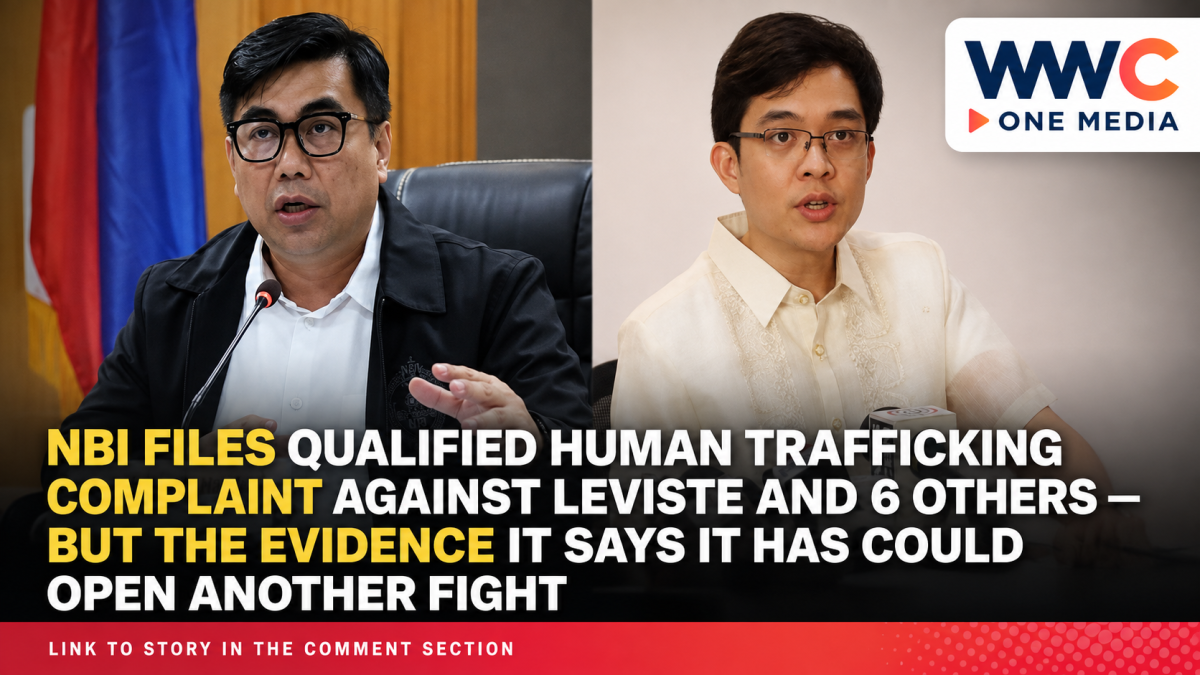
MANILA, Philippines — What began as an investigation into an alleged plan to use women to manufacture damaging accusations against Executive Secretary Ralph Recto has escalated into a major criminal complaint involving a sitting congressman, a former lawmaker, four lawyers and the talent manager whose testimony helped expose the supposed operation.
The National Bureau of Investigation (NBI) on Friday, September 4, formally filed a complaint for qualified trafficking in persons before the Department of Justice against Batangas 1st District Rep. Leandro Leviste, former Negros Oriental Rep. Jacinto “Jing” Paras and five other individuals.
The five others identified in reports are lawyers Orlando E. Mendiola, Ruy Alberto S. Rondain, Patrick L. Criaga and Josemilio Manuel Z. Apostol, along with a talent manager identified as “Alias Ken.”
NBI Director Melvin Matibag said investigators believe the elements of qualified human trafficking are present. He said the bureau’s evidence includes testimonial evidence, CCTV footage and statements made by individuals implicated in the investigation.
But that finding is only the beginning of the prosecution process.
The complaints now go through the DOJ’s preliminary investigation, where prosecutors will determine whether probable cause exists to file criminal cases in court. None of the respondents has been convicted, and the allegations remain to be tested through the legal process.
What was the alleged ‘honey trap’ supposed to do?
At the center of the investigation is an extraordinary allegation: that four women were supposedly being recruited to make fabricated claims involving Recto.
According to accounts attributed to Alias Ken, the women were allegedly supposed to claim that Recto had forced them to use illegal drugs and engage in sexual activity with him. The talent manager told the Inquirer that none of the four women had personally met Recto.
The alleged arrangement reportedly involved payments totaling as much as ₱5.5 million.
Ken claimed the proposed breakdown was ₱1 million for each of the four women, ₱1 million for himself and ₱500,000 for Paras for allegedly facilitating the arrangement. These are Ken’s allegations and have been disputed by those implicated.
According to Ken’s account, meetings were held at a Quezon City restaurant on July 15 and July 26, 2026.
He alleged that lawyers attending the discussions were supposed to prepare affidavits or a “script” that the women would use.
How did Leviste become involved?
Ken alleged that Leviste was repeatedly described during the discussions as the supposed “VIP” and financier behind the operation.
However, one distinction is critical for accurate reporting: Ken acknowledged that he had never personally met or spoken with Leviste.
His allegation concerning the congressman was based on what he said Paras and lawyers had told him, including claims that the lawyers presented themselves as Leviste’s representatives.
That distinction could become significant as prosecutors assess whether the evidence directly connects Leviste to the alleged scheme.
Leviste has denied financing or participating in the supposed operation. His lawyer previously invoked his right to remain silent during the NBI investigation while maintaining that he had no involvement in the alleged plot.
Leviste has also accused Matibag of merely “following orders” and previously characterized the allegations as a story manufactured against him.
Paras also denies the allegations
Paras has likewise denied being part of a plot to manufacture allegations against Recto.
After the complaints were filed Friday, Paras told the Inquirer he was ready to face them and described the accusations as “fabricated.”
His lawyers had previously offered a substantially different version of events.
They maintained that the talent manager approached them voluntarily seeking help with an affidavit. Paras’ camp also disputed suggestions that money involved represented a payoff, saying a reported ₱5.5 million was intended as financial assistance connected with expenses following testimony rather than a bribe.
One of the lawyers implicated in the probe, Orlando Mendiola, had also publicly denied allegations that the lawyers planned the supposed honey-trap scheme.
Why is the allegation classified as ‘qualified trafficking’?
The NBI is pursuing the case under the Philippines’ Anti-Trafficking in Persons Act, Republic Act No. 9208 as amended.
Under the law, trafficking may become qualified trafficking under several circumstances. One is when the offense is allegedly committed by a syndicate—defined by the statute as three or more persons conspiring or confederating with one another.
The NBI is accusing seven respondents.
Reports say the complaint cites Section 4(a) in relation to Section 6(c) of the anti-trafficking law. NBI investigators contend that the alleged recruitment of the women and the number of people supposedly participating in the scheme satisfy the necessary elements. That remains the prosecution’s position and has not yet been established by a court.
A conviction for qualified trafficking carries extremely serious penalties. The implementing rules provide for life imprisonment and a fine of ₱2 million to ₱5 million for a person found guilty of qualified trafficking.
The NBI says it has CCTV and testimonial evidence
Matibag said the bureau did not base its recommendation solely on a single allegation.
According to the NBI chief, investigators gathered testimonial evidence, CCTV footage and statements or pronouncements attributed to people under investigation.
Exactly how strongly those materials connect each of the seven respondents to the alleged trafficking offense will now be an important question for DOJ prosecutors.
That distinction matters because an NBI recommendation does not automatically result in a court case.
During preliminary investigation, respondents have the opportunity to answer the allegations and submit evidence before prosecutors decide whether probable cause exists.
Leviste remains outside the Philippines
Another detail likely to draw attention is Leviste’s location.
Matibag said the NBI’s most recent information placed the congressman in France. GMA News reported that Leviste had left the Philippines on August 2 and that the Office of the Ombudsman said he had obtained a two-month travel authority.
That authorized travel is important context: his being overseas should not by itself be characterized as fleeing or evading the investigation without evidence supporting such a conclusion.
Leviste and Paras had earlier sent lawyers rather than personally appearing before the NBI in response to subpoenas. Their representatives submitted affidavits denying involvement.
And the case may not end with the DOJ complaint
The qualified trafficking complaint may not be the NBI’s final action.
Matibag said the bureau is also considering an ethics complaint against Leviste before the House of Representatives and possible disbarment complaints involving the four lawyers named in the investigation.
Those proceedings, if pursued, would be separate from the DOJ’s assessment of the trafficking complaint.
For Leviste and the six other respondents, the next major development will therefore come from prosecutors: whether the NBI’s evidence is strong enough to move the allegations out of the investigative stage and into an actual courtroom.
And that is where the alleged “honey trap” story could become considerably more consequential.W
WWC ONE MEDIA J.M.D
Leave a Reply