
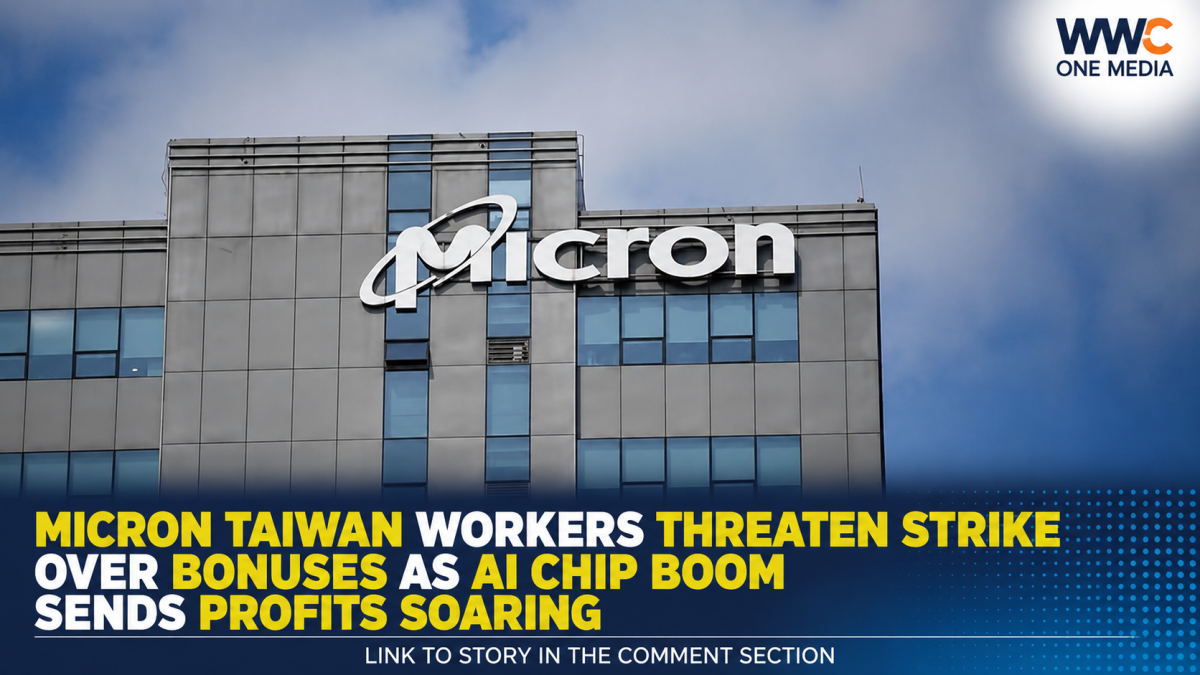
Micron Technology is facing a growing labor dispute in Taiwan, where unions representing nearly 10,000 workers are moving toward possible strike action over the company’s bonus system and their share of record profits.
The dispute comes at a critical moment for the U.S. memory-chip giant. Demand for memory used in artificial intelligence data centers has surged, tightening global supplies and helping drive exceptional profits across the semiconductor industry.
Nearly 10,000 Workers Represented
Two unions representing Micron employees at facilities in Taoyuan and Taichung said they are preparing for possible strike action unless the company agrees to overhaul its incentive system and provide workers with a larger share of its profits.
The unions said they have nearly 10,000 members among approximately 15,000 Micron employees in the two cities.
More than 80% of members who participated in an internal online survey in August reportedly supported strike action. Importantly, this was a preliminary union survey — it was not yet a formal strike vote.
What Are Workers Demanding?
At the heart of the dispute is Micron’s Incentive Pay Plan, or IPP.
The unions argue that the existing system does not adequately reflect the company’s profitability and is less favorable than profit-sharing arrangements at major South Korean competitors such as Samsung Electronics and SK hynix.
For fiscal 2026, the unions are seeking an additional one-time payment. For fiscal 2027 onward, they want the current system replaced with a formula that would allocate 15% of operating profit to employee bonuses, with payments distributed quarterly.
Micron, however, says its compensation structure is different and includes base salaries, annual performance incentives, operational bonuses and equity programs.
The company also says this year’s performance-bonus payout will be the highest in its history, with more details on its Incentive Pay Plan expected in October.
Why This Could Matter to the Global AI Chip Market
The timing of the dispute is particularly important.
Micron reported record fiscal third-quarter revenue of US$41.46 billion and net income of US$28.24 billion, as demand for memory products surged amid the AI boom.
Taiwan is also a crucial manufacturing base for Micron. Authorities in Taiwan say the company has invested heavily on the island and produces DRAM and high-bandwidth memory there.
A prolonged disruption could therefore affect not only Micron’s operations but also an already-tight global memory supply chain. Taiwan’s Central Taiwan Science Park administration has said it is monitoring the dispute because a strike could have wider consequences for workers, the company and the semiconductor sector.
That matters because high-bandwidth memory, or HBM, has become a critical component for AI accelerators and data-center systems.
The Samsung Effect
Micron workers are also looking at what happened at Samsung in South Korea.
A planned strike involving Samsung workers was called off after negotiations produced a special bonus arrangement tied to the semiconductor division’s operating profit. The agreement reportedly established a bonus pool equivalent to 10.5% of operating profit, strengthening the argument from Micron’s Taiwan unions that employees should receive a more direct share of the AI-driven semiconductor boom.
SK hynix has also used a profit-linked bonus structure, further raising expectations among workers at other memory-chip companies.
A Strike Is Not Imminent Yet
Despite the headlines, Micron workers have not yet gone on strike.
Under Taiwan’s labor-dispute process, negotiations and mediation must take place before workers can proceed to a formal strike vote. Mediation is expected to begin by mid-September, according to reports.
If those discussions fail, the unions could then move toward a formal strike vote.
That gives Micron and its unions a limited window to reach an agreement before the dispute potentially escalates.
For Micron, the stakes are unusually high. The company is benefiting from one of the strongest memory-chip cycles in years, while its Taiwan operations sit at the center of its manufacturing network.
For workers, meanwhile, the argument is straightforward: if AI demand is generating record profits, they believe employees who help produce those chips should receive a larger share.
WWC ONE MEDIA J.M.D




Leave a Reply