
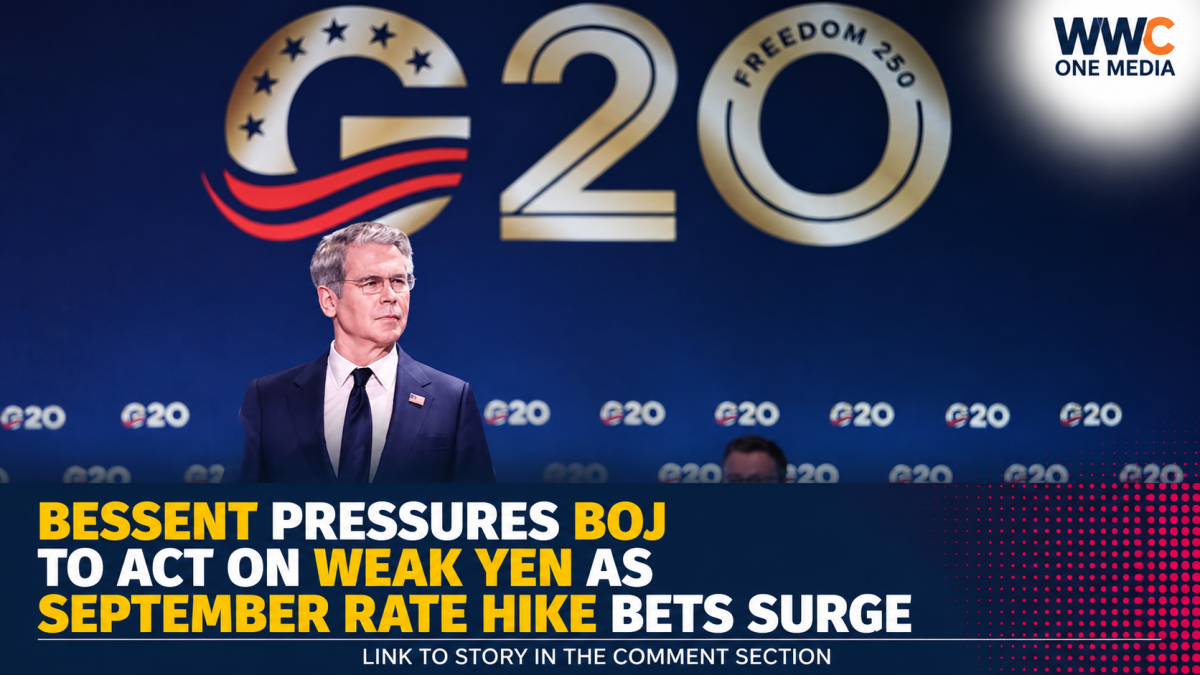
U.S. Treasury Secretary Scott Bessent has stepped up pressure on Japan’s central bank to take “decisive” action against the yen’s weakness, adding fresh momentum to expectations that the Bank of Japan could raise interest rates later this month.
Bessent met Bank of Japan Governor Kazuo Ueda on Aug. 30 on the sidelines of the G20 finance ministers and central bank governors’ meeting in Asheville, North Carolina. According to the U.S. Treasury Department, Bessent backed Japan’s efforts to address what he described as the yen’s “substantial undervaluation” and highlighted the currency’s contribution to domestic inflation.
The comments are significant because the yen’s prolonged weakness has become an increasingly important issue for Japan. A weaker currency raises the cost of imported goods and energy, adding pressure to household expenses and making it more difficult for policymakers to control inflation.
September rate decision now in focus
The Bank of Japan’s next monetary policy meeting is scheduled for Sept. 17-18, and markets are increasingly expecting another rate increase.
Ueda has not committed the BOJ to a September hike. However, he said the central bank will thoroughly assess inflation risks and economic conditions at its upcoming meeting. He also said the BOJ hopes to continue raising interest rates while acknowledging that policymakers must consider the cumulative effect of the five rate increases already implemented.
The BOJ last raised its policy rate in June, taking it to 1%, a 31-year high, before leaving rates unchanged in July.
Ueda has also pointed specifically to the weak yen as one factor that could increase inflationary pressure. Other risks being watched include developments in the Middle East and strong demand associated with artificial-intelligence investment.
Bessent’s message goes beyond interest rates
Bessent’s latest comments come after he previously said he expected Ueda to “do the right thing” on monetary policy to combat yen declines.
He has also argued that Japan has moved beyond the era of massive monetary stimulus associated with Abenomics, suggesting that the country should rely more on normalized monetary policy rather than aggressive fiscal and monetary support.
That position puts Bessent somewhat at odds with Japan’s more expansionary fiscal ambitions under Prime Minister Sanae Takaichi, which have raised concerns among some investors about government debt and bond yields.
The yen has already triggered extraordinary action
The pressure comes after Japan and the United States took the unusual step of conducting a joint yen-buying intervention on July 31.
The intervention was aimed at preventing excessive currency volatility and limiting potential spillovers into Japanese government bonds and global financial markets. However, the yen has remained under pressure, keeping the possibility of further policy action in focus.
Bessent has since said that recent yen movements were relatively contained and did not constitute the kind of disorderly trading that would automatically justify another intervention.
Markets are watching what Ueda does next
Recent comments from Ueda and other BOJ officials have strengthened expectations for another rate increase.
BOJ board member Hajime Takata has argued that interest rates should be raised flexibly in response to inflation rather than according to a fixed schedule. Following the latest hawkish comments, the yield on Japan’s two-year government bond rose to 1.83%, its highest level since 1995, according to Reuters.
The bigger question is what happens after September.
A September hike could encourage investors to expect the BOJ to move toward a faster tightening cycle, potentially raising the possibility of additional increases in December and beyond. Some economists have already revised their forecasts toward a more frequent pace of rate increases.
For Japan, the challenge is delicate: raising rates could support the yen and help contain inflation, but moving too aggressively could weigh on economic activity after years of exceptionally loose monetary policy.
For the United States, meanwhile, yen weakness matters beyond Japan because sharp moves in the currency and Japanese government bond market can have wider implications for global financial markets.
The BOJ now faces a critical decision: will it deliver the rate hike markets increasingly expect, or will Ueda choose to move more cautiously?
WWC ONE MEDIA J.M.D




Leave a Reply