
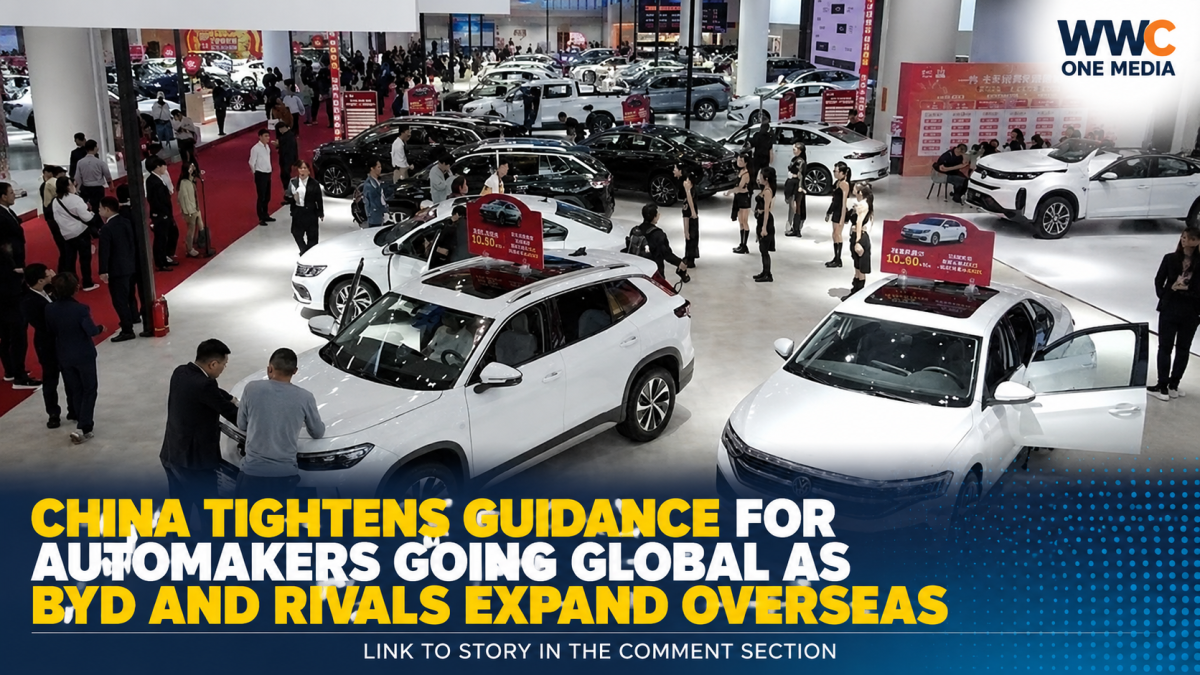
China has issued new guidelines aimed at reshaping how its automakers compete in overseas markets, urging companies to avoid disruptive price wars, misleading advertising and other practices that could damage consumers or the reputation of Chinese car brands.
The move comes as Chinese automakers rapidly expand across international markets, particularly in electric vehicles, while fierce competition and weaker demand at home push manufacturers to look overseas for growth.
Beijing Wants Chinese Carmakers to “Play by the Rules” Abroad
The 20-article guidelines were jointly issued by China’s Ministry of Commerce, Ministry of Industry and Information Technology, and State Administration for Market Regulation.
Importantly, the document is a general guidance framework rather than a blanket new law or formal ban on overseas price competition. China’s Commerce Ministry describes it as a reference for companies conducting international operations.
Among the most notable recommendations is pricing.
Chinese automakers are encouraged to establish prices based on costs and international market supply and demand, while avoiding frequent or substantial price changes that could hurt consumers, disrupt sales networks or damage brand reputation.
Companies are also encouraged to respect the pricing autonomy of overseas dealers and avoid using pricing strategies to obtain an unfair competitive advantage.
Why Is China Acting Now?
The timing is significant.
Chinese automakers have been aggressively expanding abroad as competition inside China intensifies. Reuters reported that Chinese car sales have been facing weaker domestic demand after years of intense price competition and excess capacity, while overseas markets have become an increasingly important source of growth.
BYD provides a striking example.
The company reported total August sales of 440,293 vehicles, up 17.8% year on year, while overseas shipments surged 134.5% to 189,466 vehicles, according to Reuters calculations.
That rapid international expansion is increasing scrutiny of how Chinese manufacturers compete in markets ranging from Southeast Asia and Europe to Latin America and the Middle East.
Price Wars Are a Major Concern
China’s new guidance specifically addresses the aggressive pricing strategies that have become a defining feature of its domestic auto market.
The guidelines call for clear pricing structures between different vehicle configurations and caution against frequent, large price adjustments.
They also tell companies to consider differences in taxes, logistics costs and market conditions when setting prices across different countries.
The objective is to prevent disorderly competition from spilling into overseas markets.
Reuters Breakingviews described the move as a potential “speed bump” for Chinese automakers going global, although it questioned how much the advisory framework will change the behavior of major manufacturers given their strong incentives to expand abroad.
It Goes Far Beyond Pricing
The guidelines also cover how Chinese automakers operate after entering foreign markets.
Companies are encouraged to:
- Provide accurate and transparent marketing information
- Avoid false or misleading advertising
- Comply with local labor laws
- Strengthen quality control and after-sales service
- Protect consumer personal information
- Comply with rules governing connected-car and autonomous-driving data
- Protect intellectual property
- Strengthen antitrust compliance
- Assess political, economic and security risks
- Improve environmental and supply-chain practices
This means Beijing is not simply asking automakers to sell fewer cars or raise prices. It is trying to establish a broader framework for how Chinese automotive companies operate once they become multinational businesses.
China’s Auto Industry Is Already Global
The scale of the overseas expansion explains why the guidelines matter.
China exported 8.32 million vehicles in 2025, reaching more than 200 countries and regions, according to official data. Chinese companies have also invested in automobile manufacturing operations in more than 80 countries and regions.
Chinese electric vehicle brands have become particularly visible in international markets, putting pressure on established manufacturers from Japan, Europe, South Korea and the United States.
The growing presence has also triggered trade and industrial-policy responses in several markets, making regulatory compliance increasingly important for Chinese manufacturers seeking long-term international expansion.
A New Phase for Chinese Automakers?
Beijing’s message appears to be that simply exporting large volumes of vehicles is no longer enough.
Chinese automakers are being encouraged to adapt products to local markets, build stronger service networks, comply with local regulations and integrate more deeply into the economies where they operate.
That could become increasingly important as Chinese brands move from being primarily exporters to becoming global manufacturers with factories, dealerships, suppliers and employees overseas.
But there is a major question hanging over the policy.
Can Beijing persuade Chinese automakers to ease aggressive competitive tactics abroad while companies remain under enormous pressure to grow outside an increasingly crowded domestic market?
The answer could determine whether China’s global auto expansion becomes a long-term success story — or triggers even greater resistance from competitors and governments overseas.
WWC ONE MEDIA J.M.D




Leave a Reply