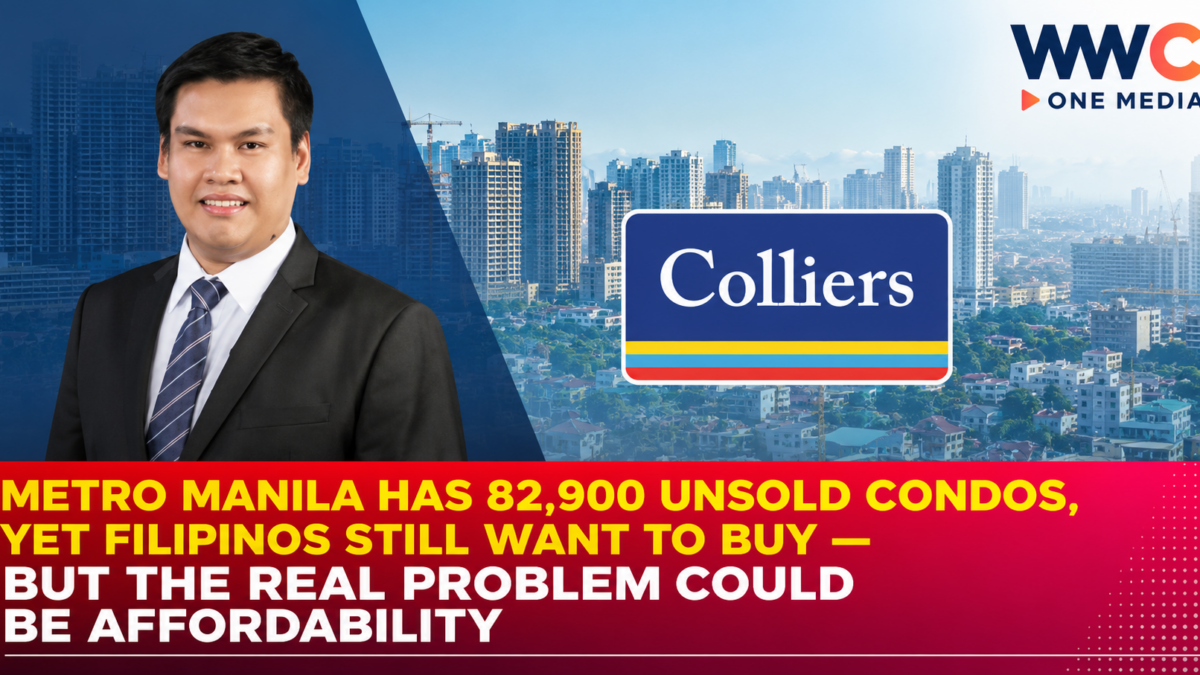
MANILA, Philippines — Metro Manila’s condominium market is confronting one of its biggest challenges in years, with unsold units reaching a record 82,900 even as new research shows that Filipinos have not abandoned their dream of owning a home in the country’s major business districts.
A property investment survey released by Colliers Philippines on October 14, 2026, found that 31% of respondents still favor condominiums in central business districts, matching the 31% who prefer house-and-lot developments in North or South Luzon.
The findings point to a surprising disconnect in the Philippine real estate market.
Filipinos still want condominiums. But many may no longer be willing or able to buy them under the payment terms and prices developers are offering.
With thousands of units sitting unsold and developers introducing discounts, extended payment schedules and rent-to-own arrangements, the next phase of the property market could increasingly favor buyers who have sufficient financial capacity.
But the biggest question is whether these incentives will genuinely make homeownership more affordable or simply postpone the financial burden.
82,900 Unsold Condos Put Pressure on Developers
Metro Manila’s unsold condominium inventory climbed to 82,900 units across 616 actively selling buildings in the second quarter of 2026, according to Leechiu Property Consultants.
The figure was the highest recorded since the consultancy began tracking the market in 2016.
Leechiu estimated that clearing the inventory would require approximately 34 months at prevailing absorption rates, compared with a historical average of roughly 12 months.
Although the supply remains elevated, the company noted that the market was showing signs of stabilization.
Condominium take-up reached 7,255 units in the second quarter, while first-half take-up increased 6% to approximately 14,500 units.
Developers also introduced fewer units than buyers absorbed during the period, helping prevent an even sharper increase in inventory.
However, the figures require careful interpretation.
Leechiu’s 82,900-unit estimate covers unsold inventory across actively marketed condominium developments. It should not be confused with Colliers’ separate count of completed, ready-for-occupancy units.
The two consultancies use different datasets and methodologies, meaning their inventory figures and absorption estimates are not directly interchangeable.
Colliers Survey Shows Filipinos Still Want Condos
Despite the supply overhang, Colliers’ latest survey suggests that the appeal of city living remains strong.
The study found an equal split between respondents favoring condominiums in major business districts and those preferring house-and-lot developments in Luzon.
For condominium buyers, accessibility is a major attraction.
Living near offices, public transportation, shopping centers and major commercial establishments can reduce commuting time and provide easier access to everyday services.
Properties in established business districts may also appeal to investors hoping to earn rental income, although actual returns depend on occupancy, rental rates, maintenance costs and market conditions.
House-and-lot developments offer different benefits, particularly larger living spaces, privacy and access to suburban communities.
The survey indicates that both lifestyles continue to attract interest.
However, interest in buying a property is not equivalent to a confirmed reservation, mortgage approval or completed transaction.
Actual demand will depend on whether prospective buyers can meet financing requirements and afford the total cost of ownership.
61% Want Easier Payments, Not Just Discounts
Perhaps the most revealing finding in the Colliers survey concerns how Filipinos want to pay for homes.
A majority of respondents — 61% — said they preferred longer and more flexible payment terms.
Only 18% favored arrangements requiring no immediate downpayment.
The results suggest that buyers are increasingly focused on managing monthly financial obligations rather than simply securing promotional giveaways.
For developers, this presents a challenge.
Offering a discount may help reduce a property’s advertised price, but that does not automatically make monthly amortization affordable.
Longer payment arrangements can lower installments during particular stages of a purchase, but they can also extend financial commitments.
Likewise, deferred downpayments or rent-to-own programs may improve short-term cash flow without necessarily reducing the property’s total cost.
Buyers therefore need to examine the full purchase price, financing charges, turnover fees, association dues, insurance and future mortgage obligations.
The real measure of affordability is whether a household can sustain the payments over the entire ownership period.
Middle-Income Condos Carry Much of the Unsold Inventory
Colliers’ latest data show that the supply problem is particularly concentrated in more affordable and middle-income residential segments.
According to the report, condominium units priced between ₱3.6 million and ₱6.99 million account for 44% of the relevant unsold inventory.
Another 28% consists of units priced from ₱2.5 million to ₱3.59 million.
Together, these categories account for 72% of the inventory measured in that breakdown.
Colliers also identified 9,260 completed but unsold units priced between approximately ₱3.601 million and ₱5 million as of the second quarter of 2026.
These figures highlight a difficult reality for developers.
Even properties marketed toward middle-income households can remain out of reach when families face competing expenses, borrowing costs and uncertain income prospects.
Colliers also observed a renewed increase in buyer cancellations in the ₱3.6-million to ₱12-million segments during the first half of 2026.
Canceled purchases can create further pressure on developers because previously reserved units must return to the market.
They can also indicate that some buyers who initially committed to purchases later found the payment obligations difficult to sustain.
Developers Are Offering Discounts and Rent-to-Own Deals
To attract customers and reduce unsold stock, condominium developers have become increasingly aggressive with promotions.
These include longer downpayment periods, discounted ready-for-occupancy units, flexible payment schedules and selected rent-to-own arrangements.
Such offers can make properties more accessible to buyers who are financially prepared but need additional time to manage their cash flow.
They can also help developers convert completed units into sales rather than carrying inventory for extended periods.
But prospective buyers should carefully compare advertised discounts with actual market prices.
A large promotional discount does not necessarily mean a unit is cheaper than similar properties nearby.
Rent-to-own arrangements also vary considerably, including how much of each payment is credited toward the purchase price and what happens if the buyer cannot proceed.
The most useful comparison is the total cost of purchasing and owning the property, not the headline discount alone.
Metro Manila Condo Vacancies Could Reach 25.6%
The challenge does not end with unsold units.
Colliers projected that Metro Manila’s residential condominium vacancy rate could reach 25.6% by the end of 2026.
The Bay Area is among the locations facing the greatest oversupply risk.
The consultancy also expects residential rental prices to remain broadly flat during the year.
These conditions present additional challenges for property investors hoping to earn regular rental income.
When many units compete for tenants, landlords may need to offer more competitive rents, flexible lease terms or additional furnishings.
Separate Leechiu figures reported by GMA News illustrate the pressure.
In the second quarter of 2026, average residential rents remained below pre-pandemic levels in several business districts.
Makati rents were reported at approximately ₱887 per square meter, while the Bay Area averaged around ₱706 per square meter.
Bonifacio Global City was among the few markets showing relative resilience, with reported rents of approximately ₱1,105 per square meter.
These differences show why location remains a major factor in determining a condominium’s investment prospects.
House-and-Lot Developments Continue to Attract Buyers
While Metro Manila’s condominium market struggles with unsold inventory, suburban housing developments continue to attract interest.
Colliers reported that cumulative inventory sales reached approximately 96% in Cavite, 91% in Laguna and 90% in Batangas as of the second quarter of 2026.
These figures reflect relatively strong historical sales absorption in the markets and project categories covered by the consultancy.
They do not mean that almost every existing house in those provinces has been sold or occupied.
Suburban demand is supported by buyers seeking larger spaces, family-oriented communities and alternatives to high-density urban living.
However, buyers must also consider commuting expenses, transportation availability, flood exposure, utility reliability and proximity to employment centers.
A house-and-lot development outside Metro Manila may offer more floor area for the purchase price, but the overall financial and lifestyle benefits depend on location and individual circumstances.
Green Features Are Becoming More Important
The Colliers survey also revealed growing interest in environmentally sustainable housing.
Approximately 69% of respondents considered green features either essential or important when deciding whether to purchase a home.
Another 31% regarded such features as desirable, even if not mandatory.
None of the respondents surveyed dismissed sustainability features as unimportant.
These findings suggest that homebuyers are increasingly considering long-term operating costs and environmental performance.
Energy-efficient lighting, better ventilation, water-saving systems and climate-resilient building design can potentially reduce utility expenses or improve comfort.
However, properties marketed as environmentally friendly should still be assessed against measurable specifications and credible certifications.
A sustainability claim alone does not guarantee lower maintenance costs or better investment returns.
Is Metro Manila Becoming a Buyer’s Market?
The combination of elevated inventory, developer promotions and soft rental conditions may improve negotiating opportunities for some buyers.
Those with secure income, sufficient savings and access to affordable financing may find more choices than during periods when new condominium projects sold rapidly.
But a buyer’s market does not automatically mean every condominium is a bargain.
Well-located properties with strong tenant demand may behave very differently from units in oversupplied districts.
Likewise, financing costs, taxes, association dues and maintenance expenses can offset part of the apparent savings from a lower purchase price.
For investors, rental yield should be calculated after expenses and realistic vacancy allowances.
For end-users, affordability should be measured against household income and long-term financial commitments.
The best purchase is not necessarily the unit with the largest advertised discount.
It is the property that meets the buyer’s needs at a sustainable total cost.
The Bigger Question: Will Developers Lower Prices Enough?
The Philippine condominium market is not experiencing a complete collapse in buyer interest.
Colliers’ survey and Leechiu’s sales figures both suggest that demand continues to exist.
But demand is becoming increasingly selective.
Buyers are paying closer attention to payment arrangements, location, property quality and financial value.
For developers, the challenge is to match available inventory with what prospective buyers can realistically afford.
That could require more flexible financing, carefully targeted promotions, slower project launches and greater emphasis on housing segments with stronger underlying demand.
For buyers, the oversupply may create opportunities, but it also reinforces the need for financial discipline.
Metro Manila may have tens of thousands of unsold condominium units, yet Filipinos have not abandoned their interest in owning city homes.
The real challenge is turning that interest into financially sustainable purchases.
With 82,900 unsold units and 61% of surveyed buyers asking for easier payment terms, the biggest question is no longer whether people want condominiums — but whether developers can finally offer homes at prices and terms Filipinos can afford.