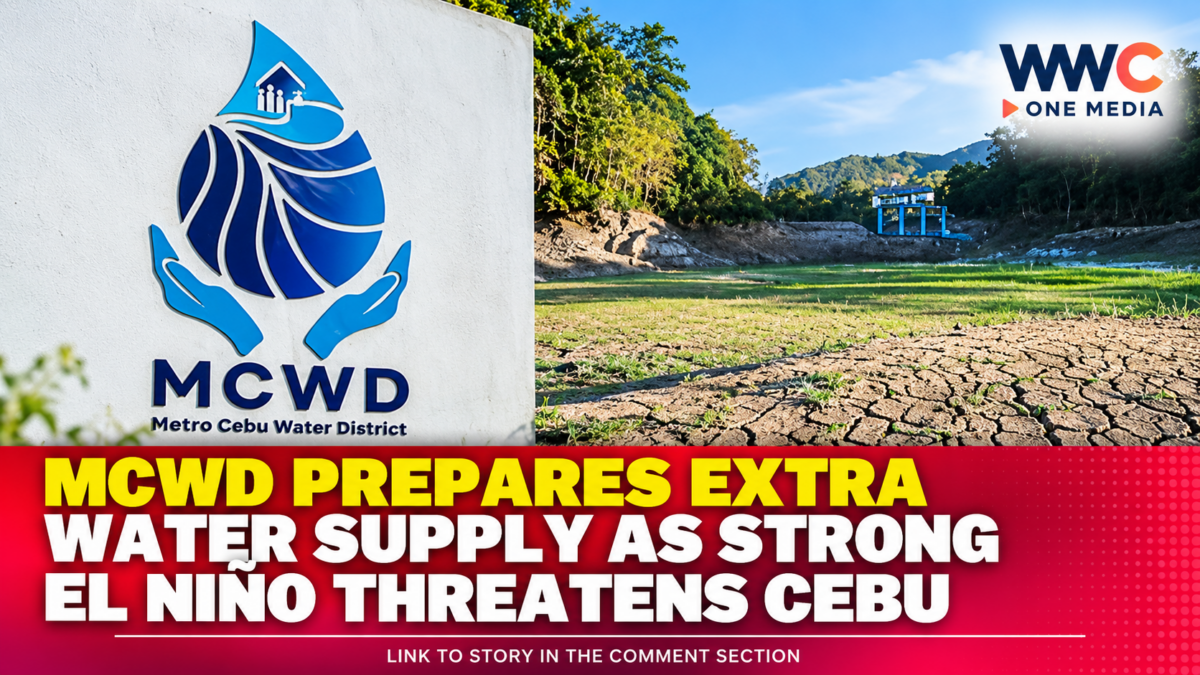
The Metropolitan Cebu Water District (MCWD) is preparing additional water sources as Cebu braces for the expected effects of a strong El Niño that could significantly reduce supplies from surface-water sources during the coming dry months.
MCWD is targeting 40.4 million liters per day (MLD) in additional supply to help offset an estimated 43 MLD decline in surface-water availability at the height of the El Niño period. The expected shortfall could become more pronounced from December 2026 through June 2027.
PAGASA Visayas weather specialist Jhomer Eclarino said the current El Niño had reached the “Strong” category in September, with Pacific Ocean sea surface temperature anomalies reaching 2.1 degrees Celsius. The phenomenon could intensify to the “Very Strong” category by the end of 2026 and continue into the first half of 2027.
The weather pattern is already affecting rainfall in Central Visayas. Rainfall in the region was reported to have dropped by 89% in August and 52% in September. PAGASA expects rainfall in October to range from below normal to near normal, although thunderstorms and other rain-producing weather systems may still occur.
MCWD currently obtains about 165 MLD from groundwater and around 90 MLD from surface-water sources. The latter includes the Mananga Dam and Buhisan River, which are considered more vulnerable to prolonged dry conditions.
At the peak of El Niño, MCWD estimates that its 90 MLD surface-water supply could fall to roughly 47 MLD, representing a potential reduction of 43 MLD.
To help make up for the expected decline, the water district is increasing production from several alternative sources. The Mambaling desalination facility is expected to increase output from 5 MLD to 15 MLD starting December, while the Opaw desalination facility in Mandaue is expected to provide another 5 MLD.
MCWD also plans to increase Carmen Bulk Water supply from about 30 MLD to between 37 and 40 MLD. Eight new pumping stations scheduled to become operational before the end of the year are expected to contribute another 5.8 MLD.
The district is also working to reduce non-revenue water, or water that enters the distribution system but is not billed because of leaks, illegal connections, inaccurate meters and other losses. MCWD is targeting a reduction from about 29% to 27%, which it estimates could effectively recover around 5 MLD.
Additional pumping stations awaiting power connections are expected to contribute another 3.2 MLD. MCWD is also reviving deep wells, installing booster stations and exploring additional sources of desalinated water.
The water district has been preparing for the expected dry conditions since April, following regular briefings with PAGASA. It is also considering ways to transport additional desalinated water through existing pipelines rather than relying entirely on water trucks, although the cost of desalination remains a concern.
Another challenge is electricity. MCWD normally produces around 290 MLD, but rotational brownouts in recent months have reduced average production to about 268 MLD. Output has recently improved to around 272 to 273 MLD as power conditions eased.
MCWD has asked power providers to consider exempting its pumping stations from scheduled brownouts, but the utility said short notice can make it difficult to deploy backup generators, particularly at facilities without their own standby power.
With the stronger effects of El Niño expected later in the year, MCWD is preparing consumers for reduced water availability in some parts of Metro Cebu, particularly in southern areas. Scheduled rationing remains a possibility if supply conditions deteriorate, with the district saying consumers will be informed ahead of any changes to water schedules.
The preparations come as authorities across Cebu strengthen measures against the wider effects of El Niño, which could affect water resources, power generation, agriculture and public health. National authorities have also warned that the dry conditions could persist into the first half of 2027.