
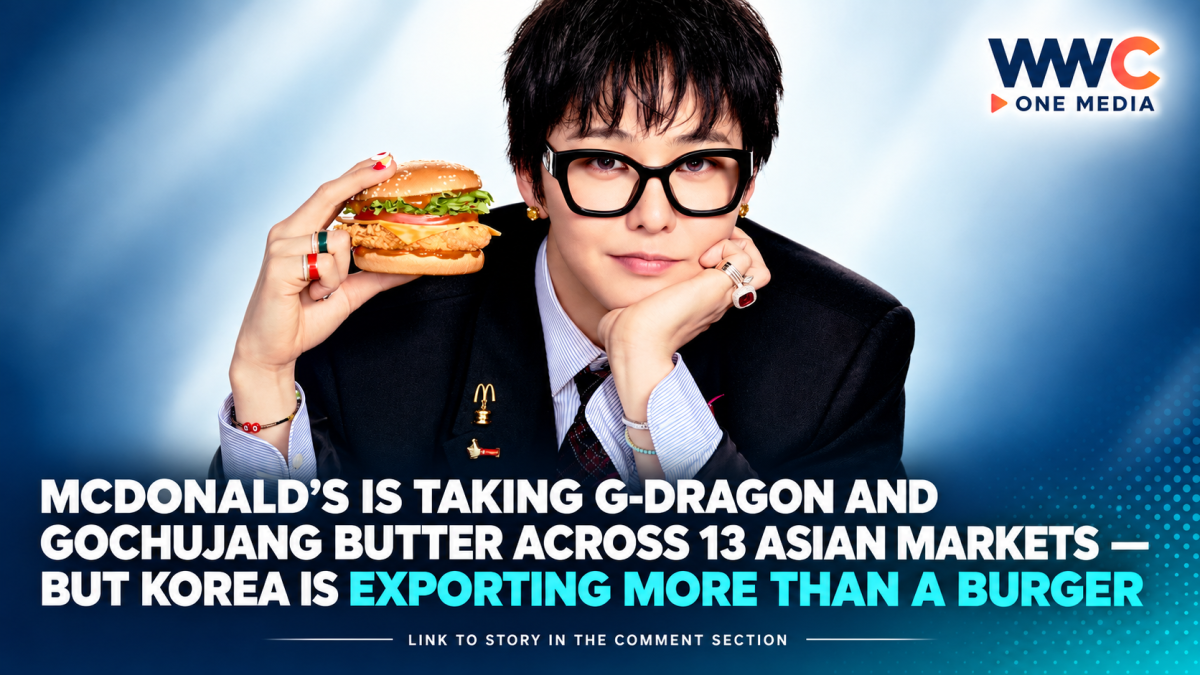
SEOUL — McDonald’s has recruited one of K-pop’s most recognisable stars to sell a distinctly Korean flavour across Asia. But the more important part of the campaign may be where the idea came from.
McDonald’s Korea launched two new chicken burgers on September 17 built around a gochujang-butter sauce developed in Korea, with G-Dragon fronting a wider campaign that will roll out sequentially across 13 Asian markets.
The Korean menu starts with the McCrispy Gochujang Butter and McSpicy Gochujang Butter, combining the fermented chilli paste that is one of Korea’s signature ingredients with butter and Colby Jack cheese. The sauce can also be ordered separately as a dip.
But this is not simply McDonald’s headquarters creating one burger and shipping exactly the same recipe around Asia.
McDonald’s Korea says it planned and is leading the regional campaign itself.
And participating markets will adapt the central gochujang-butter idea to their own consumer preferences.
That makes the launch a revealing snapshot of how the Korean Wave is changing global consumer brands.
Korea is no longer only supplying the celebrity.
This time, it is also supplying the flavour and much of the campaign concept.
The first two burgers are built around chicken
In Korea, the distinction between the two launch products comes mainly from the chicken.
The McCrispy Gochujang Butter uses a Cajun-seasoned whole chicken thigh patty topped with the gochujang-butter sauce and Colby Jack cheese.
The McSpicy Gochujang Butter uses a chicken breast patty with the same sauce-and-cheese combination.
McDonald’s Korea says the sauce is intended to balance the heat and fermented character of gochujang with the richness of butter.
Selling it separately as a dipping sauce also gives customers the option to use it with products such as McNuggets or fries rather than limiting it to one burger format.
That may seem like a small product decision.
Commercially, it matters.
A sauce is easier to adapt across markets than an entire fixed meal.
The other 12 markets do not necessarily get identical burgers
This is one of the most important details in the announcement.
All 13 participating Asian markets will use the Korean-developed gochujang-butter sauce or concept as a common theme, but local operators can create products suited to their own market characteristics and tastes.
The Korea Herald specifically identified China, Vietnam and Indonesia among the participating markets, while other regional coverage has also named markets such as Hong Kong, Singapore and Thailand.
So consumers should not assume every participating country will receive the exact McCrispy and McSpicy configuration sold in Seoul.
The regional idea is standardized.
The execution can be localized.
That is a familiar multinational food strategy—but with an unusual starting point.
Normally, the global brand creates a platform and local markets adapt it.
Here, the Korean operation developed the platform that other Asian markets are adopting.
And G-Dragon is doing more than holding the burger
McDonald’s could have stopped at putting G-Dragon in the advertising.
Instead, the collaboration extends into his fashion business.
The company says it will release limited-edition merchandise with PEACEMINUSONE, the fashion and lifestyle label founded by G-Dragon, later in September.
McDonald’s had not disclosed all of the merchandise details in its initial Korean announcement, so it would be premature to describe a complete product lineup as universally available across all 13 markets.
What is confirmed is the broader strategy.
The campaign combines three increasingly exportable pieces of Korean culture:
K-pop celebrity, Korean food and Korean fashion.
Instead of treating them as separate industries, McDonald’s is packaging them inside one regional promotion.
There is precedent: McDonald’s already learned how powerful K-pop can be
This is not McDonald’s first large-scale experiment with Korean pop culture.
In 2021, the company partnered with BTS on the BTS Meal, rolling the promotion out across nearly 50 markets.
That meal included Chicken McNuggets, fries and Coca-Cola, but its most distinctively Korean element was the addition of Sweet Chili and Cajun dipping sauces inspired by McDonald’s South Korea recipes.
The G-Dragon campaign goes a step further in one respect.
The BTS campaign was a global celebrity-order programme built around the group’s favourite McDonald’s meal.
The 2026 G-Dragon promotion is explicitly being planned and led by McDonald’s Korea, with a new sauce created there and then taken to neighbouring markets.
That is a subtle but meaningful shift.
In 2021, Korean culture helped globalize a McDonald’s celebrity meal.
In 2026, McDonald’s Korea itself is exporting a product platform.
Gochujang is becoming easier to sell without explaining it
One revealing detail is that some participating markets are expected to use the Korean word “gochujang” directly in the product name rather than replacing it with a generic phrase such as “spicy Korean sauce.”
That suggests a level of consumer familiarity that would have been harder to assume a decade or two ago.
Gochujang is a fermented red pepper paste traditionally used across Korean cooking.
Its international visibility has grown alongside Korean restaurants, television, film, music, instant noodles and social-media food culture.
The commercial evidence supports that trend.
South Korean gochujang exports reached about US$64 million in 2025, up from roughly US$62 million in 2024 and above US$60 million in 2023. During the first five months of 2026, exports increased another 2.1% year on year to about US$22.9 million, according to Korean customs data cited by Seoul Economic Daily.
Those are not enormous numbers compared with semiconductors or automobiles.
But they demonstrate that a traditional Korean condiment is increasingly a commercial export in its own right.
Korean sauces are part of a much bigger K-food expansion
Gochujang is also benefiting from a broader shift in international demand for Korean food.
Korea’s Ministry of Agriculture has previously said exports of Korean sauces were being driven not only by traditional fermented pastes such as gochujang and doenjang, but also by Korean-style chicken sauces and spicy sauces adapted for overseas consumers.
By late September 2025, Korean sauce exports had reached about US$315 million, up 9.2% year on year, according to Korea Agro-Fisheries & Food Trade Corp. data reported by Yonhap.
And the trend has not disappeared in 2026.
South Korea’s agricultural and fisheries exports reached about US$980 million in August, up 1.5% from a year earlier and the highest August total on record, according to the government’s latest trade report.
That makes McDonald’s timing logical.
The company is introducing a Korean sauce to more Asian consumers while interest in K-food is already being reinforced by export growth.
The smartest part may be mixing familiarity with novelty
From a product-development perspective, gochujang alone could be too unfamiliar or too intense for some mass-market fast-food customers.
Butter changes that.
So does cheese.
So does putting the sauce on a chicken burger rather than asking customers to approach an unfamiliar traditional dish.
The formula takes something distinctively Korean and places it inside one of the most globally recognizable food formats on earth.
Burger.
Chicken.
Cheese.
Spicy sauce.
The unfamiliar ingredient arrives surrounded by familiar ones.
That is not an accident.
It lowers the barrier for customers who may know the word “gochujang” from Korean culture but have never actually bought a tub of fermented chilli paste themselves.
McDonald’s is also testing whether K-food can become mainstream fast food
Korean cuisine’s international growth has often come through Korean businesses.
Ramyeon brands.
Korean fried chicken chains.
Bibimbap restaurants.
Barbecue restaurants.
Sauce producers.
McDonald’s creates another route.
A consumer does not need to seek out a Korean restaurant to encounter gochujang.
The flavour can instead appear at a fast-food chain they already use.
That is potentially significant for Korean food companies because mainstream adoption often accelerates when foreign ingredients stop being confined to speciality stores and ethnic restaurants.
Gochujang does not need to replace ketchup.
It only needs to become familiar enough that seeing the word on a menu no longer requires explanation.
G-Dragon gives McDonald’s access to more than music fans
G-Dragon is particularly useful for this kind of campaign because his commercial identity extends beyond recording music.
The BIGBANG member has spent years building a separate fashion profile through PEACEMINUSONE, making the McDonald’s collaboration capable of functioning simultaneously as a food promotion and a collectible fashion drop.
That matters for younger consumers whose relationship with brands often extends beyond the underlying product.
A customer may want the burger.
A fan may want the packaging.
A collector may want the merchandise.
A social-media user may want the photograph.
All four can participate in the same campaign for different reasons.
McDonald’s therefore is not simply buying G-Dragon’s face.
It is borrowing the ecosystem around his image.
The campaign also shows how multinational brands are changing their idea of “local”
For decades, localization at global food companies usually meant taking an international menu and tweaking it for one country.
Rice dishes in some Asian markets.
Spicier chicken elsewhere.
Regional desserts.
Local sauces.
This campaign points in the opposite direction.
A local McDonald’s operation has created something that the wider region believes can travel.
That is a far more consequential kind of localization.
It turns the local market from an adaptation centre into a product-development centre.
McDonald’s Korea itself highlighted that point, calling the campaign meaningful precisely because it was planned in Korea and is being rolled out across Asia.
But this is still a marketing campaign—not proof of lasting demand
There is one important limit to the story.
McDonald’s has not released sales targets for the gochujang-butter products.
It has not disclosed expected revenue from the 13-market campaign.
And it has not said the sauce will become a permanent menu item.
That means claims that the product is already an international commercial success would be premature.
The campaign has begun.
Its long-term performance is not yet known.
Celebrity launches can create enormous short-term attention without becoming durable menu businesses.
The real measure will come after the initial G-Dragon excitement fades:
Do customers reorder the food because they actually like the flavour?
That may be the bigger test for K-food too
Celebrity can introduce a consumer to a product once.
Repeat demand has to come from the product itself.
That distinction matters for the wider Korean food industry.
The Korean Wave can open the door.
A G-Dragon campaign can make millions of people curious.
Social media can make a sauce photogenic.
But for gochujang to become a genuinely mainstream international pantry ingredient, consumers eventually have to buy it without a K-pop star standing beside it.
McDonald’s may help push that transition.
By mixing gochujang with butter and placing it in one of the world’s most familiar restaurant chains, the company is taking a Korean flavour one step further away from novelty and one step closer to everyday fast food.
Korea is exporting the recipe and the celebrity at the same time
That is what makes this promotion more interesting than another famous-person endorsement.
G-Dragon gives McDonald’s attention.
PEACEMINUSONE gives it fashion credibility.
The Golden Arches provide distribution.
But the sauce itself came from McDonald’s Korea, and the Korean business is leading the regional campaign.
The sequence matters.
Korea did not simply receive a global campaign and insert a local star.
It developed the flavour, built the concept around a Korean cultural figure and then sent that idea outward.
In an era when Korean music, television, beauty products and food are increasingly exported as interconnected pieces of the same cultural economy, that may be the most telling part of the launch.
G-Dragon is carrying the burger.
But McDonald’s Korea is exporting the idea behind it.



Leave a Reply