
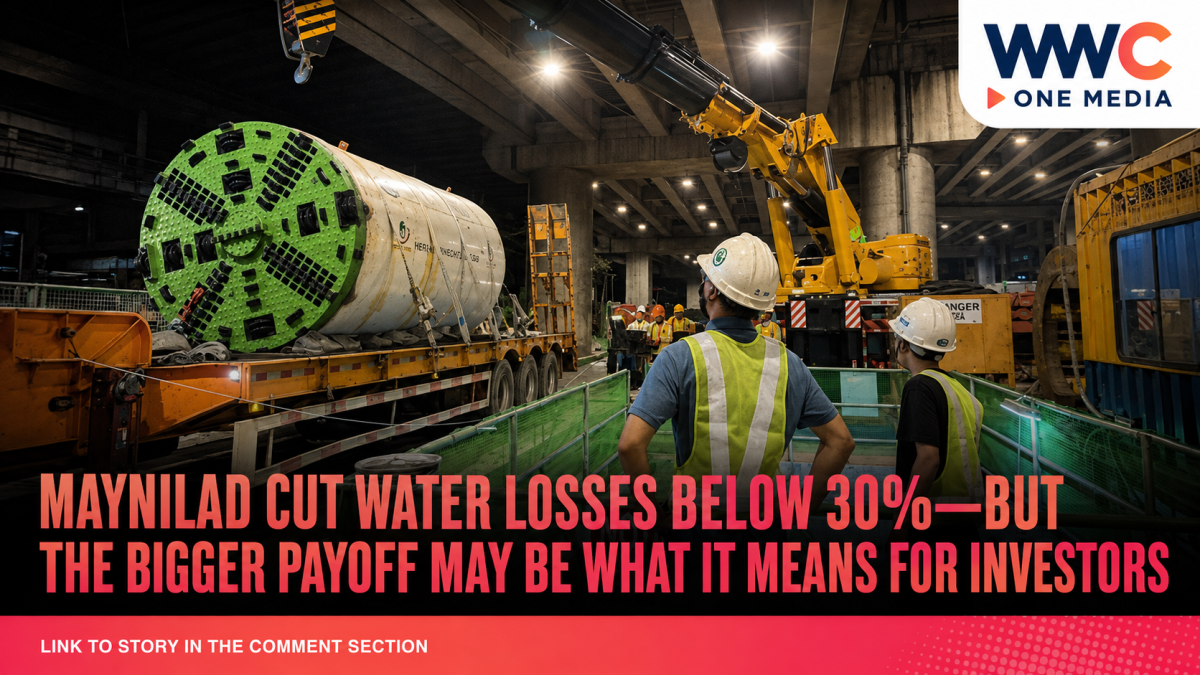
MANILA, Philippines — Maynilad Water Services Inc. may have just collected five Philippine Quill Awards for communication campaigns, but the numbers behind those campaigns tell a much bigger story.
The West Zone water concessionaire is increasingly turning one of the utility sector’s oldest problems—water disappearing through leaks, faulty meters, illegal connections and other system losses—into a potential source of additional supply, lower operating costs and stronger returns on billions of pesos in infrastructure investment.
And following Maynilad’s massive stock-market debut, investors now have another reason to watch every percentage point.
Maynilad received three Awards of Excellence and two Awards of Merit at the 22nd Philippine Quill Awards for initiatives covering water-loss reduction, crisis communication, public participation and its transition into the capital markets.
Among the winners was “Grand Walk-the-Line,” which brought employees into the company’s campaign against non-revenue water, or NRW—the portion of treated water that does not generate revenue because it is physically lost or commercially unaccounted for.
Another campaign, “Leak Warriors 2025,” encouraged residents to report visible leaks. According to Maynilad, reported leaks increased 142% year-on-year during the campaign period. The company also won recognition for its communications during the Pritil leak repair incident.
But behind the awards is a more important operational milestone.
Maynilad’s Water Losses Have Fallen to a Record Low
By the end of June 2026, Maynilad had reduced its NRW level to 29.7%, down sharply from 35.25% a year earlier.
It was the first time the company pushed period-end water losses below the 30% mark.
That matters because water recovered from leaks can effectively become additional supply without requiring Maynilad to immediately build another major treatment plant or secure an entirely new raw-water source.
Maynilad has said its NRW program has recovered roughly 278 million liters per day since 2019, an amount comparable to the output of more than two treatment plants. Management has also estimated that every one-percentage-point reduction in NRW can generate more than ₱70 million in operating-expense savings.
That makes leak reduction more than a maintenance issue.
It is increasingly a financial strategy.
The Earnings Numbers Are Moving Too
Maynilad reported first-half 2026 net income of ₱8.51 billion, up 14% from the comparable period.
Revenue increased 4.1% to ₱19.11 billion, while EBITDA climbed 7.5% to ₱13.70 billion.
At the same time, the utility spent ₱12.89 billion in capital expenditures, 18.9% higher than the ₱10.85 billion invested during the first half of 2025.
That combination is important for investors: Maynilad is spending heavily, but some of those investments are also helping the company squeeze more billable water out of infrastructure it already operates.
Instead of producing more water only to lose a significant portion before it reaches paying customers, plugging leaks allows more existing production to become usable—and potentially revenue-generating—supply.
The Next Target Is Much Tougher
The progress did not happen overnight.
During 2025, Maynilad repaired more than 70,000 smaller leaks, fixed 206 major leaks in primary distribution lines and replaced approximately 82 kilometers of aging pipelines in high-loss areas.
It has also introduced technology such as AI-assisted leak localization and the Geo-AI Leak Locator, or GAILL, to identify underground problems that can be difficult to locate through traditional methods.
Maynilad ended 2025 with period-end NRW at 30.7%, compared with 38.4% at the end of 2024, recovering an estimated 256 million liters per day during the year.
The target now becomes more demanding.
Maynilad wants to bring NRW down to 25% by 2027 and eventually around 20% by 2030, a level management considers close to an international benchmark.
BusinessMirror reported that the company expects to spend roughly ₱5 billion to ₱6 billion annually on NRW reduction as it works toward those goals, within a broader 2026 capital expenditure program of about ₱30 billion.
The company has separately said approximately ₱7.7 billion under its MWSS-approved business plan was allocated for NRW-management initiatives scheduled for implementation in 2026.
The distinction is important: the ₱7.7 billion refers to programmed 2026 NRW initiatives under the approved plan, while the ₱5-billion-to-₱6-billion figure is management’s estimate of the annual spending it expects to sustain as it pursues the longer-term 20% target.
Then Came the ₱34-Billion IPO
The investor angle is now impossible to separate from the operational story.
Maynilad listed on the Philippine Stock Exchange on November 7, 2025, raising ₱34.34 billion.
The PSE described it as the second-largest IPO in Philippine stock-market history. Proceeds from the primary shares were earmarked for capital expenditures, including water and wastewater infrastructure, customer information systems and other corporate requirements.
Reuters reported the transaction at about $590 million, noting participation from major domestic and international investors.
The offering also attracted the Asian Development Bank and International Finance Corporation as lead cornerstone investors, with the two multilateral institutions investing a combined $245 million, according to the PSE. Six other foreign cornerstone investors also participated.
That helps explain why two of Maynilad’s five Quill recognitions specifically involved investor relations and IPO communications.
One recognized the company’s effort to explain its long-term business case to investors; another covered media relations surrounding its public-market debut.
But after an IPO, communications can only go so far.
The market eventually wants numbers.
Why Investors Should Watch NRW
For Maynilad, NRW may become one of the clearest indicators of whether its enormous infrastructure spending is producing tangible returns.
Lower water losses can mean less unnecessary treatment and pumping, more water available for billing, stronger supply reliability and reduced pressure to immediately develop expensive new sources.
It also matters because Metro Manila remains vulnerable to fluctuations in its major raw-water sources, particularly Angat Dam.
The more water Maynilad recovers from its own distribution network, the more flexibility it gains during periods of tight supply.
That is especially relevant as El Niño risks again put water security in focus.
Maynilad has said reduced NRW, new treatment capacity and alternative water sources have already helped lower its dependence on Angat compared with the 2019 dry spell.
The Hard Part Starts Now
Getting NRW from nearly 40% to below 30% is significant.
Getting it from 29.7% to 25%—and eventually toward 20%—could prove much harder and potentially more expensive.
The easiest leaks are not always the ones that remain.
Older underground pipelines still have to be replaced. Hidden leaks must be located. Meters have to be modernized. Illegal connections and commercial losses need continuous enforcement. And billions of pesos in capital spending must ultimately translate into better service rather than simply higher expenditure.
That is where Maynilad’s communications awards and its investor story converge.
A campaign can persuade employees to hunt for leaks. It can encourage customers to report them. It can explain a massive IPO to investors.
But the company’s next test will be measurable underground.
Maynilad has already pushed water losses through a historically important threshold.
The question now is whether the next few percentage points can deliver an even bigger payoff—for Metro Manila’s water supply and for the investors who helped finance Maynilad’s next chapter.
WWC ONE MEDIA MJE

Leave a Reply