
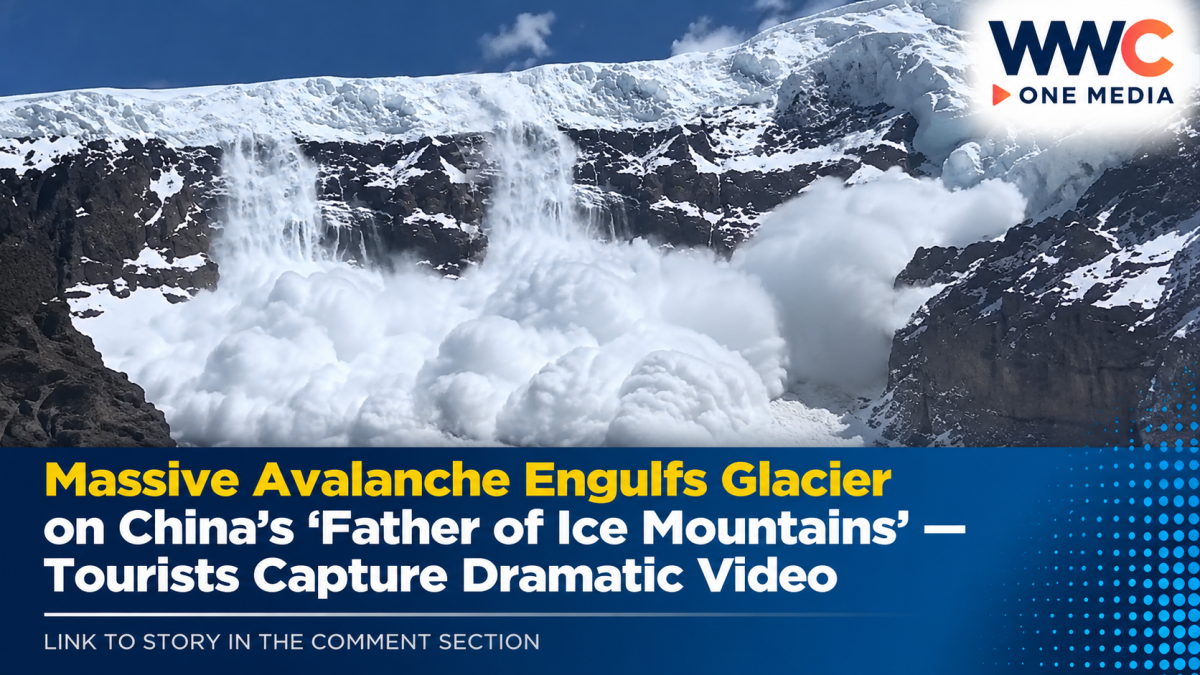
BEIJING — A massive wall of snow and ice came crashing down a glacier on one of China’s most famous mountains, creating a huge cloud of snow more than 100 metres wide in dramatic scenes captured by tourists.
The avalanche struck Glacier No. 2 on Muztagh Ata, a towering mountain near China’s border with Tajikistan in the northwestern Xinjiang region, Chinese state broadcaster CCTV reported.
Several tourists captured the frightening moment on their mobile phones as snow and ice cascaded down the mountainside.
Despite the dramatic scale of the avalanche, authorities said there were no casualties and no property damage because it occurred in an unpopulated area far from major roads.
A Massive Wall of Snow and Ice
Video footage of the incident showed an enormous mass of snow and ice racing down the mountainside.
As the avalanche moved, it generated a vast plume of snow that CCTV said stretched more than 100 metres wide.
The scenes quickly drew attention because of the sheer scale of the mountain and the dramatic visibility of the avalanche.
Muztagh Ata’s main peak rises to about 7,546 metres (24,757 feet) and is covered by extensive ice and glaciers, making it one of the most striking peaks in the region.
No Deaths or Damage Reported
Authorities said the location of the avalanche prevented the incident from becoming a tragedy.
The avalanche occurred in an area without residents and away from major roads.
As a result, no deaths, injuries or property damage were reported in connection with the incident, according to CCTV.
That distinction is significant given the recent series of major glacier-related disasters across the Himalayas and surrounding high-altitude regions.
In recent weeks, the wider Himalayan region has faced heightened concern over glacier instability and related natural hazards, including the catastrophic glacier collapse and flooding along the China-Nepal border.
Glacier No. 2 Is Closed to the Public
Officials have already closed Glacier No. 2 to the public because of heightened risks linked to glacial activity.
The local culture and tourism bureau also issued a warning to tourists against entering unauthorised high-risk restricted areas on Muztagh Ata.
Officials cited several dangers, including:
- Complex mountain terrain
- Rapidly changing weather
- Weak communication signals
- Dangerous glacial conditions
- Extremely difficult rescue operations
The warning highlights the risks faced by tourists and climbers who venture beyond authorised areas on one of the world’s highest and most remote mountain landscapes.
Why Muztagh Ata Is One of China’s Most Famous Mountains
Muztagh Ata is one of the most recognisable peaks in the Pamir mountain region.
Its name is often translated as “Father of Ice Mountains”, a reference to its enormous glaciers and snow-covered slopes.
The mountain’s main summit reaches 7,546 metres, placing it among the world’s highest peaks.
Its location near China’s border with Tajikistan and its vast ice-covered landscape have made it a popular destination for experienced climbers and high-altitude adventurers.
But the same conditions that make Muztagh Ata visually spectacular also make it dangerous.
Extreme weather can change rapidly.
Communication can be unreliable.
And emergency rescues in remote high-altitude areas can be exceptionally difficult.
That is why officials have urged visitors to respect restricted zones and avoid unauthorised routes.
Tourists Captured the Incredible Moment
The avalanche was recorded by several tourists who happened to be in the wider area when the glacier gave way.
The footage showed snow and ice tumbling down the mountain before creating a huge expanding cloud.
For those watching from a safe distance, the video captured the raw power of a high-altitude avalanche.
But the incident also served as a reminder of how quickly conditions can change in mountain environments.
An avalanche can travel rapidly and generate dangerous snow clouds, while remote terrain can make escape or rescue extremely difficult.
In this case, the avalanche’s isolated location meant no one was caught in its path.
Glacier Risks Are Drawing Fresh Attention
The Muztagh Ata avalanche comes as scientists and authorities continue to focus on growing risks associated with glaciers across the Himalayan and surrounding mountain regions.
A devastating glacier collapse near the China-Nepal border in late August triggered catastrophic flooding and mudslides that caused widespread destruction and left large numbers of people dead or missing.
The disaster has renewed concerns about glacial instability and the growing risks posed by warming temperatures in high mountain regions.
However, authorities have not said that climate change caused the Muztagh Ata avalanche, and no official cause for the specific event was immediately reported.
That distinction is important.
While scientists have warned broadly about increasing glacial hazards in warming mountain regions, the cause of an individual avalanche requires separate investigation and should not be assumed without official evidence.
A Stunning Scene — and a Serious Warning
The footage from Muztagh Ata may look spectacular from a distance.
A giant mountain.
A wall of ice and snow.
A massive cloud spreading across the glacier.
But officials say the event should also serve as a warning.
Mountain environments can change within seconds.
Areas that appear safe can become dangerous without warning.
And rescue operations at extreme altitudes may be difficult or impossible depending on weather and terrain.
That is why authorities are urging visitors not to enter restricted zones around Glacier No. 2 or other high-risk areas without authorisation.
No Casualties — But the Images Tell a Powerful Story
For now, the most important fact is that the Muztagh Ata avalanche did not cause any reported deaths or injuries.
No property damage was reported either.
But the dramatic footage has given people around the world a rare look at the immense natural forces at work on China’s high mountain glaciers.
A mountain rising more than 7,500 metres into the sky.
A glacier in a restricted zone.
And suddenly, an enormous mass of snow and ice rushing down its slopes.
This time, no one was in the avalanche’s path.
But the dramatic scenes from Muztagh Ata are a powerful reminder that in the world’s highest mountains, nature can change everything in seconds.
WWC ONE MEDIA J.M.D

Leave a Reply