
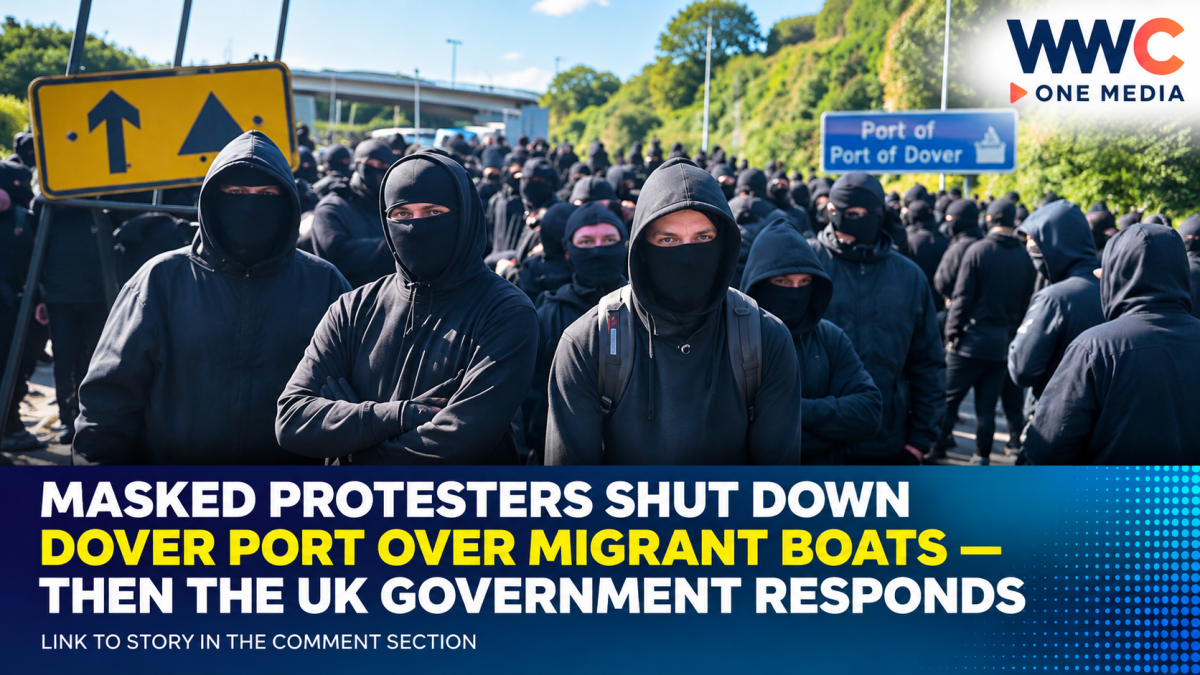
Hundreds of masked protesters brought traffic around one of the United Kingdom’s most important ferry gateways to a standstill on Saturday, September 5, disrupting passengers and freight traffic between Britain and France and triggering condemnation from the government.
The demonstrators, many dressed in black and wearing balaclavas, blocked roads leading to the Port of Dover and were heard chanting “Stop the boats,” a reference to migrants crossing the English Channel in small boats. Police described the gathering as a protest and said officers were engaging with those involved.
The disruption temporarily stopped traffic into and out of the port, with National Highways reporting congestion stretching about 4 miles (6.4 kilometers). Access was restored around midday, and Kent Police said the protesters had dispersed. No arrests were reported.
Dover brought to a standstill
The Port of Dover described the situation as an ongoing public-order incident as protesters occupied roads around the terminal.
The disruption had an immediate impact on travelers. P&O Ferries said passengers who missed their scheduled sailings because of the blockade would be offered the next available crossing. By around midday, the port said access had been restored and traffic was moving again.
The Financial Times reported that the protest caused several hours of disruption, with National Highways closing the eastbound A20 and local diversions introduced.
Dover is Britain’s largest international ferry port and a crucial link with continental Europe. The Associated Press reported that the port handled more than 9 million passengers and around 2 million freight vehicles in 2025.
That makes the protest significant beyond the immigration debate: blocking access to Dover can quickly affect ordinary travelers, freight movements and cross-Channel commerce.
Why were the protesters there?
The demonstration centered on opposition to migrant crossings in the English Channel.
Video footage showed masked protesters dressed in black chanting “Stop the boats,” while reports from Reuters and the BBC identified the protest as being connected to opposition to asylum seekers arriving from France by small boats.
Far-right activist Stephen Yaxley-Lennon, commonly known as Tommy Robinson, publicly supported the demonstration. The Associated Press reported that Robinson described the protesters as having mobilized to close the port.
Reports also linked the action to anti-immigration activists, although authorities did not initially attribute criminal conduct to the protesters and no arrests were reported.
Government condemns the disruption
The British government condemned the blockade while acknowledging the right to protest.
A government spokesperson said peaceful protest is a fundamental part of democracy but criticized the behavior in Dover because of the disruption caused to travelers and the port.
Mike Tapp, the Labour MP representing Dover, also criticized the protesters, calling the disruption unacceptable and arguing that the demonstrators were interfering with residents and travelers.
The Associated Press reported that Tapp also pointed out that small-boat crossings have fallen substantially this year.
The numbers behind Britain’s migration debate
The protest comes as the UK government says small-boat arrivals have fallen sharply in 2026.
According to Home Office data cited by the BBC, 16,513 people had crossed the English Channel in small boats between January 1 and September 1, 2026. That was 43% lower than during the same period in 2025.
The decline has been attributed in part to increased cooperation between Britain and France, including efforts to disrupt people-smuggling operations and prevent boats from launching.
But the issue remains politically explosive.
Small-boat arrivals have become a central issue for Britain’s right-wing political movement, with immigration and border control continuing to generate fierce debate across the country.
Dover has seen this before
Saturday’s confrontation was not the first time Dover has become a focal point for Britain’s immigration controversy.
The town sits directly opposite Calais and is one of the principal destinations for cross-Channel ferry traffic. Its geographic position has also made it a highly visible symbol in the debate over migrants attempting to reach Britain by sea.
The latest protest demonstrates how immigration remains capable of producing immediate disruption far beyond Westminster politics.
For travelers, the issue was much more immediate: blocked roads, delayed ferries and thousands of people caught in a sudden transportation disruption.
What happens next?
Although traffic at the port has returned to normal, Saturday’s events could reignite questions about public order, protest tactics and Britain’s response to Channel crossings.
The government’s position is becoming increasingly difficult to balance: it must protect the right to peaceful protest while preventing demonstrations from shutting down critical transportation infrastructure.
At the same time, the fall in small-boat arrivals gives the government a statistic it can point to as evidence that its cooperation with France is producing results.
Yet for anti-immigration groups, the decline has not ended the campaign.
And with Dover remaining one of Britain’s most politically sensitive migration flashpoints, Saturday’s blockade may be less an isolated incident than another warning that the country’s immigration debate is far from over.
WWC ONE MEDIA M.J.E




Leave a Reply