
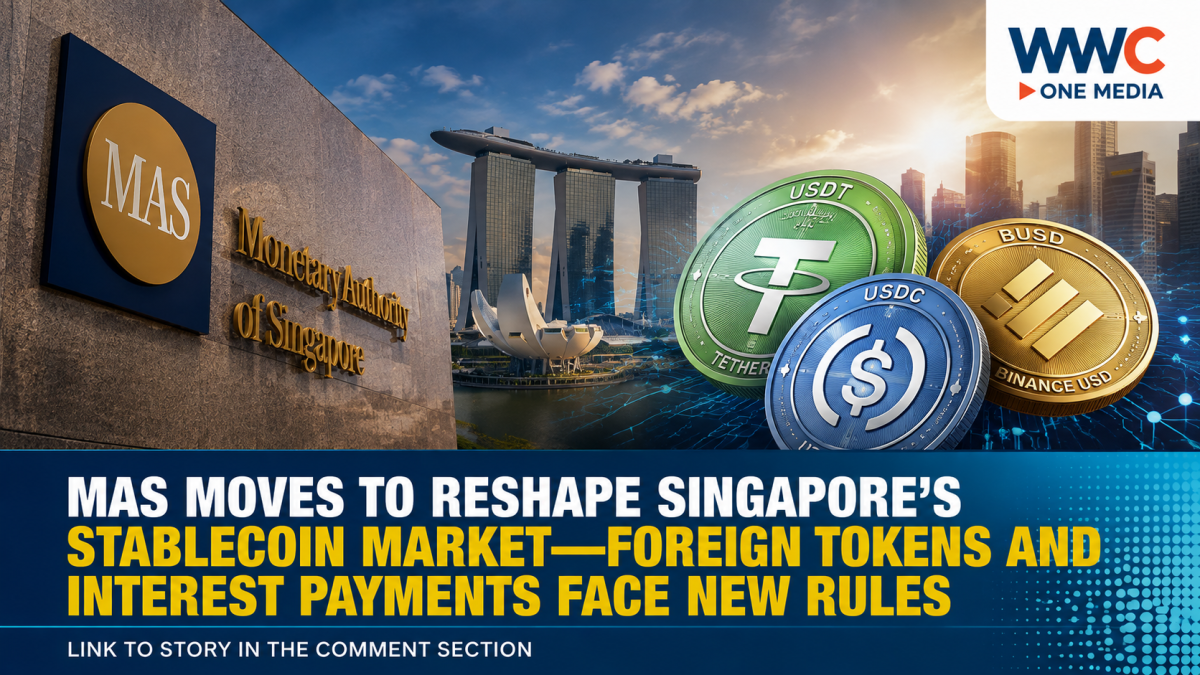
SINGAPORE — Singapore is preparing to tighten its rules for stablecoins, with the Monetary Authority of Singapore (MAS) proposing new requirements that could reshape how digital tokens are issued, marketed and used for cross-border payments.
The proposed changes would amend the Payment Services Act 2019 and introduce a more detailed regulatory framework covering locally issued single-currency stablecoins, foreign-issued tokens and financial-stability safeguards.
The consultation comes as stablecoins become increasingly important in digital payments, international settlement and other financial applications.
Only licensed issuers could use the MAS-regulated label
Under the proposed framework, stablecoins issued in Singapore and pegged to the Singapore dollar or a G10 currency could qualify for MAS regulation.
But there would be an important distinction.
Only issuers licensed by MAS would be allowed to market their tokens as “MAS-regulated stablecoins.” The move is intended to help users distinguish regulated stablecoins from other crypto assets that may use the stablecoin label without being subject to the same regulatory safeguards.
Stablecoins outside the framework would continue to be treated as digital payment tokens under Singapore’s existing rules.
Foreign stablecoins could get a pathway into Singapore
One of the most closely watched proposals involves foreign-issued stablecoins.
MAS is considering recognizing a limited number of foreign-issued stablecoins that operate under regulatory frameworks comparable to Singapore’s, particularly where the tokens are used for cross-border wholesale transactions.
The regulator is also proposing a pathway for jointly issued Singapore-foreign stablecoins to qualify under the framework, provided the associated risks can be sufficiently managed.
That could potentially make Singapore’s regulated stablecoin ecosystem more internationally connected while maintaining regulatory controls.
But interest payments could be banned
Perhaps the biggest change for stablecoin users is the proposed restriction on interest.
MAS is looking to prohibit interest payments on MAS-regulated stablecoins.
The proposed approach reinforces the idea that regulated stablecoins should function primarily as payment and settlement instruments rather than investment products offering returns simply for holding the tokens.
That distinction could become increasingly important as stablecoins compete with traditional deposits and other yield-generating digital assets.
Issuers would face tougher financial safeguards
The proposed framework would also introduce additional safeguards designed to protect users and reduce risks to financial stability.
Stablecoin issuers could be required to conduct stress testing and maintain plans for recovery and an orderly wind-down if their operations encounter serious problems.
MAS is also considering requirements for issuers to protect customer money received before stablecoins are issued.
Other proposed requirements would cover:
- Value stability
- Capital requirements
- Redemption at par
- Disclosure
- Protection of customer funds
- Recovery and wind-down planning
Why Singapore is tightening the rules
Stablecoins are designed to maintain a relatively stable value, usually by being linked to a fiat currency such as the US dollar or Singapore dollar.
They are increasingly being explored for payments, remittances, settlement and other financial transactions.
That creates opportunities—but also risks.
If a stablecoin becomes widely used and confidence in its value or reserves suddenly collapses, the consequences could extend beyond individual token holders.
Singapore’s approach is therefore focused on making sure stablecoins operating under its regulatory framework maintain strong backing, reliable redemption mechanisms and adequate safeguards.
The consultation is now open
MAS is seeking feedback on the proposed legislative amendments and related policy measures until October 16, 2026.
The proposals are not yet final rules.
The consultation process gives financial institutions, stablecoin issuers, technology companies and other stakeholders an opportunity to comment before the legislation is finalized.
Singapore’s stablecoin experiment enters a new phase
The proposals signal that Singapore wants to remain open to digital-asset innovation while drawing a much clearer line between regulated stablecoins and the broader cryptocurrency market.
For users, the changes could make it easier to identify which stablecoins are subject to MAS oversight.
For issuers, however, the framework could mean higher compliance costs and stricter requirements around reserves, capital, redemption and risk management.
And for the growing cross-border digital payments market, the most consequential question may be whether Singapore can successfully balance international interoperability with financial stability.
The rules are not final yet—but MAS’s latest proposals show that Singapore is preparing for stablecoins to become a much bigger part of the financial system.
WWC ONE MEDIA J.M.D



Leave a Reply