
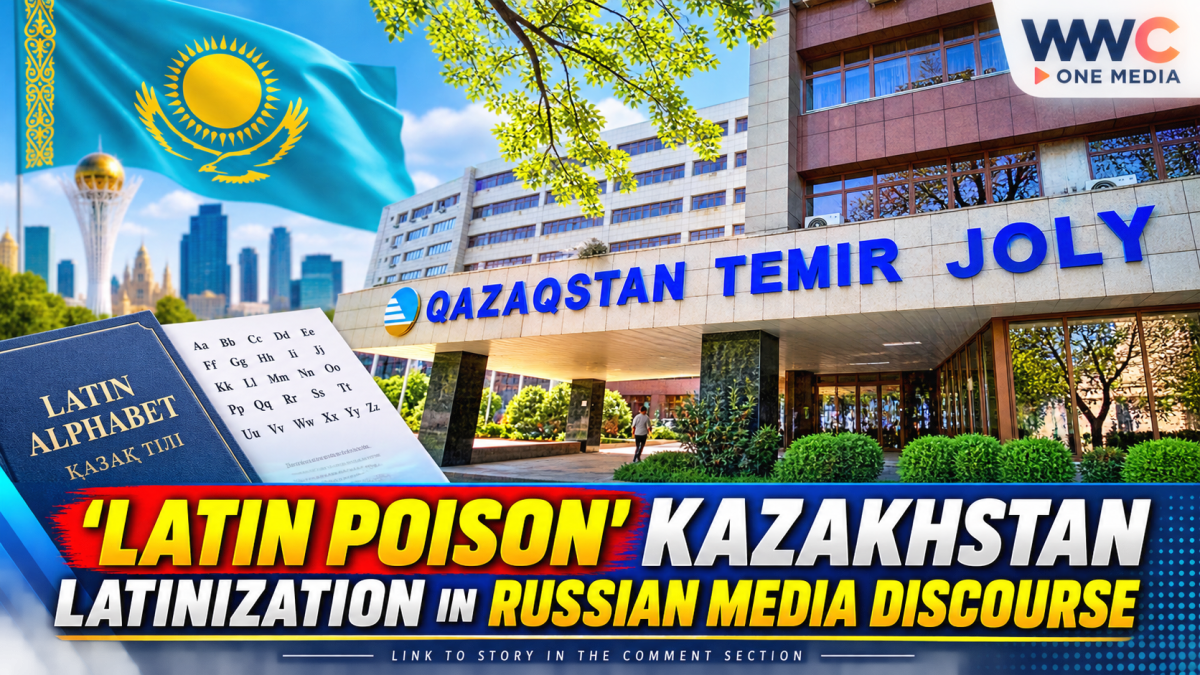
Kazakhstan’s Latin Alphabet Shift Is Becoming More Than a Language Reform
Kazakhstan’s long-running plan to move the Kazakh language from Cyrillic to Latin script is increasingly becoming a battleground over national identity, Russia’s cultural influence and the future direction of Central Asia.
A recent The Diplomat analysis, “‘Latin Poison’: Kazakhstan’s Latinization in Russian Media Discourse,” argues that the hostile language used by parts of Russian media goes well beyond a technical debate about alphabets. The coverage frames Latinization as evidence that Kazakhstan is moving away from the Russian cultural sphere.
But there is an important fact often lost in the online debate: Kazakhstan has not simply “abolished Cyrillic” overnight. The transition remains a gradual, unfinished reform, with the current timetable extending toward 2031.
The real story behind Kazakhstan’s “Latinization”
Kazakhstan’s alphabet debate dates back decades. The country used Arabic script historically, adopted Latin in the Soviet period from 1929 to 1940, and was then moved to a Cyrillic-based alphabet during the Soviet era.
After independence, the idea of returning Kazakh to a Latin-based script gradually gained political momentum.
In 2017, then-President Nursultan Nazarbayev formally ordered a transition from Cyrillic to Latin. The original target was 2025. However, the reform proved considerably more complicated than initially anticipated, involving debates over spelling, letters, education, technology and implementation costs.
By 2021, Kazakhstan had moved to a phased 2023–2031 transition plan, rather than the earlier 2025 deadline.
And the process is still evolving.
Kazakhstan’s e-government information says authorities have continued working on a Latin-based alphabet and examining different international models, including the alphabets of Turkey, Azerbaijan, Uzbekistan and Turkmenistan.
Why does Russia care?
This is where the story becomes geopolitical.
For Moscow, language has historically been far more than a communication tool. Russian remains deeply embedded across Central Asia through education, media, business, migration and regional diplomacy.
A January 2026 analysis by Eurasianet described Russia as actively working to preserve its linguistic position in Central Asia, arguing that Russian remains an important instrument for Moscow’s influence even as its broader regional dominance faces competition from China, the United States and Europe.
That makes Kazakhstan’s alphabet reform symbolically important.
The Latin script is associated not only with modernization and global communication but also, in Kazakhstan’s political and cultural discourse, with strengthening the Kazakh language and recovering aspects of national identity that were weakened during the Soviet period. The Diplomat notes that these objectives are part of the official rationale behind the reform.
Russian media criticism can therefore be interpreted as a reaction to something larger than typography: the gradual erosion of Russia’s traditional cultural and linguistic centrality in Kazakhstan.
Russian media turns an alphabet into a geopolitical issue
The new The Diplomat analysis highlights particularly sharp terminology appearing in Russian media discussions, including descriptions of Kazakhstan’s Latinization as “Latin poison,” “a stab in the back” and “a slap in the face.”
The article argues that these narratives frequently position Kazakhstan’s decision within a broader “Russian World” framework — the idea that Russian language, culture, history and the Cyrillic script form a shared civilizational space in which Russia occupies a central position.
That interpretation is consistent with earlier research.
A 2022 academic study of Russian-media responses to Kazakhstan’s alphabet reform found that Russian coverage frequently linked Latinization to themes such as loss of culture, declining literacy and intergenerational divisions, rather than treating the issue simply as a linguistic reform.
Another academic study found that Kazakhstan’s own Latinization discourse emphasizes national identity, modernization and linguistic advantages, while presenting Cyrillic as a potential threat to the development of Kazakh.
So the battle is not really about A, B, C versus А, Б, В.
It is about what those letters represent.
Kazakhstan says the reform is about Kazakh — not erasing Russian
This distinction is crucial.
Kazakhstan’s government has historically emphasized that switching the Kazakh language to Latin does not mean banning Russian or removing the rights of Russian-speaking citizens.
In a 2017 statement, Kazakhstan’s presidential administration explicitly said that the Latinization of Kazakh would not affect the use of Russian, which would continue in Cyrillic. The stated objective was to develop Kazakh and integrate it more effectively into the global information environment.
The country’s linguistic reality is also much more complicated than a simple “Russian versus Kazakh” divide.
Russian remains widely spoken and continues to play an important role in Kazakhstan’s society, business and education. Eurasianet describes Russian as a common language for trade, higher education, communication and diplomacy across Central Asia, while noting that governments are simultaneously strengthening their national languages.
That creates a delicate balancing act for Astana.
Kazakhstan wants to strengthen Kazakh without creating unnecessary linguistic divisions — while simultaneously maintaining its traditionally multi-vector foreign policy.
The Turkic dimension adds another layer
Kazakhstan’s move also fits into a wider trend across the Turkic world.
In September 2024, the Turkic World Common Alphabet Commission agreed on a 34-letter proposed Common Turkic Alphabet designed to promote greater linguistic cooperation among Turkic peoples. The Turkic Academy stressed that the proposal was advisory rather than automatically binding on individual countries.
Kazakhstan’s President Kassym-Jomart Tokayev subsequently described adoption of the Common Turkic Alphabet as a historic achievement in 2025.
The development is significant because Kazakhstan is not making its language policy in isolation. Its alphabet debate sits within a broader effort by Turkic states to deepen cultural, educational and institutional connections.
That inevitably has geopolitical implications.
The alphabet is still not finalized
This is one of the most important points to emphasize.
Despite years of discussion, Kazakhstan’s Latin alphabet remains a work in progress.
The Diplomat reports that the latest version presented in 2021 has not yet been definitively finalized, while Kazakhstan’s Ministry of Science and Higher Education has indicated that work to improve the alphabet continues.
The government’s own e-government information likewise describes ongoing work on the draft Latin alphabet and spelling principles.
That means headlines suggesting Kazakhstan has already completely replaced Cyrillic with Latin are misleading.
The country is undertaking a long-term transition, not announcing an overnight script ban.
Why this matters beyond Kazakhstan
The debate is significant because Kazakhstan occupies a unique position in Central Asia.
It maintains close economic and security ties with Russia while simultaneously expanding relations with China, Türkiye, Europe and other partners.
At the same time, Central Asian governments have increasingly emphasized national languages and cultural sovereignty.
Eurasianet argues that Russia sees language as an inexpensive but powerful tool for retaining influence in the region, even as Moscow’s relative economic and geopolitical position has weakened.
That makes Kazakhstan’s alphabet reform a useful indicator of a much larger transformation:
Central Asia is becoming less linguistically dependent on its former imperial center.
For Moscow, that can look like cultural retreat.
For supporters of Latinization in Kazakhstan, it can look like national modernization and decolonization.
And for Kazakhstan’s leadership, the challenge is finding a path that strengthens the Kazakh language without destabilizing the country’s multilingual social fabric.
The bigger picture
The most accurate way to understand Kazakhstan’s Latinization is therefore not as a simple anti-Russia campaign.
It is simultaneously:
a language modernization project;
an effort to strengthen the Kazakh national language;
part of a broader post-Soviet identity transformation;
connected to Kazakhstan’s growing engagement with the Turkic world;
and, inevitably, a geopolitical signal that Russian cultural dominance is no longer taken for granted.
The controversy in Russian media shows precisely why the alphabet matters.
A change in letters can become a change in identity — and, eventually, a change in geopolitical orientation.
WWC ONE MEDIA G.A

Leave a Reply