
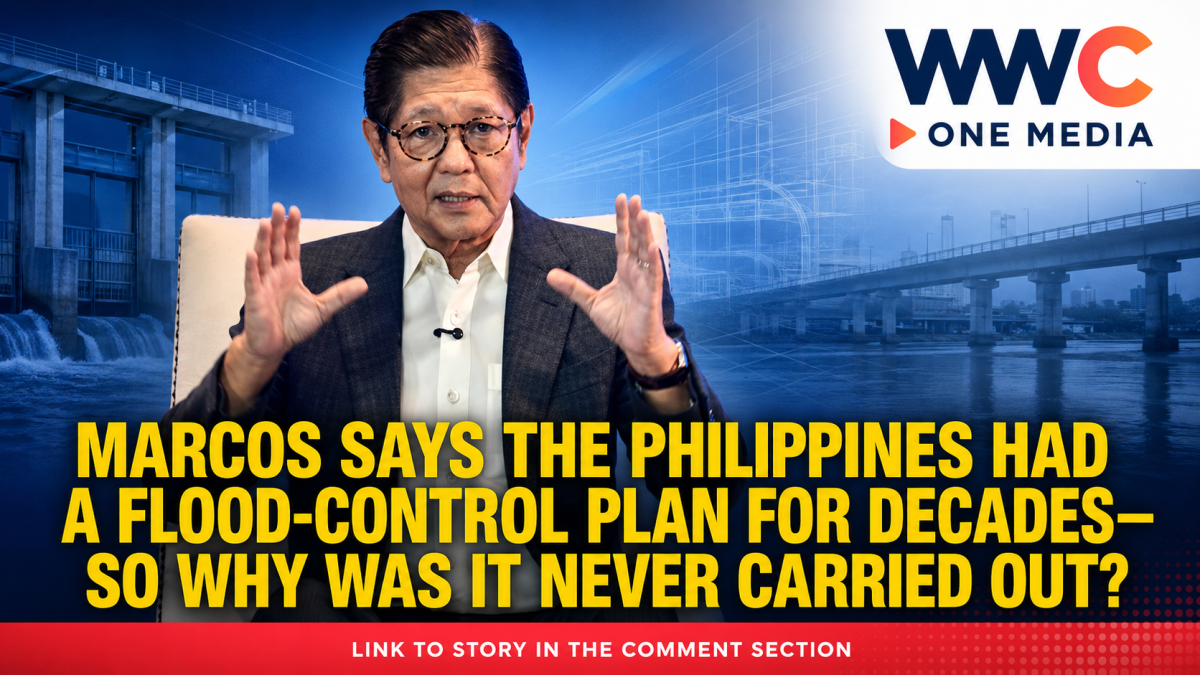
MANILA, Philippines — As millions of Filipinos count the cost of another devastating stretch of floods, President Ferdinand Marcos Jr. has made a striking admission: the Philippines has had flood-control plans for decades, but many were never fully carried out.
Now, as communities across Luzon recover from weeks of relentless rain, damaged infrastructure and widespread flooding, the government says it is finally moving to put long-delayed plans into action.
But there is a complication.
The Department of Public Works and Highways has separately acknowledged that the country still does not have a single, completed national flood-control master plan—and that many existing river-basin and urban drainage plans are either outdated, unfinished or undergoing major revisions because of climate change.
That distinction could become increasingly important as the Marcos administration faces pressure to explain not only what flood-control blueprint exists, but which projects will actually be built, how quickly they can be completed and whether billions of pesos in future spending can avoid the problems that have plagued previous projects.
“We already have a master plan”
Marcos raised the issue Wednesday after inspecting the Aquino and Agana bridges in Tarlac City, both of which were partially damaged following powerful river currents and persistent rains associated with the southwest monsoon.
“We already have a master plan; it’s just never been executed,” Marcos told reporters.
The President said flood-control planning had existed for decades but had largely remained unrealized, adding that the government was only now beginning to implement it. He did not identify one specific nationwide document when making the statement.
The government also plans to allocate ₱300 million for the rehabilitation of the damaged Aquino and Agana bridges. Marcos said the Agana Bridge could potentially reopen to pedestrians within a week and to light vehicles within two weeks, while repairs to Aquino Bridge could take longer because of the extent of the damage.
But the President’s remarks come against a much broader national disaster.
9.4 million Filipinos affected
The Office of Civil Defense said the combined effects of tropical cyclones Luis, Maymay and Neneng, together with the southwest monsoon, had affected approximately 9.4 million people or 2.7 million families as of Wednesday morning.
The disaster had also left 39 people dead, 20 injured and three missing.
More than 71,000 people were staying in 968 evacuation centers, while flooding had been recorded in hundreds of areas.
Infrastructure damage had climbed to roughly ₱6.27 billion, while agricultural losses were estimated at around ₱2.84 billion, according to OCD figures reported by GMA News.
Authorities said 178 cities and municipalities had declared states of calamity, while government assistance to affected communities had reached about ₱1.85 billion.
Those numbers have turned what might normally be a technical debate over engineering plans into a much larger question of national policy.
If the country already had flood-control plans, why did catastrophic flooding remain so widespread?
DPWH says the national picture is more complicated
That question becomes harder to answer because Public Works Secretary Vince Dizon recently gave lawmakers a more nuanced picture.
During a House budget hearing on August 26, Dizon said flood-mitigation master plans across the country were not yet complete.
He explained that the Philippines does not currently operate under one single national flood-control master plan. Instead, planning is generally organized around major river basins and urban centers.
Of the country’s 18 major river-basin master plans, 14 are being updated, with consultants being asked to finish the revisions by the first half of 2027.
Dizon also stressed that older studies cannot simply be followed unchanged because extreme rainfall patterns, urban development and climate change have altered the engineering requirements of flood-control infrastructure.
The DPWH chief’s explanation does not necessarily contradict Marcos’ assertion that long-standing plans exist.
It does, however, reveal something more complicated than the phrase “master plan” might suggest.
The Philippines has accumulated numerous flood-control, drainage and river-management plans over the years—but implementation has been fragmented, some documents have become obsolete, and significant gaps remain.
Metro Manila’s flood problem is changing
The problem is particularly urgent in Metro Manila.
Recent government proposals have identified 39 locations in the National Capital Region for possible flood-mitigation projects.
Among the options being studied are detention ponds, inland wetlands, restored river floodplains, green corridors and river-renaturation projects—approaches designed to hold or absorb water before it overwhelms densely populated communities.
Experts cited by GMA News have pointed out that implementing these systems in a highly urbanized region will not be simple. Land acquisition can be costly, drainage networks between cities are often disconnected, and flood-control planning requires coordination across local government boundaries.
The government’s strategy therefore appears to be shifting away from relying almost exclusively on concrete dikes, pumps and drainage channels toward structures that temporarily store water or restore areas capable of absorbing it.
That may be especially important as rainfall events become more extreme.
Then there is the money
Even a technically sound master plan means little without consistent funding—and that issue is becoming politically sensitive.
The Senate finance committee is considering restoring money for unfinished flood-control projects in the proposed 2027 budget after new locally funded projects were largely withheld from the 2026 budget amid investigations into alleged ghost, substandard and anomalous flood-control works.
Senate finance committee chair JV Ejercito has said unfinished projects should be completed, while maintaining his position against financing new projects for now.
The DPWH proposed roughly ₱107.4 billion for flood-control projects for 2027, while the National Expenditure Program contains around ₱103.45 billion for the Flood Management Program, according to Philstar.
That creates another dilemma for policymakers.
Freezing questionable projects may protect taxpayers—but leaving legitimate flood defenses unfinished can also expose communities when the next extreme rainfall event arrives.
The real test begins now
For decades, flooding in the Philippines has often been treated as an unavoidable consequence of typhoons and monsoon rains.
The latest disaster is forcing a different conversation.
Climate change is increasing the pressure on drainage systems built for another era. Urbanization has covered natural floodplains with buildings and roads. Rivers and waterways have narrowed or become obstructed. And government projects have repeatedly struggled with fragmented planning, changing administrations, funding disputes and allegations of corruption.
Marcos’ statement therefore raises a question bigger than whether a master plan exists on paper.
The real test is whether government can turn decades of studies into one coordinated system of projects that actually works—from river basins upstream to drainage networks and communities downstream.
Because after billions of pesos spent and millions of Filipinos once again affected by flooding, simply having a plan is no longer enough.
The question Filipinos will be watching is whether this time, the plan will finally leave the drawing board.
WWC ONE MEDIA MJE



Leave a Reply