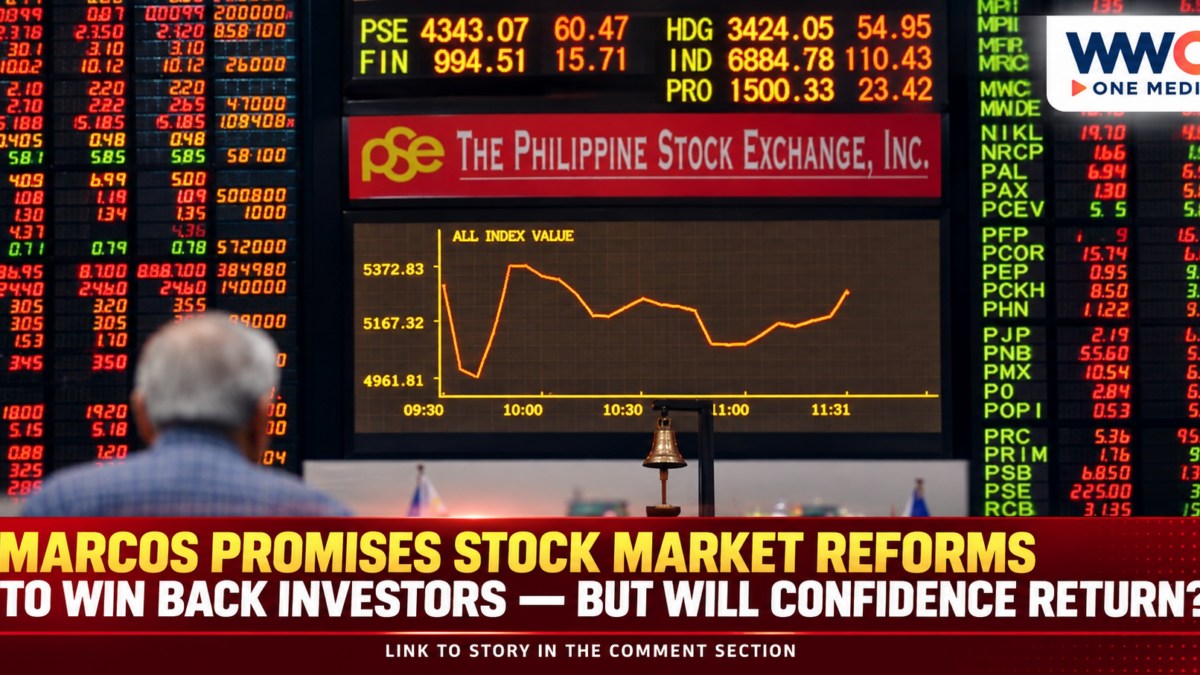
MANILA, Philippines — President Ferdinand “Bongbong” Marcos Jr. is pushing reforms aimed at strengthening investor confidence and improving the Philippine stock market, as the government seeks to attract more capital, expand business opportunities, and make the country more competitive in the regional investment landscape.
The administration’s reform agenda comes as the Philippines works to encourage greater participation in its capital markets, improve the ease of doing business, and address barriers that can discourage companies and individual investors from entering the market.
However, the bigger question remains: Will these reforms be enough to convince more investors to put their money into Philippine stocks and support the country’s long-term economic growth?
Government targets stronger investor confidence
Investor confidence is a crucial factor in the performance of the Philippine stock market. When investors believe that economic policies are predictable, regulations are transparent, and businesses have room to grow, they may be more willing to commit capital to companies operating in the country.
The government has been pursuing measures to improve the investment environment, including regulatory streamlining, investment incentives, and reforms intended to broaden access to the capital market.
In a September 10, 2026, report, the Philippine News Agency said Marcos urged investors to pursue sustained, long-term investments in the country. He highlighted the administration’s commitment to infrastructure, workforce development, stability, and a business environment conducive to investment.
The government has also promoted its Green Lanes initiative, established under Executive Order No. 18 in 2023, to accelerate the approval of strategic investment projects and reduce bureaucratic delays.
According to the Philippine Information Agency, data from the Board of Investments showed that approved capital projects under the initiative reached approximately ₱6.36 trillion by the end of August 2026, including ₱4.46 trillion attributed to Philippine-based enterprises.
These figures represent approved investment projects, however, and should not automatically be interpreted as money already spent or fully realized investments.
SEC reforms aim to make the capital market more accessible
The Securities and Exchange Commission (SEC) has also been pursuing changes intended to deepen the country’s capital market and make it easier for businesses to raise funds.
In an August 24, 2026, report, GMA News Online reported that the SEC was advancing measures covering debt and equity offerings, market making, Personal Equity and Retirement Account (PERA) reforms, and financial literacy.
Market making is particularly important because it can help improve liquidity by supporting the availability of buy and sell quotations for eligible securities. Better liquidity can make it easier for investors to buy or sell shares without encountering substantial trading difficulties.
On October 19, 2026, the Daily Tribune reported on new SEC rules establishing a comprehensive framework for market making in Philippine capital markets. The framework covers equity and fixed-income securities and introduces common requirements for participating firms, including licensing, capital, disclosure, and reporting standards.
The reforms are intended to promote more efficient trading, strengthen market participation, and bring Philippine market practices closer to international standards.
Still, the effectiveness of these measures will depend on implementation, market participation, and the ability of regulators to maintain investor protection.
Lower transaction costs could encourage more Filipinos to invest
One important reform already implemented is the Capital Markets Efficiency Promotion Act, or Republic Act No. 12214.
The law, which took effect in 2025, reduced the stock transaction tax from 0.6% to 0.1% and removed the documentary stamp tax on certain mutual fund and unit investment trust fund transactions.
The changes are designed to lower some of the costs associated with investing and make capital-market products more accessible to ordinary Filipinos.
The Department of Finance and the Presidential Communications Office have presented the law as part of the government’s effort to broaden financial inclusion and strengthen the country’s investment environment.
Lower transaction costs may help, but they do not eliminate the risks of investing. Share prices can still fall, company earnings can disappoint, and economic or political developments can affect market performance.
For first-time investors, financial education and an understanding of investment risks remain essential.
Philippine Stock Exchange seeks more retail investors
The Philippine Stock Exchange (PSE) is also working to increase participation among individual investors.
A July 18, 2026, report by BusinessMirror, citing Bloomberg reporting, said the exchange was preparing measures to attract more retail investors, including a new trading engine, additional exchange-traded fund offerings, and changes intended to make trading more accessible.
The report highlighted a persistent challenge: individual participation in Philippine equity trading remains limited compared with some other Asian markets.
The exchange has also been looking to attract more companies to list their shares, potentially giving investors a wider selection of businesses in which to invest.
More listed companies and broader retail participation could help deepen the market. However, increasing participation alone is not enough; investors also need reliable disclosures, effective safeguards, and confidence that the market operates fairly.
Corruption concerns and economic uncertainty remain challenges
The government’s effort to strengthen investor confidence is taking place against a backdrop of economic and governance concerns.
In January 2026, Bloomberg reported that Philippine economic officials were seeking to shore up investor sentiment following a corruption scandal involving government projects.
The issue matters because investors consider more than tax incentives or regulatory changes when deciding where to allocate their money. They also assess governance, policy consistency, the credibility of public institutions, and the predictability of government decisions.
Other factors—including inflation, currency movements, global interest rates, and geopolitical developments—can influence the Philippine stock market regardless of domestic reforms.
Consequently, restoring confidence requires more than announcements. Investors will be watching whether reforms are implemented consistently and whether the government can demonstrate transparency, accountability, and stable economic management.
What happens next?
For the Philippines, the challenge is to turn reform commitments into measurable improvements in market participation, business investment, and economic opportunities.
A more accessible stock market could give companies additional ways to raise capital while offering Filipinos more opportunities to participate in long-term wealth creation. At the same time, stronger regulation and investor education will be necessary to ensure that market expansion does not come at the expense of investor protection.
Marcos’ investment agenda therefore faces a practical test: Can the government create conditions that encourage investors to stay, businesses to expand, and more Filipinos to participate in the country’s financial markets?
The answer will depend not only on the reforms announced, but also on the results they deliver.
For now, investors and businesses will be watching closely to see whether the administration’s promises translate into a stronger, more liquid, and more trusted Philippine stock market.