
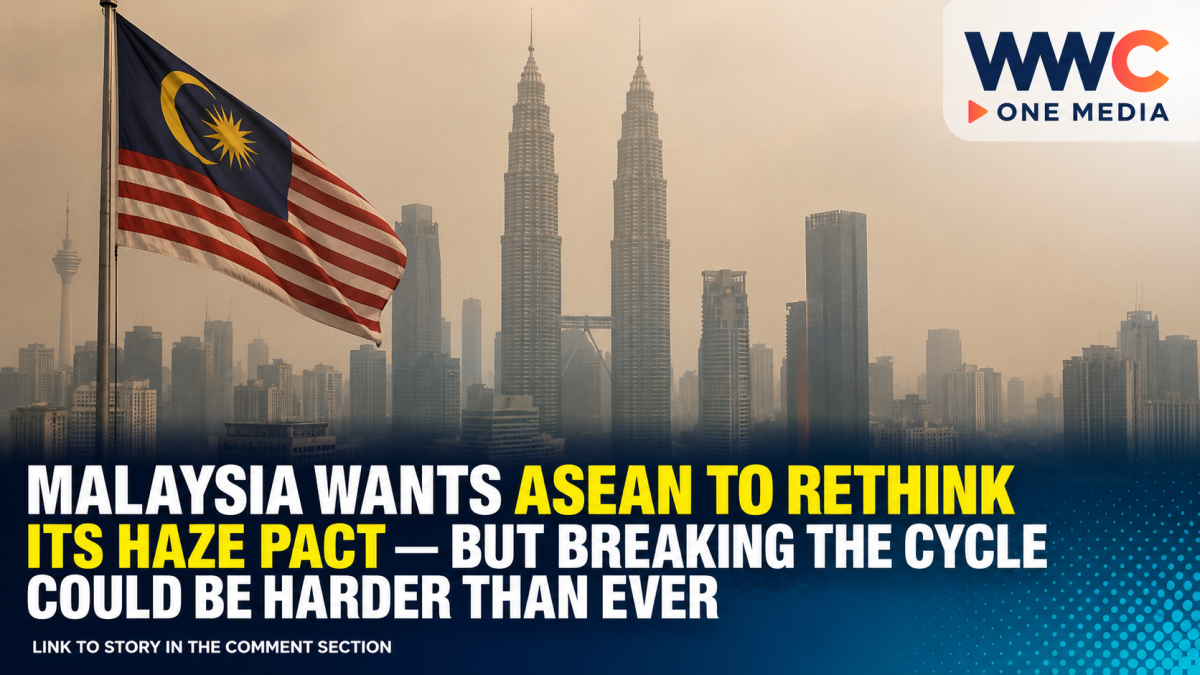
KUALA LUMPUR — Malaysia is pushing ASEAN to take a harder look at its decades-old approach to transboundary haze as thick smoke from fires in Indonesia once again spreads across Southeast Asia, raising concerns over public health, schools, air quality and regional cooperation.
The pressure comes as the region enters another dangerous fire season, with prolonged dry weather and strengthening El Niño conditions increasing the risk that land and forest fires could spiral into a wider haze crisis.
Malaysia has said it will use ASEAN’s diplomatic mechanisms to seek a regional solution, while calls are growing for the ASEAN Agreement on Transboundary Haze Pollution to be reviewed and backed by stronger, measurable and enforceable measures.
A 20-year-old agreement is facing a new test
The ASEAN Agreement on Transboundary Haze Pollution was signed in Kuala Lumpur in 2002 and entered into force in 2003. It was created after the devastating 1997-1998 fires to help ASEAN countries prevent, monitor and respond to land and forest fires that generate cross-border smoke.
The agreement provides for monitoring, prevention, emergency response, information sharing and regional cooperation. All ASEAN member states have now ratified or approved it, with Indonesia becoming the final member to ratify the agreement in 2014.
But more than two decades later, the same problem continues to return whenever severe drought and widespread fires hit Indonesia.
That has prompted Malaysian voices to argue that ASEAN needs to move beyond emergency response and put greater emphasis on prevention, accountability and enforcement.
Social activist Tan Sri Lee Lam Thye recently called for an urgent high-level review of the agreement and a stronger regional action plan with clear targets and enforcement mechanisms.
Malaysia is not walking away from ASEAN
Despite growing frustration, Kuala Lumpur is still relying on ASEAN rather than abandoning the regional framework.
Foreign Minister Datuk Seri Mohamad Hasan said Malaysia would use ASEAN diplomatic channels to address the haze and that the Ministry of Natural Resources and Environmental Sustainability would communicate with the ASEAN Secretariat and its Indonesian counterpart.
Prime Minister Anwar Ibrahim and Brunei’s Sultan Hassanal Bolkiah have also agreed to use the ASEAN mechanism to tackle the recurring problem.
That matters because haze does not respect national borders: fires in one country can quickly become an air-quality emergency in another.
The fires are already getting worse
The ASEAN Specialised Meteorological Centre issued its highest Alert Level 3 for the southern ASEAN region on Aug. 26 after detecting widespread moderate-to-dense smoke from clusters of hotspots in Kalimantan and Sumatra.
Satellite data recorded hundreds of hotspots in Kalimantan and Sumatra on Aug. 24 and 25, while the centre warned that persistent dry conditions combined with strengthening El Niño conditions could further increase the risk of severe transboundary haze.
Malaysia has already experienced the consequences.
CNA reported that parts of Sarawak and the Klang Valley reached unhealthy air-quality levels, with some locations in Sarawak previously reaching the “very unhealthy” category. More than 100 schools in Sarawak were temporarily closed during an earlier period of severe haze, affecting almost 200,000 students.
Malaysia’s Health Ministry also reported sharp increases in upper respiratory tract infections and asthma cases during the worsening haze period, according to CNA.
Indonesia is fighting the fires too
Indonesia, meanwhile, has stepped up its own response.
Reuters reported on Aug. 31 that Indonesian authorities were inspecting 19 companies linked to fires covering more than 11,000 hectares inside concession areas across seven provinces. Officials said investigations would determine whether fires were accidental or deliberately started, while emphasizing that strict liability applies when fires occur within concessions.
Indonesia has also deployed thousands of personnel and dozens of aircraft for firefighting operations.
Reuters reported that nearly 95,000 hectares burned in Indonesia during July as the El Niño pattern intensified. Carbon emissions from the fires also surged, highlighting how quickly the environmental consequences can escalate during a severe fire season.
The Associated Press separately reported that Indonesian authorities detected thousands of hotspots and warned against illegal open burning as smoke spread across Borneo and into neighboring Malaysia.
Malaysia and Indonesia are already cooperating
There is also evidence that the two countries are trying to strengthen cooperation rather than simply trading accusations.
Malaysia and Indonesia have agreed to increase hotspot monitoring, strengthen enforcement against open burning and potentially share airspace and firefighting resources for cloud-seeding operations.
Indonesia subsequently gave Malaysian agencies permission to enter its airspace for cloud-seeding operations aimed at helping combat the haze.
That cooperation could become increasingly important as weather conditions deteriorate.
Why changing the ASEAN system could be difficult
The biggest challenge may not be identifying the problem — it is agreeing on how much authority ASEAN countries are willing to give a regional mechanism.
ASEAN’s haze agreement already provides a framework for countries to exchange information, coordinate emergency responses and deploy assistance. But regional action generally depends heavily on cooperation between sovereign governments.
Critics argue that this makes the system stronger at coordination than at enforcement.
Malaysia’s current push therefore points toward a fundamental question: Should ASEAN continue treating haze primarily as an emergency that countries respond to, or should it build a system designed to prevent fires before they become a regional disaster?
Experts quoted by CNA have argued that the region has enough climate and weather information to prepare months in advance for periods of elevated fire risk. They say governments could use those forecasts to intensify prevention efforts before the dry season reaches its peak.
The deeper problem is bigger than El Niño
El Niño can make the situation worse, but it does not create the underlying problem by itself.
Research and expert commentary cited by CNA point to land-clearing practices, degraded peatlands, economic incentives and weaknesses in enforcement as important factors behind recurring fires.
During extremely dry conditions, fires that might otherwise remain limited can spread rapidly across vulnerable landscapes.
That means firefighting alone cannot permanently solve the haze problem.
Prevention, peatland management, land-use enforcement, corporate accountability and transparent information sharing are all part of the equation.
The next test for ASEAN
Malaysia’s renewed push comes at a critical moment.
The region already has an agreement, monitoring systems and mechanisms for cooperation. What Kuala Lumpur and other advocates are increasingly asking is whether those mechanisms are strong enough to prevent the same crisis from returning year after year.
Malaysia is calling for greater preparedness, earlier intervention, stronger hotspot surveillance and closer regional coordination. Other voices are going further, demanding measurable targets and enforceable accountability.
The difficult question now is whether ASEAN can transform those calls into action before the next wave of smoke arrives.
Because if the regio n simply waits for the skies to clear again, the haze problem may disappear temporarily — only to return with the next dry season.
WWC ONE MEDIA MJE

Leave a Reply