
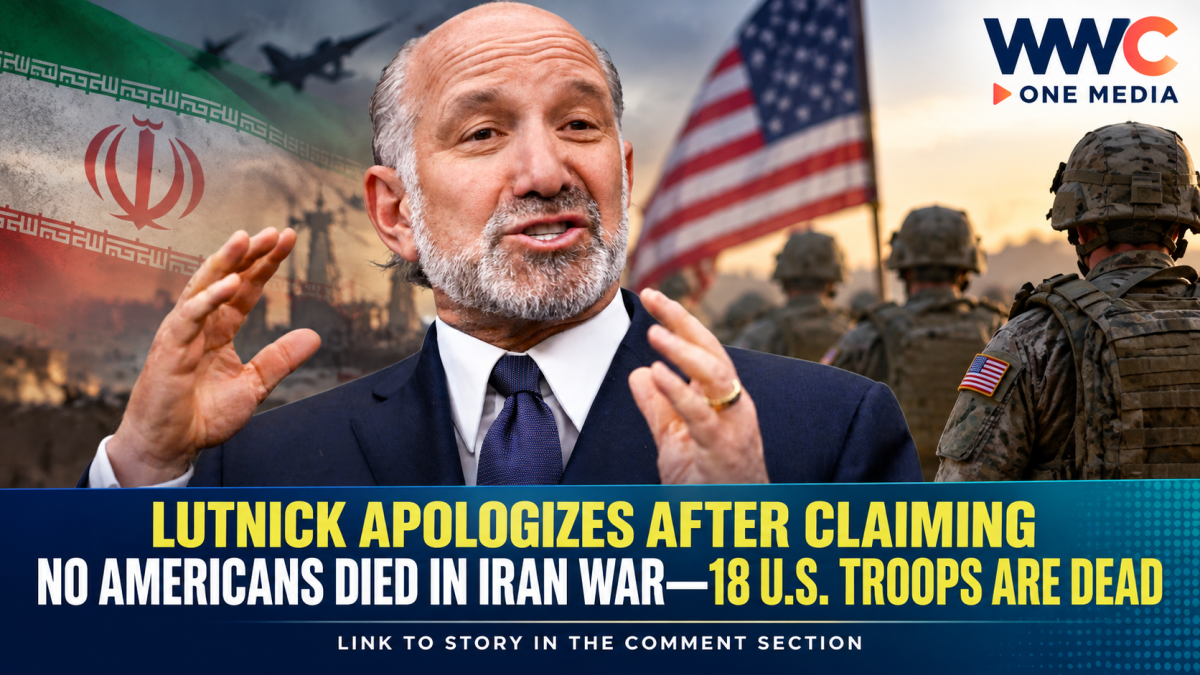
U.S. Commerce Secretary Howard Lutnick has apologized after mistakenly claiming that no Americans had died in the ongoing conflict with Iran—an assertion quickly contradicted by the U.S. military’s reported casualty figures.
Lutnick acknowledged Thursday that 18 U.S. service members have been killed in the conflict and said more than 750 have been wounded. He attributed his earlier statement to confusion with a separate U.S. military operation in Venezuela, where no American service members were killed.
The controversy erupted after Lutnick appeared on CNBC on Wednesday while discussing the Trump administration’s strategy toward Iran.
During the interview, Lutnick characterized the U.S. approach as primarily an economic campaign and incorrectly said there had been no American deaths.
The statement drew immediate attention because the Iran conflict has already resulted in confirmed American military fatalities.
Lutnick admits mistake
In an apology posted Thursday, Lutnick said he had “misspoke” and acknowledged the deaths of 18 U.S. military personnel.
He also expressed sympathy to the families of those killed.
Lutnick explained that he had been thinking about the administration’s military operation in Venezuela when he made the comment. Reuters reported that Venezuela was not discussed during the CNBC exchange in which he made the original statement.
President Donald Trump also addressed the controversy, saying Lutnick had Venezuela on his mind when he made the erroneous claim and explicitly acknowledging that 18 people had been killed in Iran.
The numbers put the mistake in sharper focus
The correction comes as the U.S.-Iran conflict continues into its seventh month.
According to recent reporting, 18 U.S. service members have died and more than 750 have been wounded since the conflict began.
The administration has simultaneously faced scrutiny over how it describes the conflict.
On Friday, Trump defended Vice President JD Vance’s characterization of the fighting as a “military conflict” rather than a war, calling it “small potatoes” and saying the U.S. military engagement was not a major conflict from America’s perspective.
The comments came despite the reported U.S. military deaths and the substantial financial cost of the operation, which the Associated Press reported has exceeded $37.5 billion.
Conflict continues despite efforts to contain escalation
The controversy surrounding Lutnick’s remarks comes against a backdrop of renewed fighting and uncertainty over the future of the conflict.
Recent U.S. strikes and Iranian retaliation have continued to threaten regional stability, while the strategically important Strait of Hormuz remains a major concern for energy markets and global shipping.
Reuters reported that oil prices climbed to six-week highs amid renewed tensions, with Brent crude reaching about $97 a barrel and U.S. crude rising above $93 a barrel on September 3.
The economic consequences have added another layer of pressure on the Trump administration, particularly as Washington continues to emphasize sanctions and economic measures against Tehran.
A damaging slip at a politically sensitive moment
Lutnick’s error comes at a particularly sensitive point for the administration.
The White House has sought to emphasize the economic pressure being placed on Iran while simultaneously defending continued military operations.
At the same time, public opinion toward the conflict appears to be deteriorating. A recent Reuters/Ipsos poll found that only 25% of Americans surveyed believed the Iran war was worthwhile, highlighting the political challenge facing the administration as the November midterm elections approach.
The episode has therefore become more than a simple verbal mistake: it has renewed questions about how the administration communicates the human cost of the conflict.
For Lutnick, the correction was unequivocal. But with 18 American service members already dead and hundreds more wounded, his initial claim that there had been no American deaths has placed renewed attention on the toll of a conflict Washington continues to describe in increasingly careful terms.
The question now is whether the administration’s changing language about the conflict can keep pace with the mounting costs on the ground.
WWC ONE MEDIA J.M.S




Leave a Reply