
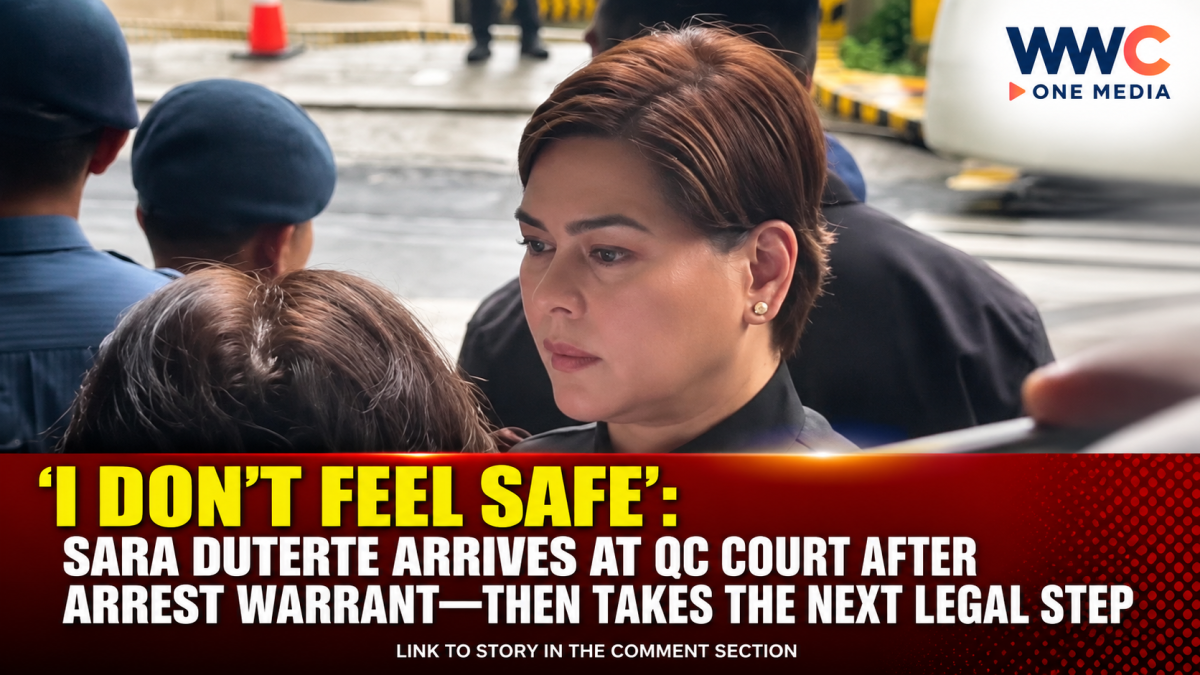
MANILA, Philippines — Vice President Sara Duterte arrived at the Quezon City Hall of Justice on Saturday, September 5, saying she feared for her life and the safety of her children a day after a court issued an arrest warrant against her over three counts of grave threats.
Duterte told reporters that she had documented threats and harassment against her since 2023 and said she did not feel safe even as she appeared before the court to address the warrant.
“I fear for my children. I do not feel they are safe if I am with them,” Duterte said in a statement released by her office.
She also said in Filipino that she had already left the location where her children were staying to go to court, but police still went there.
“I do not feel safe. Pakiramdam ko papatayin nila ako,” Duterte said, expressing her belief that someone might kill her.
From arrest warrant to court appearance
Duterte’s appearance came less than 24 hours after the Quezon City Regional Trial Court Branch 98 issued a warrant for her arrest.
The court found probable cause to hold Duterte for trial on three counts of grave threats. The warrant was issued after the court rejected her camp’s efforts to defer or recall the warrant and challenge the criminal case on jurisdictional grounds.
The court set bail at P120,000 for each count, or P360,000 for all three charges.
By Saturday, Duterte had appeared at the QC Hall of Justice and posted bail. Her lawyer Michael Poa said she was considered surrendered to authorities as she went through the process required to post bail.
The development means Duterte will remain able to fight the criminal charges outside detention while the case proceeds.
What triggered the case?
The criminal case traces back to Duterte’s online press briefing on November 23, 2024.
During that briefing, she said she had instructed another person to kill President Ferdinand Marcos Jr., First Lady Liza Araneta Marcos and then-House Speaker Martin Romualdez if she herself were killed.
Duterte later maintained that her remarks had been taken out of context and denied that she had actually threatened the three officials.
The Department of Justice subsequently pursued three counts of grave threats against the Vice President under the applicable cybercrime-related provisions.
The QC court’s decision does not mean Duterte has been found guilty. As lawmakers and her defense team have emphasized, an arrest warrant based on probable cause is part of the criminal process and does not constitute a conviction.
Security tightens at QC Hall of Justice
The legal confrontation unfolded amid heightened security at the Quezon City court.
The Quezon City Police District had deployed additional personnel to the Hall of Justice following the issuance of the warrant. Police officials said the deployment was for security purposes after the court’s building security requested additional assistance—not specifically to arrest Duterte at the premises.
Duterte nevertheless expressed unease about the presence of police and security personnel when she arrived.
Her lawyers, including Paul Lawrence Lim and Michael Poa, accompanied her as she prepared to comply with the court process.
Lim had earlier said Duterte had no intention of evading the law and would pursue all legal remedies available to her.
Criminal case runs alongside impeachment proceedings
The arrest warrant comes at a particularly consequential moment for Duterte, who is also facing an impeachment trial before the Senate.
The alleged threats against Marcos, Liza Marcos and Romualdez form part of the allegations raised against the Vice President in the impeachment proceedings.
However, the criminal case before the QC RTC and the Senate impeachment proceedings are legally distinct processes. House impeachment prosecution spokespersons have stressed that the warrant is not itself a determination of guilt, while the DOJ maintains that the criminal case can proceed independently.
The Duterte camp, meanwhile, has challenged whether criminal proceedings should proceed while she remains a sitting impeachable official. The DOJ has rejected that position, arguing that presidential immunity does not extend to the Vice President in the same manner.
The next legal battle
With bail posted, the immediate prospect of Duterte being detained over the warrant has been averted, but the underlying criminal case remains unresolved.
Her legal team is expected to continue challenging the prosecution’s case and pursuing available remedies while the proceedings move forward.
For Duterte, the latest development represents another major legal and political test—one unfolding simultaneously in the courts and before the Senate impeachment tribunal.
For the government, the case is being presented as a matter of enforcing the rule of law.
And for the Vice President, the message she delivered outside the QC Hall of Justice was unmistakably personal: she says she fears for her own life and, more significantly, for the safety of her children.
The court battle is far from over.
WWC ONE MEDIA J.M.S



Leave a Reply