
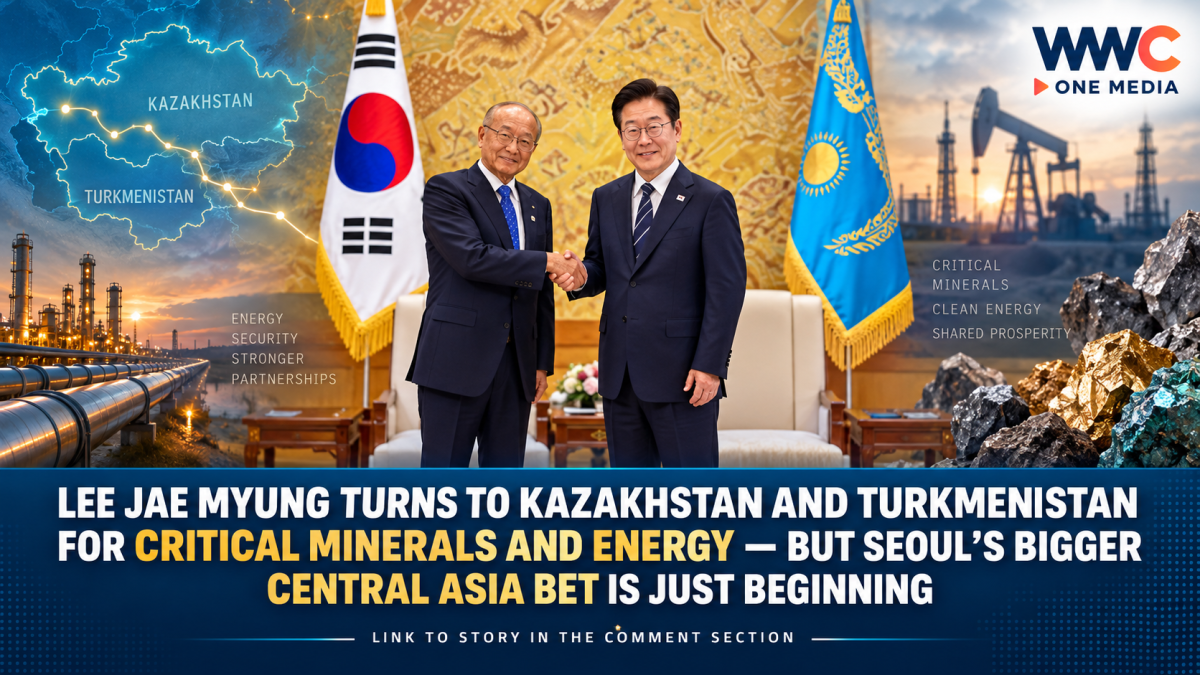
SEOUL — South Korean President Lee Jae Myung is turning his attention to two of Central Asia’s most resource-rich states as Seoul accelerates a diplomatic push designed to secure much more than friendly relations.
Energy, uranium, lithium, rare earths, artificial intelligence, industrial infrastructure and alternative supply chains are increasingly sitting at the center of the conversation.
Lee was scheduled Tuesday to hold separate summits with Turkmen President Serdar Berdimuhamedow and Kazakh President Kassym-Jomart Tokayev, one day before South Korea hosts all five Central Asian leaders for their first-ever multilateral summit in Seoul.
And while the ceremonial program includes state luncheons, gifts and the exchange of memorandums of understanding, the strategic stakes are much larger.
South Korea is a manufacturing powerhouse with relatively few domestic natural resources.
Central Asia has many of the minerals and energy resources Korean industries increasingly need.
The relationship is almost tailor-made.
Turkmenistan brings gas. Kazakhstan brings minerals.
The two Tuesday meetings offer different—but highly complementary—opportunities for Seoul.
Turkmenistan possesses enormous natural-gas resources and has long attracted Korean engineering and construction companies seeking major petrochemical and energy projects.
Kazakhstan, meanwhile, is a major producer of oil and uranium and possesses significant deposits of chromium, titanium, copper, zinc and other minerals essential to advanced manufacturing.
That means Lee is not simply hosting two foreign leaders as part of a diplomatic calendar.
He is meeting countries capable of contributing directly to South Korea’s energy security and the raw-material supply chains underpinning everything from semiconductors to electric vehicles and batteries.
Korea Herald says 13 agreements are planned with each side
According to the Korea Herald’s report, Lee’s first meeting Tuesday was scheduled with Berdimuhamedow.
The two sides planned to discuss practical bilateral cooperation and wider regional and international issues.
A ceremony involving the exchange of 13 agreements and memorandums of understanding was scheduled to follow.
Lee was then set to meet Tokayev.
That conversation was expected to cover a notably broad range of areas:
economy and trade, energy, critical minerals, artificial intelligence, science and technology, cultural exchanges and people-to-people ties.
South Korea and Kazakhstan also planned to elevate their relationship to a future-oriented comprehensive strategic partnership, according to the presidential office.
Another 13 bilateral MOUs were expected to be exchanged.
The wording matters: those were planned exchanges at the time of the Korea Herald report. Until the signing ceremonies and final texts are officially confirmed, they should not be written as completed agreements.
Kazakhstan may be the bigger long-term prize for Korea’s technology industries
Kazakhstan is particularly attractive to Seoul because its mineral endowment aligns remarkably closely with the needs of South Korean manufacturers.
The country has substantial uranium, chromium, titanium and rare-earth resources.
It is also seeking investment in lithium, copper, zinc and other materials needed in batteries, electronics and clean-energy technologies.
But Kazakhstan is making clear that it does not simply want to dig minerals out of the ground and ship them abroad.
Kazakh Foreign Minister Mukhtar Tileuberdi told Yonhap ahead of the summit that Astana wants greater cooperation in processing and higher-value manufacturing, including integration into Korean battery, electronics and advanced industrial supply chains.
That makes the relationship more interesting than a conventional buyer-seller arrangement.
Kazakhstan wants technology and industrial investment.
Korea wants reliable mineral supplies.
If both sides get what they want, raw materials could increasingly be processed or developed inside Kazakhstan before entering Korean industrial chains.
The two countries already signed a major minerals framework in 2024
Seoul is not beginning this relationship from scratch.
During a 2024 summit, South Korea and Kazakhstan signed a critical-minerals supply-chain partnership covering exploration, development, refining and commercialization.
The framework was intended to give Korean companies opportunities to participate in projects involving lithium, chromium, uranium and rare earths.
Other agreements included cooperation on lithium exploration and technologies for commercializing rare metals.
The logic behind those agreements has only become stronger.
South Korea’s biggest industrial champions—from semiconductor manufacturers to automakers and battery companies—depend on globally sourced raw materials.
Disruptions caused by geopolitical conflict, trade restrictions or export controls can therefore become a direct threat to Korean factories.
Diversification is increasingly an economic-security policy rather than merely a procurement strategy.
Korea researchers have already found lithium in Kazakhstan
There is also something more concrete beneath the diplomatic language.
The Korea Institute of Geoscience and Mineral Resources said in 2024 that its researchers had identified a lithium deposit in eastern Kazakhstan while investigating a former tantalum-producing region.
The institute said it planned to pursue further development work.
That gives South Korea’s mineral cooperation with Kazakhstan an unusually practical dimension.
Officials are not talking only about hypothetical future mines.
Korean organizations have already been participating in geological exploration.
Bilateral trade is already measured in billions
Kazakhstan government data put bilateral trade with South Korea at about US$3.17 billion in 2025.
During the first six months of 2026, trade amounted to approximately US$1.3 billion, while Kazakhstan said its exports to Korea increased 17.2%.
The trade structure also shows the complementarity between the economies.
UN Comtrade-based figures indicate that Korean exports to Kazakhstan are dominated by vehicles, machinery and electronics, while Korean imports from Kazakhstan include energy and industrial raw materials.
Kazakhstan therefore offers Seoul more than mineral deposits.
It is already a meaningful market for Korean manufactured goods.
And Kazakhstan wants Korea’s AI expertise too
Minerals may produce the easiest headline, but Tokayev’s government is increasingly interested in moving the relationship into technology.
Kazakh officials say they want cooperation in artificial intelligence, data infrastructure and high-tech manufacturing, rather than allowing the relationship to remain concentrated on Korean automobiles and raw materials.
That aligns closely with Lee’s domestic economic agenda.
South Korea is pushing massive investments in AI infrastructure, semiconductors and advanced manufacturing.
Central Asian governments, meanwhile, increasingly want access to Korean technology and investment as they attempt to modernize their economies.
That creates another potentially useful trade:
Central Asian resources for Korean technology and capital.
Turkmenistan offers a very different opportunity
If Kazakhstan is the minerals-heavy relationship, Turkmenistan is much more closely linked to energy and large-scale engineering projects.
In 2024, Korean companies secured or pursued agreements associated with Turkmenistan’s massive Galkynysh gas field, petrochemical facilities and fertilizer projects.
Hyundai Engineering signed a framework agreement connected to another desulfurization facility at Galkynysh and also explored work to restore operations at the Kiyanly Polymer Plant.
South Korean officials said the broader package of proposed projects could potentially generate around US$6 billion in orders for Korean companies.
That does not mean US$6 billion in guaranteed contracts ultimately materialized.
It was an estimate of the potential project pipeline.
But it demonstrates why Turkmenistan matters to Korean engineering and construction companies.
There is also a geopolitical energy angle
Turkmenistan sits directly north of Iran and possesses some of the world’s largest natural-gas reserves.
Its geographic position has become particularly relevant during the current Middle East instability.
Earlier this year, Berdimuhamedow’s government helped South Korean nationals leave Iran by allowing them to cross into Turkmenistan and facilitating immigration procedures.
Lee later sent the Turkmen leader a letter thanking his government for helping 25 South Korean citizens and four Iranian family members evacuate safely.
That episode added a practical security dimension to a relationship traditionally dominated by infrastructure and energy.
It also explains why discussions between Lee and Berdimuhamedow may extend beyond commercial deals into wider regional issues.
Korea is trying to connect all five countries into one supply-chain strategy
The bigger story, however, is not Kazakhstan or Turkmenistan individually.
It is what Seoul is attempting to build around the entire Central Asian region.
On Monday, industry ministers from Kazakhstan, Kyrgyzstan, Tajikistan, Turkmenistan, Uzbekistan and South Korea met in Seoul ahead of the leaders’ summit.
They agreed to deepen cooperation across critical-mineral supply chains and encourage Korean participation in industrial complexes, plant modernization and smart-infrastructure projects.
The central idea is straightforward:
Central Asia has raw materials.
South Korea has strong refining, manufacturing, engineering and technology capabilities.
The governments want to connect those strengths across the entire chain—from extraction and processing to advanced manufacturing.
Uzbekistan offered a preview of where Lee wants this to go
Lee began his Central Asia summit diplomacy Monday with Uzbek President Shavkat Mirziyoyev.
That meeting gives the clearest preview of what South Korea is trying to achieve with the broader region.
The two countries exchanged 13 agreements and MOUs covering areas including critical minerals, transportation, tourism, agriculture and industrial cooperation.
One agreement involving the Export-Import Bank of Korea aims to identify projects in six strategic Uzbek sectors:
critical minerals,
AI and data centers,
smart cities,
an industrial complex for Korean companies,
pharmaceuticals and biotechnology,
and food, beauty and cultural content.
The two governments also discussed high-speed trains, digital transformation, defense and infrastructure.
In other words, minerals may open the door.
Seoul wants the relationship to become far broader.
Why Central Asia suddenly matters so much
Central Asia has always had strategic geography.
It sits between China, Russia, the Middle East and Europe.
What has changed is how aggressively outside powers are competing—or cooperating—to build relationships there.
Central Asian governments have increasingly expanded diplomatic formats with China, the United States, the European Union, Japan and other partners, while trying to avoid excessive reliance on any single outside power.
The United States hosted all five Central Asian leaders at the White House in November 2025 under the C5+1 framework.
China has simultaneously deepened trade, investment and energy links across the region.
The European Union has also elevated its Central Asia engagement to leader level.
South Korea is therefore entering a region that is anything but diplomatically neglected.
But it possesses some advantages of its own.
Seoul’s pitch is different from Russia’s, China’s or America’s
South Korea is not geographically adjacent to Central Asia.
It has no military alliance network there.
And it cannot match China’s sheer economic scale.
What it can offer is a combination many Central Asian governments find attractive:
advanced manufacturing,
infrastructure expertise,
semiconductor and battery technology,
AI know-how,
healthcare,
education,
consumer brands,
and investment without the baggage of being one of the region’s traditional great powers.
That does not guarantee Seoul preferential access to resources.
But it can make Korea a useful diversification partner.
There is also a deep Korean connection most people overlook
The relationship is not purely commercial.
Central Asia is home to significant communities of Koryoin, ethnic Koreans whose families were deported from the Russian Far East to Soviet Central Asia in 1937.
Uzbekistan alone is home to a large Korean diaspora.
During Monday’s summit with Mirziyoyev, Lee specifically highlighted those historical ties and thanked Uzbekistan for embracing the Korean community.
The Seoul government plans to expand cultural, educational and youth exchanges as the region approaches the 90th anniversary of those settlements in 2027.
That gives Korea’s Central Asia strategy a cultural connection that many other external powers cannot easily replicate.
Wednesday is the real centerpiece
The bilateral meetings are effectively the opening act.
On September 16, Lee is scheduled to host the presidents of:
Kazakhstan, Uzbekistan, Turkmenistan, Tajikistan and Kyrgyzstan
at the inaugural Korea–Central Asia Summit in Seoul.
The gathering will elevate a relationship that has largely operated through the Korea–Central Asia Cooperation Forum at ministerial level since 2007 into a regular leader-level framework.
The summit theme centers on innovation, prosperity and connectivity.
And one document could matter more than all the ceremonial photographs.
The Seoul Declaration could turn a one-off meeting into a permanent framework
The six countries plan to adopt a Seoul Declaration setting out a medium- to long-term framework for cooperation.
The priorities are expected to include critical minerals, energy, global supply chains, artificial intelligence, science and technology, climate change, infrastructure and people-to-people exchanges.
Seoul also wants cooperation on customs, regulation and intellectual property to make it easier for Korean companies to enter Central Asian markets.
After the political summit, the leaders are expected to participate in a Korea–Central Asia Business Summit involving roughly 500 government and business representatives.
That business meeting may ultimately reveal whether the political declarations produce investable projects.
South Korea has another powerful reason to diversify: supply-chain vulnerability
Korea’s economy thrives on international trade.
That is also one of its biggest vulnerabilities.
It imports much of its energy.
Its chip, battery and vehicle industries rely heavily on externally sourced minerals and components.
And recent years have demonstrated how quickly wars, tariffs, export restrictions and geopolitical rivalries can disrupt ordinary supply chains.
That makes alternative sources of uranium, lithium, rare earths, copper and energy strategically valuable even when they are not necessarily the cheapest available option.
Kazakhstan and the rest of Central Asia offer Seoul a potential hedge.
Not a replacement for existing suppliers.
A hedge against depending too heavily on them.
But signing MOUs is the easy part
This is where the diplomatic excitement needs some restraint.
South Korea and Central Asian states have signed many cooperation documents over the years.
An MOU does not automatically become a mine, a processing plant or a long-term supply contract.
Projects involving critical minerals face difficult economics.
Exploration can take years.
New mines require large amounts of capital.
Transport routes from landlocked Central Asia can be complicated.
Processing capacity is expensive.
Commodity prices can change before a project reaches production.
And Central Asian governments increasingly want more local processing and value-added production rather than simply exporting raw resources.
The real measure of Lee’s summit diplomacy will therefore come later:
How many of these agreements become commercially viable projects?
That is especially important for critical minerals
A country can possess enormous mineral resources without becoming a major supplier.
The material has to be identified.
Deposits must be commercially viable.
Permits must be obtained.
Infrastructure has to be constructed.
Ore has to be processed to industrial standards.
And buyers need secure transportation routes to get it home.
Kazakhstan’s desire to build domestic processing industries could be highly beneficial for both sides—but it also makes cooperation more complex than simply signing an extraction contract.
Seoul will need to bring financing, engineering and long-term purchase commitments if it wants Central Asian mineral partnerships to become serious alternatives in its supply chain.
The gifts may grab attention, but the resources are the real story
Tuesday’s bilateral program included carefully selected diplomatic gifts.
Lee planned to give Berdimuhamedow, known for horseback riding, artwork depicting a hunting scene from Korea’s ancient Goguryeo kingdom.
Tokayev, who is fond of table tennis, was set to receive a table-tennis racket as well as a taekwondo uniform ahead of Kazakhstan hosting the World Taekwondo Championships next year.
Those details are designed to personalize diplomacy.
But neither gift explains why five Central Asian presidents have traveled to Seoul simultaneously.
The answer is increasingly found underground.
Gas.
Uranium.
Lithium.
Copper.
Chromium.
Rare earths.
And above ground, there is another asset:
a region positioned directly across the Eurasian transport map at a moment when every major trading economy is reconsidering where its supplies come from.
Lee’s Central Asia week is therefore about much more than diplomacy
Seoul’s immediate goals are easy enough to identify.
Help Korean companies win infrastructure and industrial contracts.
Secure access to more diverse sources of energy and strategic minerals.
Expand AI and technology exports.
Build transportation and business links.
And institutionalize relations with five countries that are themselves trying to diversify their international partnerships.
The harder question is whether South Korea can convert its technology advantage into enough commercial projects to compete for attention in a region already courted aggressively by much larger powers.
That is what makes the Tokayev and Berdimuhamedow meetings more consequential than two ordinary bilateral summits.
For Kazakhstan and Turkmenistan, Korea offers capital, technology and industrial expertise.
For South Korea, they offer something its high-tech economy can never manufacture domestically in sufficient quantities:
the raw materials underneath it.
And if the agreements signed in Seoul turn into mines, processing plants, energy projects and long-term supply contracts, Lee’s first Central Asia summit may eventually be remembered less for the diplomatic ceremony than for what it did to Korea’s supply chains.
Leave a Reply