
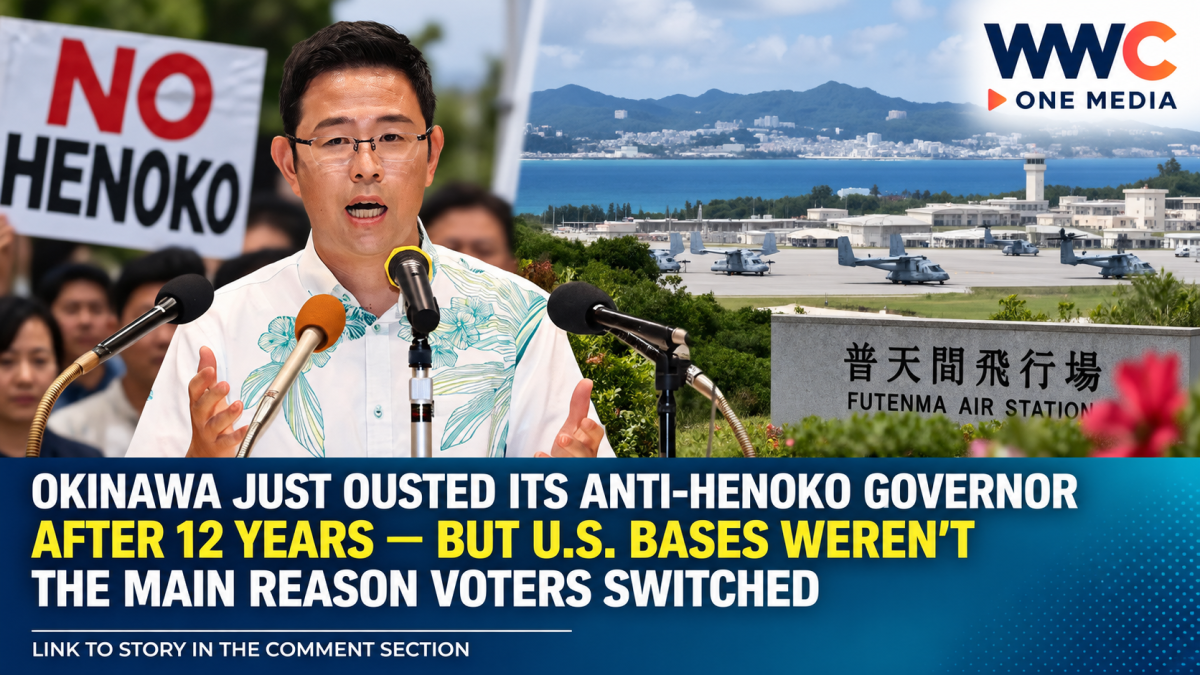
NAHA, Okinawa — For 12 years, one of Japan’s most strategically important prefectures was governed by leaders willing to fight Tokyo over the concentration of U.S. military bases on their islands.
That era has ended.
Genta Koja, a 42-year-old former Naha deputy mayor backed by Prime Minister Sanae Takaichi’s Liberal Democratic Party and a broad conservative coalition, decisively defeated two-term Governor Denny Tamaki in Okinawa’s September 13 gubernatorial election.
Koja received 423,124 votes, against 276,060 for Tamaki, according to final results. Turnout reached 61.57%, up from 57.92% in the previous gubernatorial election. Koja’s total was reported as the highest number of votes ever received by an Okinawa gubernatorial candidate since the prefecture returned to Japanese administration in 1972.
That sounds at first like an unmistakable referendum on the U.S. military.
It was not.
The data coming out of Okinawa tell a much more interesting story.
Voters were worried more about their wallets than about Henoko.
And that may be precisely why an election that looked like another chapter in Okinawa’s decades-old base dispute ended up producing the biggest political shift the prefecture has seen in years.
Nearly half of voters said the economy mattered most
A Kyodo News exit poll asked voters which issue mattered most when choosing their candidate.
49.5% answered economic revitalization.
Only 20.9% identified the U.S. base issue as their top priority.
And among voters who said economic revitalization mattered most, an overwhelming 78.7% supported Koja.
Among those who prioritized the base issue, 72.9% voted for Tamaki.
That is probably the single most important set of numbers for understanding why Tamaki lost.
Okinawa did not simply hold another election about whether residents like or dislike U.S. bases.
Instead, many voters appear to have concluded that inflation, wages, employment, tourism and household finances deserved more attention than another round of confrontation with Tokyo.
The Japan Times itself described the local economy—particularly high consumer prices—as the deciding issue in Koja’s victory.
Another exit poll found an even smaller focus on bases
A Yomiuri Shimbun exit poll produced a similar picture using somewhat different categories.
The largest group, 20%, said economic conditions and measures against rising prices were their priority.
Another 16% chose education and child-rearing support, while 15% selected improving prefectural income.
Only 14% identified the military-base issue as their top concern.
That was roughly half the share recorded in the newspaper’s previous gubernatorial-election survey.
The precise percentages differ because the polls used different questions and categories.
But the conclusion is consistent:
Okinawa’s election agenda shifted heavily toward everyday economic concerns.
That was exactly the territory on which Koja had built his campaign.
Koja’s first message after winning was not about Henoko
That alone is revealing.
After his victory became clear, Koja did not make the U.S. base relocation the centerpiece of his first message to voters.
He promised to improve residents’ lives, strengthen Okinawa’s economy and expand support for families raising children.
“I will work to improve people’s lives, shore up the local economy and enhance support for child-rearing families,” he told reporters Monday.
Koja portrayed the election as a choice for administrative renewal and said he wanted to “move Okinawa forward.”
That language fits the electorate revealed by the exit polls.
Even in a prefecture whose modern political identity has been shaped profoundly by the U.S. military presence, household economics proved capable of pushing security disputes into the background.
Koja even won voters who backed Tamaki four years ago
The coalition shift went deeper than mobilizing conservative voters.
Kyodo’s exit poll found that Koja captured 30.8% of people who said they had voted for Tamaki in the 2022 gubernatorial election.
That is a major warning sign for the political movement that supported Tamaki.
A candidate does not win by almost 150,000 votes simply by turning out his existing side more efficiently.
Koja persuaded a meaningful number of former Tamaki voters to switch.
He also dominated among younger residents.
The Kyodo survey found Koja ahead among every age group in their 60s or younger and taking more than 70% among voters in their teens through 30s.
Another exit poll found his support among 18- to 39-year-olds was more than three times Tamaki’s.
That could have consequences well beyond one election.
For decades, Tokyo has often treated strong Okinawan resistance to military-base policy as almost a structural feature of island politics.
A younger generation voting primarily on wages, prices and economic prospects could gradually change that equation.
But there was another striking number: Henoko actually won majority support in one exit poll
This cannot be ignored either.
Kyodo asked respondents directly whether they supported relocating U.S. Marine Corps Air Station Futenma from densely populated Ginowan to the Henoko coastal district of Nago, also within Okinawa.
50.2% said they supported the relocation.
43.8% opposed it.
That is politically significant.
It suggests Koja’s victory cannot be explained exclusively as voters reluctantly ignoring an unpopular base policy because the economy mattered more.
At least in that exit poll, a narrow majority also accepted Henoko.
That represents an extraordinary change compared with the atmosphere surrounding the project only several years ago.
In 2019, more than 70% voted against Henoko reclamation
Okinawa held a prefecture-wide referendum in February 2019 specifically on land reclamation for the Henoko facility.
The result was overwhelming.
434,273 people, or 71.7% of valid votes, opposed the reclamation.
Only 19% supported it.
Turnout was 52.48%.
That 2019 referendum and the 2026 exit poll are not directly comparable surveys.
The referendum was a formal vote on a single issue.
The 2026 result comes from an exit poll conducted after a multi-issue gubernatorial election.
Different questions, samples and political circumstances matter.
Still, the contrast is impossible to miss.
Okinawan politics around Henoko no longer looks exactly as it did seven years ago.
Does that mean Okinawa has suddenly become pro-base?
No.
That would be an oversimplification.
The same 2026 exit poll still found 43.8% opposition to the Henoko move—an enormous minority.
And the underlying burden that has driven Okinawan resentment for decades has not disappeared.
Okinawa accounts for only about 0.6% of Japan’s national land area, yet roughly 70% of the land used exclusively by U.S. forces in Japan is concentrated there.
U.S.-exclusive facilities occupy around 8% of the prefecture overall and about 14% to 15% of Okinawa’s main island.
The islands have also dealt with aircraft noise, environmental concerns, accidents and crimes involving U.S. personnel.
That history cannot be erased by one gubernatorial result.
A more careful interpretation is that many residents may now differentiate between wanting Okinawa’s overall military burden reduced and accepting Henoko as the most realistic way to close Futenma.
Koja’s own position largely reflects that distinction.
Koja does not campaign as someone who wants more bases for the sake of more bases
The new governor-elect accepts the Henoko relocation as a “realistic solution” to eliminating the dangers of the Futenma air station.
That is not identical to saying Okinawa should simply accept unlimited additional military infrastructure.
His campaign position acknowledged the need for deterrence while arguing that security policy should be dealt with pragmatically rather than through endless confrontation with Tokyo.
After winning, Koja also demanded greater clarity about when Futenma itself will actually be returned.
“I would like to ask the return date to be clarified as soon as possible,” he said Monday.
That may become one of his most difficult balancing acts.
Koja now has political incentive to cooperate with Tokyo.
But he also has to prove that cooperation delivers something tangible for Okinawans.
Futenma was supposed to be returned decades ago
The Futenma dispute did not begin recently.
Japan and the United States agreed in 1996 to close and return Marine Corps Air Station Futenma, which sits in the densely populated city of Ginowan.
The agreement emerged amid intense Okinawan anger following the 1995 rape of a 12-year-old girl by three U.S. servicemen.
Tokyo and Washington eventually settled on Henoko, near Camp Schwab in northern Okinawa, as the replacement location.
Yet three decades later, Futenma remains open.
The Japanese government continues to describe Henoko as the “only viable solution” for removing the danger posed by an air station surrounded by homes, schools and urban development.
Opponents argue that replacing one U.S. facility in Okinawa with another does not fundamentally solve the prefecture’s disproportionate military burden.
That argument powered the political movement that controlled Okinawa’s governorship for 12 years.
Tamaki inherited that movement
Tamaki was elected governor in 2018 following the death of Takeshi Onaga, another outspoken opponent of Henoko.
He won reelection in 2022.
Together, their administrations became the political face of Okinawa’s resistance to Tokyo’s relocation project.
The prefectural government pursued administrative and legal strategies to delay or block construction, arguing that local democratic opposition and environmental concerns were being overridden.
But courts repeatedly limited Okinawa’s ability to stop the central government.
That increasingly raised a difficult question for voters:
What was continued confrontation actually achieving?
By 2026, even Japan Times reporting before the election noted that the Henoko debate had begun fading into the background while candidates emphasized economic policy and relations with the central government.
Henoko construction is already far advanced
That political reality may have contributed to changing voter attitudes.
The project is no longer theoretical.
Japan’s Defense Ministry has continued reclamation work despite Okinawan opposition.
In June, authorities began pouring earth and sand into another section of Oura Bay.
Reclamation on the southern side of Cape Henoko is nearly complete.
The eastern side is much more difficult because of exceptionally soft seabed conditions.
The project requires large-scale ground improvement, including roughly 71,000 sand piles, according to current planning.
That engineering challenge has contributed to years of delay and escalating controversy.
But the central government has shown little sign that it intends to abandon the project.
For some voters, that may have made opposition feel increasingly symbolic rather than capable of reversing construction.
Tokyo immediately made clear the project will continue
Following Koja’s victory, the central government wasted little time.
Chief Cabinet Secretary Minoru Kihara reiterated Monday that moving Futenma to Henoko remained the “only viable solution.”
He said Tokyo would continue working to reduce Okinawa’s military-base burden while strengthening defense in Japan’s southwestern region.
Prime Minister Sanae Takaichi also said she intended to work closely with the new governor and strengthen Okinawa’s economy.
That combination—economic support plus security cooperation—is exactly what Koja campaigned on.
Instead of treating Tokyo as Okinawa’s political adversary, he argues that a better relationship can unlock investment, development and policy cooperation.
That may be why Takaichi’s party wanted this race so badly
The Liberal Democratic Party invested heavily in Koja’s campaign.
Senior party officials repeatedly traveled to Okinawa, and the LDP publicly pledged to help realize his policy program.
Koja’s coalition was unusually broad.
Along with the LDP, he received support from the Japan Innovation Party, Democratic Party for the People, Sanseito, the Conservative Party of Japan and Komeito’s Okinawa organization.
Tamaki was supported by opposition forces including the Constitutional Democratic Party, Japanese Communist Party and Social Democratic Party.
The result therefore also gave Takaichi a significant national political victory.
And the timing could hardly be more useful to her government.
Okinawa sits at the center of Japan’s military transformation
Japan is undertaking its biggest defense buildup since World War II.
Okinawa and the neighboring southwestern islands sit directly on the front line of that strategy.
The island chain stretches southwest toward Taiwan.
Yonaguni, Japan’s westernmost inhabited island, lies only around 110 kilometers east of Taiwan.
Japan has deployed missile and electronic-warfare units across its southwestern islands and expanded ammunition-storage capacity as concerns have grown over China’s military modernization and pressure around Taiwan.
Takaichi’s government is preparing another national security strategy expected to accelerate that buildup.
Okinawa’s governor cannot dictate national defense policy.
But a cooperative prefectural government can make implementation politically and administratively easier.
Civilian airports and ports could become the next major argument
Henoko may get most international headlines.
But the future use of Okinawa’s civilian infrastructure could become just as important.
Japan has been developing plans to improve civilian airports and ports so that they can also be used by the Self-Defense Forces or allied militaries during emergencies.
University of the Ryukyus professor emeritus Masaaki Gabe told Reuters that Koja could be more willing than Tamaki to approve designations that make civilian facilities available for military use.
That could give Tokyo much greater flexibility in a Taiwan-related contingency or another regional crisis.
It could also create a new source of friction inside Okinawa.
A governor willing to cooperate on Henoko does not automatically have unlimited political room to approve every defense initiative.
The election does not erase the island’s traumatic history
Okinawa’s relationship with military power is inseparable from World War II.
The Battle of Okinawa in 1945 devastated the islands and killed enormous numbers of civilians.
After the war, Okinawa remained under direct U.S. administration until 1972, decades longer than mainland Japan’s occupation.
American bases expanded during that period, often using land acquired under conditions that generated lasting resentment.
Koja himself will become the first Okinawa governor born after the 1972 reversion to Japan, as well as the prefecture’s youngest elected governor.
That generational detail matters.
He represents an electorate increasingly removed from direct memories of U.S. occupation, even though the physical military footprint remains highly visible.
Younger voters may be rewriting Okinawa’s political priorities
For older generations, the base issue has often been inseparable from Okinawan identity, war memory and local autonomy.
For younger residents, those questions still matter.
But so do wages.
Housing.
Career opportunities.
Raising children.
Tourism.
And whether they can build a prosperous life without leaving the islands.
The New York Times reported that Okinawa’s wages remain below Japan’s national average and that inflation, unemployment and child poverty were significant concerns during the campaign.
Those pressures help explain why younger voters moved so strongly toward Koja.
His victory may therefore signal less a disappearance of anti-base sentiment than a reordering of priorities.
Security identity is competing with economic aspiration.
This time, economic aspiration won.
Koja now faces a dangerous political test: he actually has to deliver
Running against an incumbent is easier than governing.
Koja promised voters that better cooperation with Tokyo could produce economic results.
Now the central government is run by the same political forces that backed him.
That removes a convenient excuse.
If Okinawa’s economy does not improve, voters may ask what exactly they received in exchange for a less confrontational posture toward Tokyo.
His government will be expected to address inflation, wages, child-rearing costs and regional development while also managing tourism growth and structural economic challenges.
And because the exit polling is so clear about why voters chose him, his political mandate will be measured primarily against those pocketbook issues.
The base question could come roaring back if cooperation fails
Economic concerns dominated this campaign.
That does not mean Henoko has permanently disappeared as a political issue.
Construction delays remain substantial.
The engineering challenge in Oura Bay is enormous.
Questions persist about when Futenma will actually close.
And earlier this year, another complication emerged when the U.S. Defense Department said Futenma would not be returned unless an adequate long-runway solution was available, because the planned Henoko runways are substantially shorter.
Tokyo subsequently insisted Japan and the U.S. remain aligned and that the Futenma site will be returned once the relocation is completed.
Koja is therefore inheriting a project whose end date is still not simple.
If Henoko continues for years while Futenma remains open, his pragmatic argument could become harder to defend.
Tokyo should also be careful not to misread the result
This may be the biggest political trap after Koja’s victory.
A central government eager to expand defense capability could interpret a 59% victory as broad Okinawan approval of its military agenda.
The exit polls do not justify such a sweeping conclusion.
Yes, one Kyodo poll found 50.2% support for Henoko.
But almost 44% remained opposed.
And the same poll shows nearly half of voters chose their governor primarily because of economic concerns, compared with barely one-fifth who prioritized bases.
Koja therefore has a strong electoral mandate to govern.
It is much harder to claim that Tokyo received a blank cheque for every future military project.
Those are different things.
Okinawa still bears a burden unlike anywhere else in Japan
The numbers remain striking.
Japan’s own Defense Ministry says about 70% of all U.S.-exclusive military facilities in the country by area are concentrated in Okinawa.
Those facilities take up roughly 8% of the entire prefecture and 14% of Okinawa’s main island.
The Japanese government argues that Okinawa’s geography makes it uniquely important for deterrence.
The Defense Ministry points to its position close to the Korean Peninsula, Taiwan Strait and key sea lanes and argues that the U.S. presence strengthens the Japan-U.S. alliance and regional stability.
Okinawan governments have historically replied that national security may be a national responsibility—but its physical burdens should also be shared nationally.
That tension will continue under Koja even if the style of politics becomes less confrontational.
Tamaki’s defeat is also a crisis for the “All Okinawa” movement
For years, the All Okinawa coalition brought together progressive parties, civic activists and some business interests around opposition to Henoko.
It helped elect Takeshi Onaga.
It then helped elect Tamaki twice.
Koja’s victory ends that run.
More seriously, it suggests that a political movement built primarily around resisting Henoko may no longer be sufficient to win a prefecture-wide election when voters rank household economics higher.
Tamaki’s supporters now face a strategic choice.
They can continue treating the base issue as the defining question of Okinawan politics.
Or they can build a broader economic platform capable of competing for younger and middle-of-the-road voters.
The election results suggest the second option may now be unavoidable.
Koja’s record vote makes the defeat difficult to dismiss
Political losers can often explain defeat through turnout, fragmented opposition or a narrow swing.
This one is harder.
Koja won 423,124 votes to Tamaki’s 276,060.
That is a gap of 147,064 votes.
He took roughly 59.4% of valid votes compared with Tamaki’s 38.8%.
Turnout rose rather than collapsed.
And he drew significant support from people who had previously backed Tamaki.
The election therefore represents a genuine political shift.
The debate is over what kind of shift.
It may be less “Okinawa turned conservative” than “Okinawa changed the question”
For decades, outside coverage of Okinawan elections often reduced the choice to:
Are voters for or against U.S. bases?
The 2026 election exposes why that framing is becoming inadequate.
Koja’s voters included people who support Henoko.
They almost certainly also included people who remain uncomfortable with U.S. bases but believed economic policy mattered more.
Some may have concluded construction could no longer realistically be stopped.
Others may have favored stronger defense because of China and Taiwan.
And younger voters may simply have viewed Okinawa through a different political lens than the generation that experienced U.S. administration directly.
All those things can be true simultaneously.
That makes September 13 much bigger than another Henoko election
The symbolic headline is easy:
An anti-Henoko governor lost, and a candidate willing to accept relocation won.
The more consequential headline may be:
Okinawan voters stopped allowing Henoko to dominate everything else.
If that shift persists, Tokyo’s relationship with the prefecture could change dramatically.
A cooperative governor may make Henoko easier to complete.
It may make defense infrastructure easier to negotiate.
It may reduce the endless pattern of lawsuits and political confrontation.
And it could strengthen Takaichi’s hand as Japan builds up military capabilities along the southwestern islands.
But Koja’s victory also comes with a warning for Tokyo.
He won an election in which voters overwhelmingly talked about economic revitalization, prices, income and families.
If the central government celebrates the result primarily as permission to accelerate military construction while failing to deliver economic gains, it could misunderstand the very voters who gave Koja his victory.
And that may be the real lesson of Okinawa’s historic election:
The U.S. base issue did not disappear. For the first time in years, voters simply decided something else mattered more.




Leave a Reply