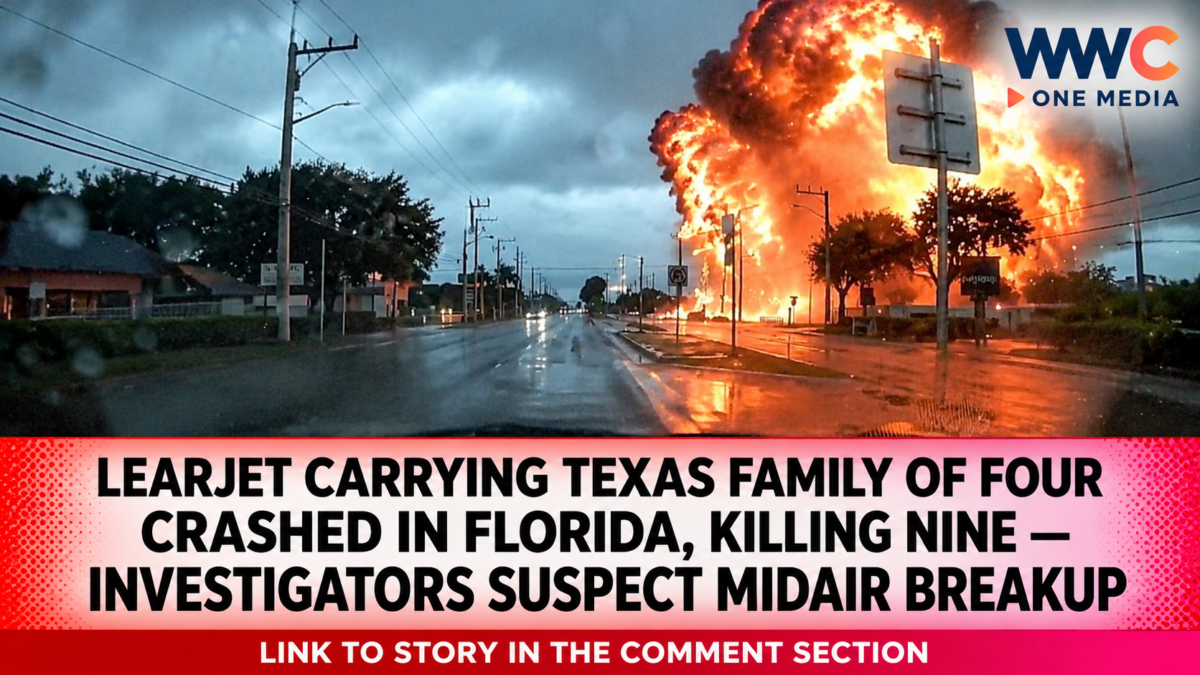
WEST PALM BEACH, Florida — November 3, 2026 — A deadly Learjet crash in South Florida has taken a new turn after federal investigators said evidence suggests the aircraft may have begun breaking apart before hitting the ground, raising fresh questions about what happened during its final moments.
All nine people aboard the Bombardier Learjet 60 died when the private jet plunged into a residential area in Greenacres, Palm Beach County, on Sunday, November 1.
Among the victims were technology entrepreneur Adam Robinson, his wife Helen Sharp, their two young children, and 20-year-old co-pilot Nathalia Gadelha Filgueiras, according to relatives and reports cited by the Associated Press.
The aircraft was travelling from Austin-Bergstrom International Airport in Texas to North Eleuthera Airport in the Bahamas when it crashed.
Investigators have not yet determined the cause. However, evidence of a possible midair breakup, reports of icing and turbulence, and the aircraft’s sudden descent are now central to the inquiry.
Investigators Find Evidence of Possible Midair Breakup
National Transportation Safety Board (NTSB) member Tom Chapman said investigators found evidence that the Learjet began breaking apart before it struck the ground.
The aircraft crashed in Greenacres, approximately 11 kilometres southwest of West Palm Beach. Video recorded by witnesses captured the jet descending rapidly before impact.
Investigators believe debris may have been scattered over a wide area, making the recovery and examination of aircraft components an important part of the investigation.
Former NTSB and Federal Aviation Administration investigator Jeff Guzzetti suggested that important parts of the aircraft’s tail may have been lost during turbulence or the rapid descent.
However, this remains an expert assessment rather than a final finding by investigators.
The NTSB must examine the recovered wreckage and other evidence before determining whether structural damage contributed to the loss of control.
Weather and Icing Conditions Become Major Investigative Focus
Weather conditions are another major area of concern.
According to investigators, one of the pilots reported icing conditions and moderate turbulence while the aircraft was flying at approximately 35,000 feet.
The region was experiencing heavy rainfall and thunderstorms around the time of the crash. An FAA warning also reportedly covered nearly stationary thunderstorms with cloud tops reaching approximately 45,000 feet.
Investigators still need to establish the precise weather conditions at the Learjet’s altitude and determine how those conditions may have affected the aircraft.
Aviation safety experts have cautioned against drawing conclusions from weather reports alone. The presence of thunderstorms, turbulence or icing does not automatically establish what caused an aircraft to crash.
The investigation will need to determine whether weather was a contributing factor, whether the aircraft experienced a technical problem, or whether several circumstances combined.
Cockpit Communications Reveal a Rapidly Deteriorating Emergency
Air traffic control recordings provide an important account of the aircraft’s final communications.
According to recordings reported by the Associated Press and Reuters, a pilot initially told controllers that ice was accumulating on the aircraft and that moderate turbulence was affecting the flight.
The crew sought a smoother ride and requested permission to climb.
The situation then deteriorated rapidly.
The pilot declared an emergency and reported that the Learjet was descending at approximately 10,000 feet per minute. The reported descent rate later increased to around 20,000 feet per minute.
The pilot warned controllers that the aircraft was going to crash.
Reuters reported that flight-tracking data from Flightradar24 indicated the descent rate briefly exceeded 32,000 feet per minute.
These communications help investigators reconstruct the emergency, but they do not independently establish why the aircraft lost control.
The cockpit voice recorder is among the important pieces of evidence investigators hope to recover.
Who Were the Victims?
The crash claimed the lives of all nine people aboard: two crew members and seven passengers.
Relatives identified technology entrepreneur Adam Robinson, his wife Helen Sharp and their two young children among those killed.
The family was travelling together on the Bahamas-bound flight.
The co-pilot was identified as 20-year-old Nathalia Gadelha Filgueiras. Her mother, Camila Corteleti, told US media that her daughter had earned her pilot’s licence in 2023, while she was still a student at West Boca Raton Community High School in Florida.
Reports said her licence included the rating to fly the Learjet model but did not qualify her to serve as the pilot in command.
The identity of the other pilot had not been publicly disclosed in the reports reviewed.
The loss of the family and the young co-pilot has drawn attention to the human impact of the crash, beyond the technical questions facing investigators.
Nearby Residents Displaced as Investigation Continues
The crash also affected people living near the impact site.
Palm Beach County officials said residents from nearly 80 mobile homes near the scene were being accommodated at a shelter while investigators continued examining the area.
Reuters reported that approximately 600 people were evacuated from the wider area and relocated to two shelters following the crash.
A man driving near the scene also suffered a leg injury, according to an NTSB investigator.
Authorities have not provided a confirmed timeline for when all affected residents will be able to return home. Investigators must first recover major wreckage and examine debris that may help explain the aircraft’s final moments.
What Investigators Still Need to Establish
The NTSB investigation will need to answer several important questions:
- Aircraft structure: Did any major component separate before impact, and if so, when and why?
- Weather exposure: What conditions did the aircraft encounter at approximately 35,000 feet?
- Aircraft systems: Did any mechanical, flight-control or other technical problem contribute to the emergency?
- Flight data and recordings: What can the cockpit voice recorder, flight records and recovered components reveal?
- Operational circumstances: What happened during the flight before the pilots reported problems?
These are investigative questions, not confirmed explanations.
The discovery of evidence suggesting a possible midair breakup is significant, but it does not establish whether structural failure caused the emergency or occurred as a consequence of another problem.
The final conclusions will depend on the physical evidence, recorded information and technical analysis.
A Wider Reminder of Why Aviation Investigations Matter
The Florida crash comes amid other serious aviation incidents that have placed aircraft safety and investigation procedures in the spotlight.
WWC ONE MEDIA has previously examined the fatal Philippine Air Force training-aircraft crash in Batangas, the Air India flight that suddenly lost altitude, and the deadly cargo aircraft crash in Miami.
Another report examined the helicopter crash involving an NBC4 news aircraft, where investigators also faced questions about the circumstances leading to the accident.
Each incident has its own circumstances, and one crash should not be used to assume the cause of another. However, they illustrate why investigators rely on evidence rather than early speculation when examining aviation accidents.
What Happens Next?
The NTSB must continue recovering and examining the wreckage, reviewing the available recordings and reconstructing the aircraft’s flight.
The cockpit voice recorder could provide additional information about the crew’s communications and the sequence of events before the crash, if investigators successfully recover it and determine that its data can be retrieved.
The investigation may take time, particularly because major wreckage remains to be recovered from the impact area.
For the families of the nine victims, the immediate loss is devastating. For investigators, the priority is to establish what happened without allowing early theories to become accepted as fact.
The central question remains: Did the Learjet begin breaking apart because of a structural or mechanical failure, or did another emergency trigger the aircraft’s catastrophic descent?
Until the NTSB completes its work, the cause of the Florida crash remains undetermined