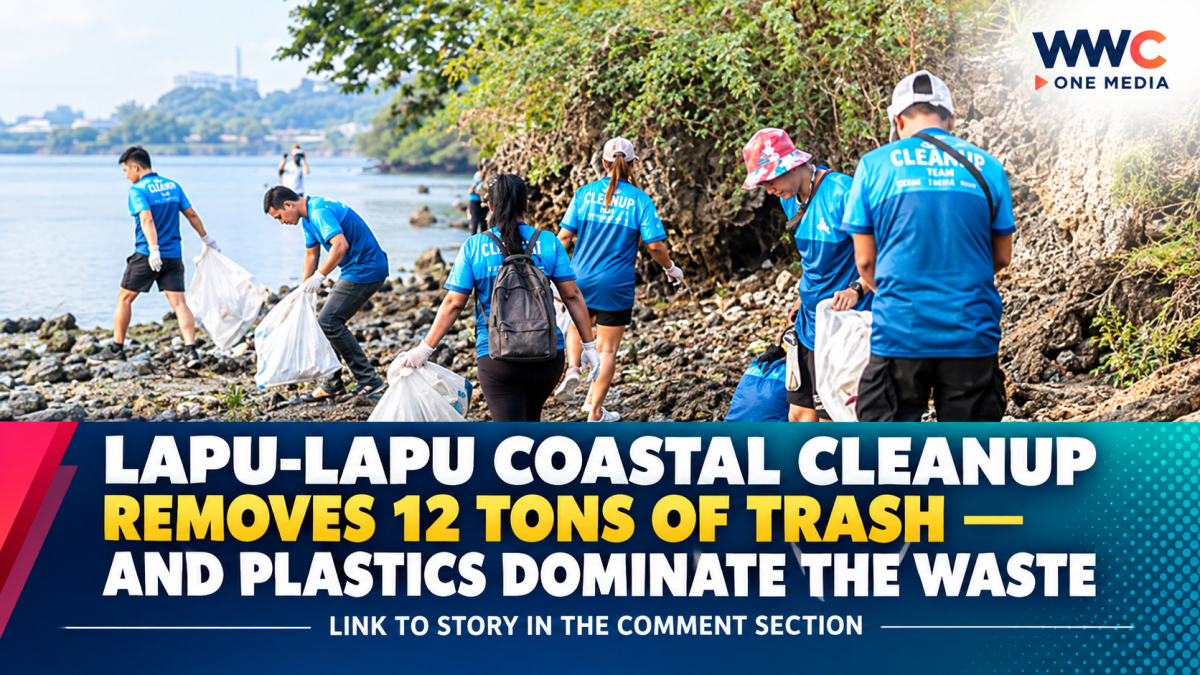
More than 12 tons of garbage were collected from the coastal areas of Lapu-Lapu City during this year’s International Coastal Cleanup, highlighting the continuing challenge of plastic pollution along Cebu’s shorelines.
A total of 12,334.40 kilograms of waste, equivalent to 1,779 sacks, were gathered during the September 19 cleanup across 15 designated coastal areas. The activity brought together around 6,800 volunteers from 91 partner organizations and institutions.
The cleanup covered coastal areas on the mainland as well as island barangays in Olango, Pangan-an, Caohagan and Caubian. It also extended underwater, with 100 volunteer divers taking part in the Scubasurero operation to remove marine debris from coastal waters.
Single-use plastics made up a large portion of the waste collected.
Among the most common items were 12,747 food wrappers, 6,841 other plastic bags, 6,584 plastic grocery bags and 5,666 plastic beverage bottles. Volunteers also recovered 4,520 beverage sachets and pouches, 4,383 plastic cups and plates, 3,551 bottle caps, 3,463 plastic food containers, 3,096 plastic and foam pieces and 2,813 plastic sachets, including detergent and shampoo packaging.
CENRO Officer-in-Charge Jocelyn Abayan said the volume collected was significantly higher than last year. However, she noted that the number of volunteers also nearly doubled, from 3,691 in 2025 to more than 6,800 this year, which contributed to the larger amount of waste recovered.
The cleanup was conducted with the participation of the Department of Environment and Natural Resources Region 7, the Lapu-Lapu City government, Ocean Conservancy, International Coastal Cleanup Philippines and other environmental organizations.
CENRO said the results will help guide information and education campaigns, waste-management efforts and the enforcement of regulations on single-use plastics. Authorities also plan to strengthen waste segregation initiatives, particularly in coastal barangays.
The 2026 cleanup shows that while thousands of volunteers can remove enormous amounts of waste in a single day, the sheer volume and dominance of disposable plastics underline the continuing need to prevent garbage from reaching the sea in the first place.