
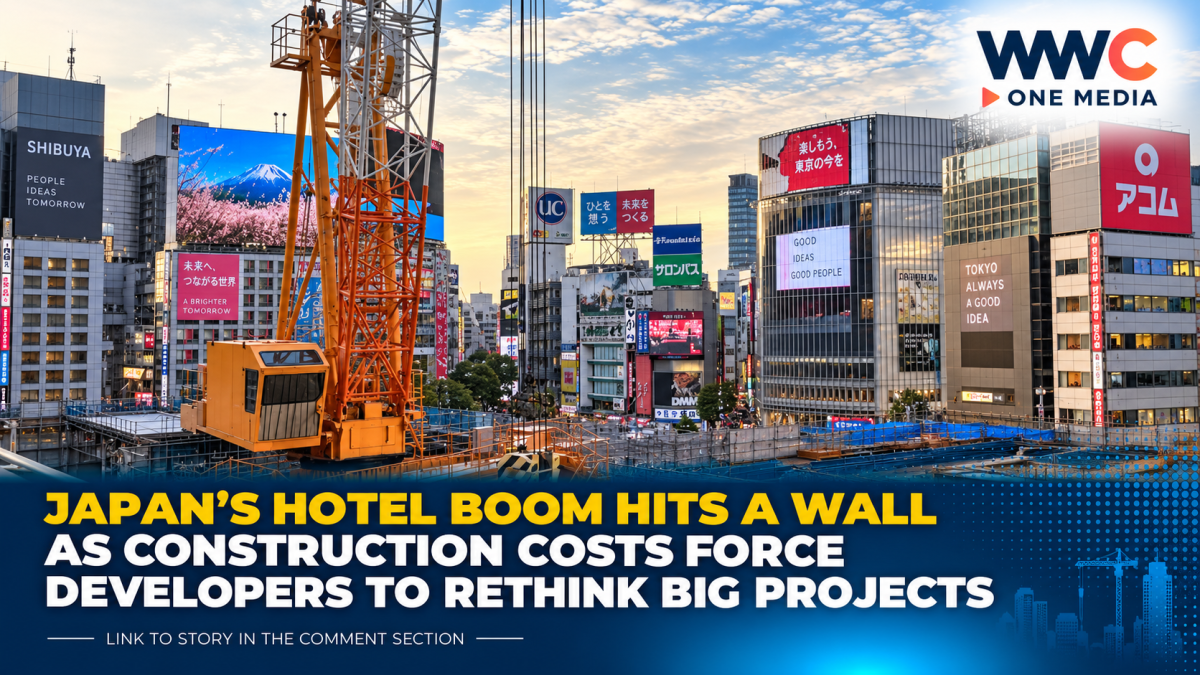
Japan’s hotel industry is facing an unexpected problem: there are plenty of travelers, but building enough new hotels is becoming increasingly difficult.
Surging construction costs, a shortage of workers, higher financing expenses and tougher profitability calculations are forcing developers to cancel, delay or rethink some of the country’s biggest hotel and mixed-use projects.
The result could be a strange new phase for Japan’s tourism boom: record visitor demand colliding with a shrinking pipeline of new hotel rooms.
The hotel boom is running into a construction crunch
Japan welcomed a record 42.68 million foreign visitors in 2025, and the government is targeting 60 million inbound tourists annually by 2030. Yet more than 70% of accommodation businesses surveyed by the government reported labor shortages, according to Japan’s 2026 Tourism White Paper.
The staffing problem is only part of the challenge.
Hotel construction has become dramatically more expensive.
Research from HotelBank, citing Construction Research Institute data, estimates construction costs for hotels increased about 41% between 2022 and 2024, from roughly ¥1.383 million to ¥1.950 million per tsubo.
That increase can completely change the financial equation for a major hotel development.
A project that looked profitable when construction was relatively cheap can suddenly become uneconomic when the developer has to spend billions of yen more before the first guest ever checks in.
Big projects are already being hit
One of the clearest examples is JR Kyushu’s Hakata Station Sky City project in Fukuoka.
The planned ¥43.5 billion development, which included offices, retail and a hotel above the Hakata Station area, was cancelled in September 2025 after construction costs nearly doubled from the original estimates. JR Kyushu had already spent about ¥6 billion on preparatory work.
The decision sent an important signal to the hotel and property market.
Even projects located in major transport hubs—with strong tourism and business demand—are no longer automatically viable if construction costs climb too far.
Another major warning: Nakano
Tokyo has experienced a similar problem.
The planned redevelopment around Nakano Station, which included a hotel component, saw its projected cost rise from about ¥181 billion to more than ¥350 billion.
The basic agreement between Nakano Ward and the prospective operator was terminated in June 2025, while the city moved toward a new process for finding a private developer.
That is not simply a hotel problem.
It illustrates how rapidly construction inflation can undermine enormous urban redevelopment projects containing hotels, offices, retail and entertainment facilities.
Labor shortages are making everything harder
Japan’s construction sector is facing its own demographic problem.
The country’s aging workforce and shortage of skilled construction workers have made it increasingly difficult to assemble the teams required for huge developments.
The Meitetsu Nagoya Station redevelopment offers another striking example.
The roughly ¥888 billion redevelopment encountered a contractor bid withdrawal in November 2025, citing difficulty securing enough personnel to build the project. The development’s schedule was subsequently left undetermined. The original plan included a roughly 150-room Andaz hotel.
For developers, this creates a vicious cycle:
fewer workers → longer construction periods → higher labor costs → higher financing costs → weaker project returns.
The Imperial Hotel is also pushing back its timeline
The pressure is not limited to new hotels.
The planned rebuilding of the Imperial Hotel Tokyo’s Tower Wing was delayed by roughly six years, with demolition now pushed to around the end of fiscal 2030, according to HotelBank’s compilation of company and media disclosures.
Meanwhile, the second phase of Tokyo’s Shibuya Scramble Square development was pushed back four years, with completion moved from fiscal 2027 to fiscal 2031.
Together, these cases point toward a broader change in Japan’s development market.
The paradox: Japan needs more hotels
This is where the story gets particularly interesting.
Japan’s tourism demand remains exceptionally strong.
Foreign arrivals reached a record level in 2025, while the country is pursuing an even larger tourism target for the end of the decade.
That should normally encourage developers to build more hotels.
Instead, the industry is confronting a supply bottleneck.
HotelBank’s analysis estimates that observed 2026 new hotel openings amounted to about 23,132 rooms, down roughly 42% from 2024. Its current lower-bound planning pipeline for 2027 stood at only about 2,103 rooms, although the figure is expected to increase as additional projects enter the construction-application pipeline.
That last qualification matters: these pipeline numbers are not a final forecast. They represent projects identifiable at the time of the analysis, and future applications can increase the totals.
Nevertheless, the direction is difficult to ignore.
Existing hotels could become the big winners
If new hotel supply remains constrained while visitor demand stays strong, existing properties may gain pricing power.
HotelBank’s analysis found sharp increases in average daily room rates in some areas affected by major project cancellations. In Hakata, for example, its tracked average daily rate rose from about ¥26,600 in September 2025 to ¥33,100 in November before subsequently easing.
But the effect is not uniform across Japan.
Tokyo and other major tourist centers with powerful demand are better positioned to benefit from limited supply, while regional markets may not experience the same pricing power.
Hotel investors aren’t necessarily leaving Japan
The situation should not be mistaken for a collapse of Japan’s hotel market.
In fact, the opposite may be happening.
Investment interest remains strong because tourism demand is strong and existing hotels can generate attractive revenue.
The problem is increasingly how to create new hotel supply profitably.
That distinction is crucial.
Investors may be more willing to buy an existing hotel, renovate it and improve its performance than take on the enormous risk of constructing a brand-new property from scratch.
The trend is similar to what is happening in other major hotel markets where expensive new construction makes existing assets increasingly valuable.
Japan’s hotel boom is entering a new phase
The country’s tourism success has therefore produced an unusual dilemma.
Japan wants more visitors.
Hotels want higher room rates.
Investors want attractive returns.
But developers are discovering that the cost of building the hotels needed to accommodate those visitors may be rising faster than the economics of the projects can support.
That could reshape Japan’s hospitality industry for years to come.
Instead of an era dominated by giant new developments, the next phase may feature more renovations, conversions, smaller projects and redevelopment of existing properties.
For travelers, that could mean higher room rates in the most popular destinations.
For hotel owners, it could mean stronger values for existing properties.
And for developers, the message is becoming increasingly clear:
Japan may have never had a better tourism story—but building the hotels to serve that boom has never been more complicated.


Leave a Reply