
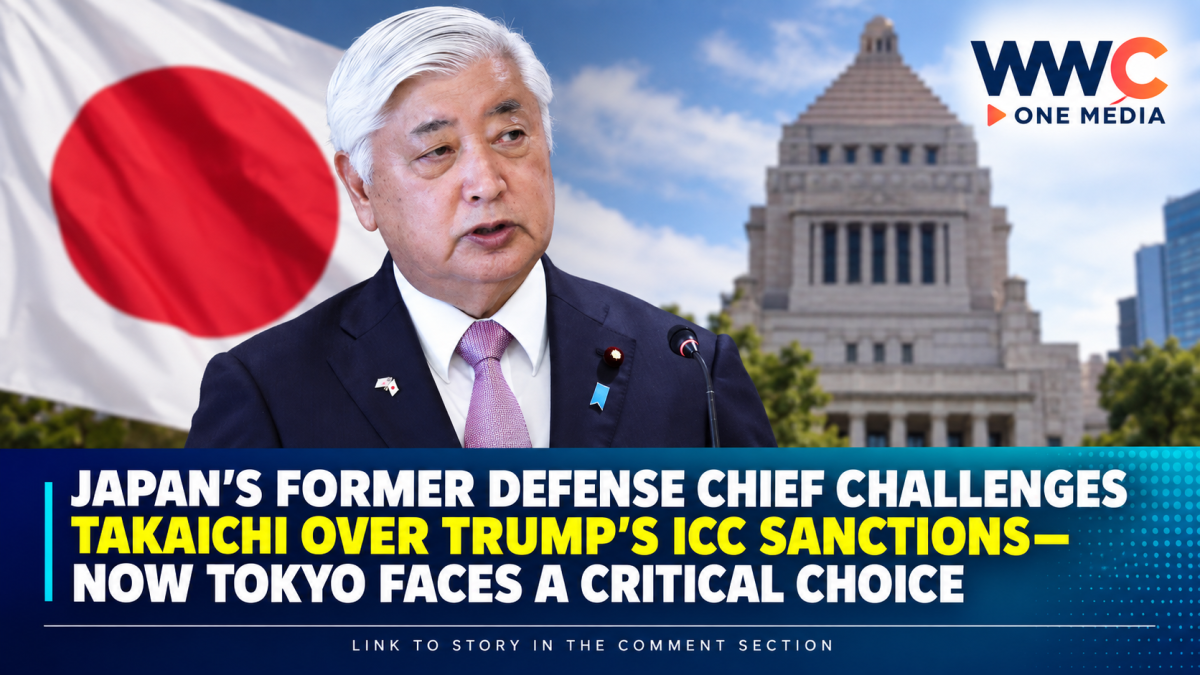
TOKYO — Japan is facing growing pressure to confront Washington over sanctions imposed on International Criminal Court (ICC) President Tomoko Akane, with former Defense Minister Gen Nakatani urging Prime Minister Sanae Takaichi to demand that the United States withdraw the measures.
Nakatani, a senior lawmaker in Japan’s governing Liberal Democratic Party and head of a cross-party group focused on human rights and diplomacy, has described the U.S. sanctions as an attack on the international rules-based order.
He is expected to submit the group’s demands to the Japanese government by mid-September, according to reporting by the Associated Press.
The pressure puts Takaichi in an increasingly difficult position: Japan must balance its close security alliance with the United States against its longstanding commitment to international law and the ICC.
Former defense chief: Japan cannot stay silent
Nakatani argues that supporting the Japan-U.S. alliance and defending the rule of law should not be treated as mutually exclusive choices.
He has urged Takaichi to make a stronger diplomatic protest to Washington and call for the sanctions against Akane and the ICC to be withdrawn.
His intervention comes after criticism that Tokyo’s initial response to the sanctions was too cautious.
Japan’s Foreign Ministry said on Aug. 19 that Akane had been designated for U.S. sanctions and described the move as “very unfortunate.” Tokyo also reiterated that Japan has consistently supported the ICC and remains committed to strengthening the rule of law internationally.
But critics argued that the language did not go far enough.
The Japan Times reported that the restrained response prompted questions about whether Tokyo was deliberately avoiding a direct confrontation with Washington because of the importance of the Japan-U.S. alliance.
Takaichi pushes back against criticism
Takaichi has since taken a somewhat stronger position.
She said the U.S. sanctions against Akane were incompatible with Japan’s position and that her government takes the matter seriously. She also rejected accusations that her administration had failed to defend the ICC.
According to The Japan Times, Takaichi said Japan had pressed Washington through various channels in an effort to prevent Akane from being sanctioned.
Still, the prime minister faces a delicate diplomatic calculation.
Japan regards the United States as the cornerstone of its security and foreign policy, while Tokyo has also positioned the rule of law as a central element of its international diplomacy.
That tension has become increasingly visible as pressure on the ICC intensifies.
Why was Tomoko Akane sanctioned?
The United States announced sanctions against Akane on Aug. 18, along with ICC senior trial lawyer Abdoulaye Seye.
U.S. Secretary of State Marco Rubio said the two officials had directly participated in ICC efforts to investigate, arrest, detain or prosecute officials whose governments had not consented to the court’s jurisdiction.
Washington has strongly opposed ICC investigations involving American personnel and Israeli officials.
The United States is not a member of the ICC, but the court maintains that it can exercise jurisdiction in certain circumstances, including crimes committed on the territory of an ICC member state.
The sanctions can freeze assets under U.S. jurisdiction and effectively restrict sanctioned individuals’ access to the American financial system. They also impose travel restrictions affecting the officials and their families.
Human Rights Watch has condemned the sanctions, saying the United States’ Aug. 18 action against Akane and Seye represents another escalation against the court.
Akane asks Japan to fight back
Akane herself has called on Japan to use its diplomatic influence to help protect the ICC.
Speaking remotely from The Hague in August, she said the sanctions would not intimidate her or prevent her from carrying out her judicial responsibilities.
She also urged Japan to persuade other ICC member states not to give in to U.S. pressure to withdraw from the court.
Akane’s appeal carries particular weight because Japan is the ICC’s largest financial contributor and has been a member of the court since 2007.
Japan’s Foreign Minister Toshimitsu Motegi has also engaged directly with Akane. The Japanese Foreign Ministry confirmed that Motegi held a telephone meeting with the ICC president on Aug. 28 to exchange views on the situation surrounding the court.
The pressure on Tokyo is growing
The dispute is no longer simply a disagreement between Washington and The Hague.
It has become a test of how far Japan is willing to defend an international institution that it has supported financially and diplomatically while maintaining one of its most important strategic alliances.
Reuters reported that current and former presidents of the ICC’s governing Assembly of States Parties recently warned that efforts to isolate or undermine the court could weaken the broader international legal order.
For Takaichi, the timing could hardly be more politically sensitive.
Nakatani’s planned intervention means pressure is coming not only from opposition politicians and international human-rights groups, but also from within Japan’s own political establishment.
The question now is whether Tokyo will move beyond expressions of regret and deliver the stronger diplomatic challenge that Nakatani and other lawmakers are demanding.
And with Takaichi expected to engage with the United States on the international stage, her next move could reveal just how far Japan is prepared to go to defend the ICC—and whether its commitment to the international rule of law will ultimately prevail over the pressure to preserve harmony with Washington.
WWC ONE MEDIA J.M.S
Leave a Reply