
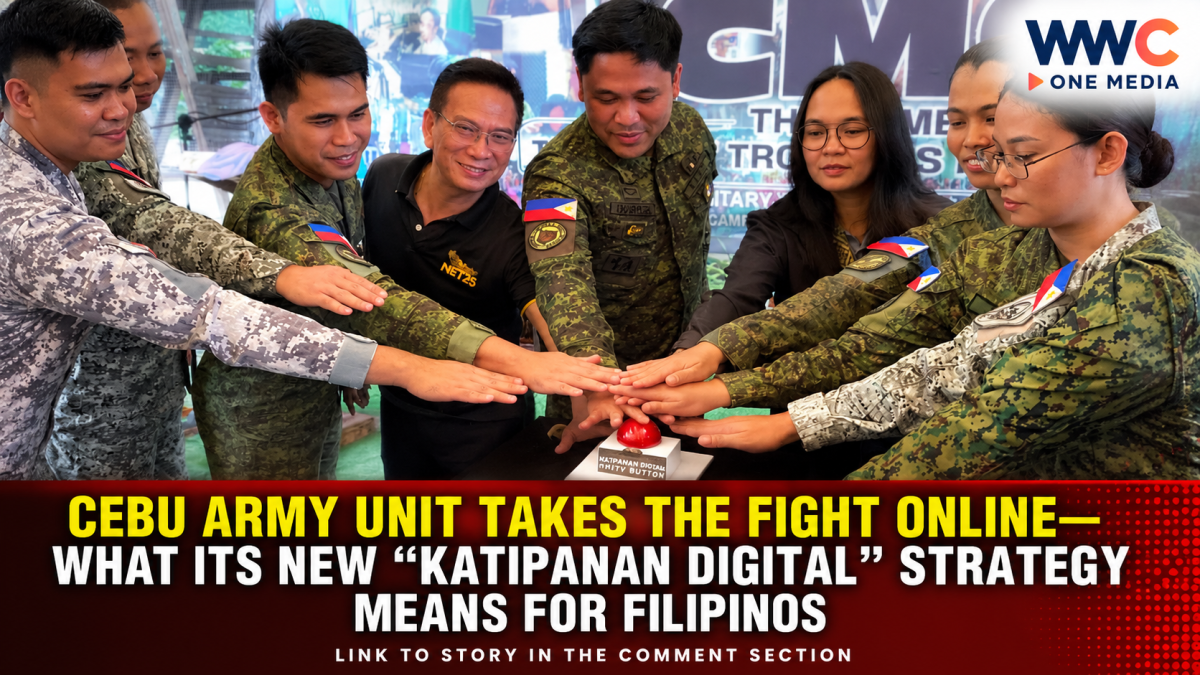
CEBU CITY — The Philippine Army is taking its information campaign deeper into the digital space as a Cebu-based civil-military operations unit launches a new social media strategy aimed at reaching more Filipinos and countering misinformation, disinformation and malinformation.
The 14th Civil-Military Operations (CMO) Katipanan Battalion has launched “Katipanan Digital,” a social media initiative covering Facebook, Instagram, TikTok, YouTube and Threads.
According to the Philippine Information Agency (PIA), the initiative will provide timely information about the battalion’s activities, community engagements, soldiers’ stories and national security concerns—including developments involving the West Philippine Sea (WPS).
But officials say the project is not simply about chasing viral posts.
‘Not about getting followers’
14th CMO Battalion commander Lt. Col. Norley Oropesa said the objective is not to accumulate followers or manufacture viral content, but to use digital platforms to provide information that can help Filipinos better understand issues affecting the country.
Oropesa said the unit’s work does not end when an operation is completed. The public, he argued, should also understand what soldiers are doing, why they are doing it and how their activities affect communities.
He cited examples such as students gaining a better understanding of the West Philippine Sea after seeing an infographic or families developing greater trust in the Army after learning about community programs.
The battalion’s content team, led by 1st Lt. Bhea Jeem Docyogen, said the strategy is designed to expand the unit’s reach beyond Cebu by tailoring digital content to different age groups and geographic audiences.
Why the Army is putting more attention on social media
The Cebu initiative comes as the Philippine military increasingly treats the information environment as an important part of national security.
In April, The Philippine Star reported that the Army’s 2nd Infantry Division was preparing a digital and social media summit focused on combating misinformation and strengthening public trust.
The summit brought together government communicators, public information officers and social media managers from the military, police, local governments and partner agencies to improve coordination in delivering accurate and responsible information.
The AFP also held a Visayas digital and social media summit in July 2026, where military officials discussed the growing importance of the information and cognitive domains.
AFP officials stressed that social media has become a major arena for competing narratives, particularly on issues surrounding the West Philippine Sea.
That broader strategy helps explain why units such as the 14th CMO Battalion are developing their own dedicated digital operations.
Nearly 96 million social media identities in the Philippines
The scale of the challenge is enormous.
DataReportal’s Digital 2026: The Philippines report estimates that there were 95.8 million social media user identities in the country in October 2025, equivalent to about 81.9% of the population.
The report also estimated 98 million internet users, representing an internet penetration rate of 83.8%.
However, DataReportal cautions that social media figures represent user identities rather than necessarily unique individuals, meaning the numbers should not simply be interpreted as 95.8 million individual Filipinos.
Still, the figures illustrate why social media has become a critical channel for government agencies and security institutions seeking to communicate directly with the public.
Fake military accounts are already a concern
The AFP has also warned that misinformation can target the military itself.
In a 2025 cybersecurity bulletin, the AFP Cyber Command warned about fraudulent social media accounts impersonating senior military leaders. According to the bulletin, fake accounts can be used to mislead the public, spread disinformation and potentially facilitate scams.
The AFP advised the public and military personnel to rely on verified official channels when checking announcements and other military information.
The problem is not limited to fabricated military accounts.
In January 2026, the Philippine News Agency reported that the AFP had rejected social media claims alleging divisions within the military and supposed political realignments among senior officers.
The AFP described those narratives as deliberate disinformation intended to create confusion and mistrust, while emphasizing that the military remains professional, united and non-partisan.
A wider information battle
The Philippine military’s increased focus on social media is also unfolding against a more complicated information environment.
A June 2026 investigation by the Digital Forensic Research Lab (DFRLab) documented two separate coordinated influence networks targeting Philippine Facebook pages—one domestic and one linked by the researchers to a Chinese Spamouflage operation.
DFRLab assessed with moderate confidence that a specific network could be connected to or supported by personnel affiliated with the AFP’s 2nd Civil-Military Operations Battalion. Crucially, however, the researchers said their open-source evidence did not establish that the operation was directed, authorized or sanctioned by the AFP as an institution.
That distinction is important.
The existence of an official military effort to counter disinformation should not automatically be treated as proof that every account or influence campaign associated with military personnel is an authorized government operation.
From the battlefield to the feed
The Cebu launch reflects a broader transformation in how security organizations communicate.
The traditional role of civil-military operations has largely centered on public information, community relations and engagement. Social media now gives those units the ability to communicate directly with millions of people almost instantly.
But that reach also comes with a responsibility.
The AFP’s recent initiatives emphasize that official accounts need to compete not merely for attention, but for credibility.
For the 14th CMO Battalion, that is the stated purpose behind Katipanan Digital: to put more verified information into the same online spaces where misleading or manipulated narratives can spread quickly.
As Oropesa put it, the goal is not simply to make content go viral—it is to make information useful enough to help people understand the issues.
And with Filipinos spending an enormous amount of their information time online, the question is no longer whether the information battle will reach social media.
It already has.
The bigger question is which information Filipinos will ultimately choose to trust.
WWC ONE MEDIA J.M.S



Leave a Reply