
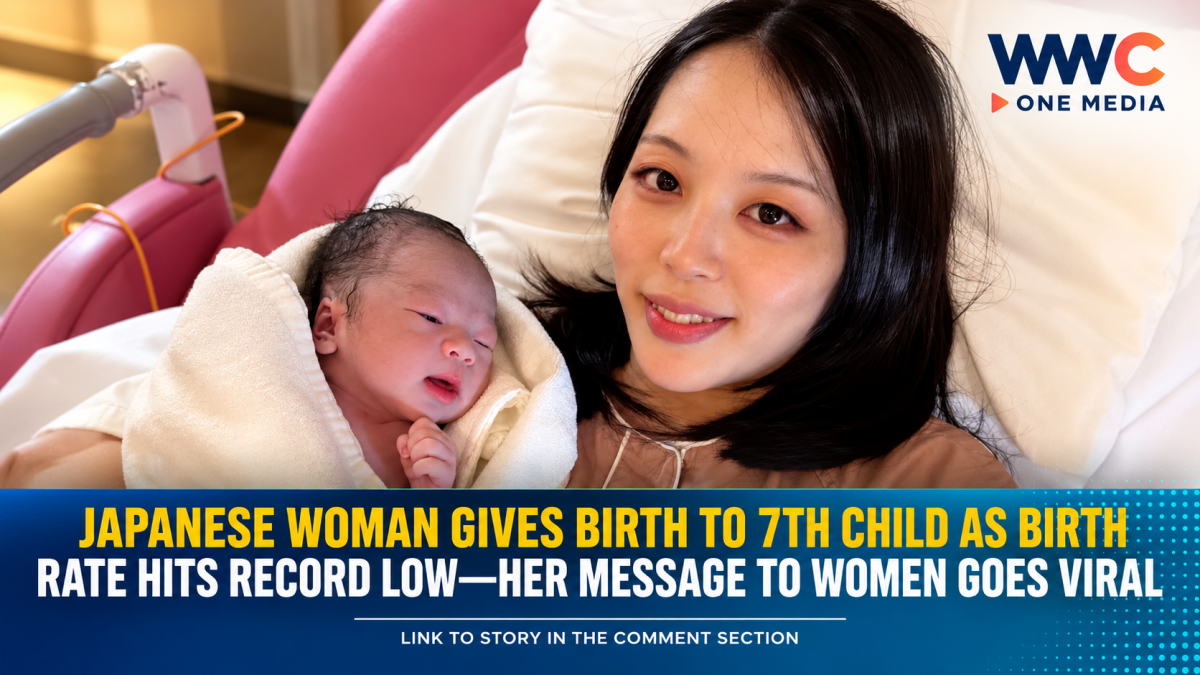
A Japanese author and former political candidate has captured widespread attention after announcing the birth of her seventh child, turning a deeply personal family milestone into a broader conversation about Japan’s worsening demographic crisis.
Kotoe Hashimoto announced on X on Aug. 29 that she had given birth to her seventh child. She thanked the doctors, midwives and nurses involved in the delivery and later said that both she and the newborn were healthy. Her post quickly spread online, with The Straits Times reporting that it had been viewed about 27 million times on X.
But it was not simply the size of her family that drew attention.
Hashimoto connected the birth to Japan’s increasingly urgent population problem, saying she believes it is a critical time for Japanese women to have children and arguing that the country’s future depends on their active role.
Her comments sparked a mixture of praise and debate online, with some users celebrating her large family while others questioned the broader economic and social pressures that make raising children increasingly difficult in Japan.
A seventh child amid a historic demographic decline
Hashimoto’s announcement comes at a particularly significant moment for Japan.
Government figures show that 671,236 babies were born to Japanese citizens in Japan in 2025, a decline of 14,937 from the previous year. It was the 10th consecutive year that births reached a record low, according to data from Japan’s Ministry of Health, Labour and Welfare.
Japan’s total fertility rate also fell to 1.14, its lowest level since comparable records began in 1947. The figure represents the average number of children a woman is expected to have over her reproductive years.
The situation is even more striking when births and deaths are compared.
Japan recorded about 1.59 million deaths in 2025, meaning deaths outnumbered births by more than 918,000. The country has now experienced natural population decline for 19 consecutive years.
Why is Japan struggling to reverse the trend?
Japan has spent years attempting to encourage people to marry and have children, but the demographic decline has continued.
Japanese officials and researchers have pointed to several contributing factors, including later marriage and childbirth, economic pressures, stagnant incomes, difficulties balancing employment and family life, and the rising cost of raising children.
The number of marriages did increase slightly in 2025, reaching 489,119, but that remains considerably below levels recorded before the pandemic. Japan’s demographic structure also means that fewer women of childbearing age are available to have children, making the decline particularly difficult to reverse.
Hashimoto has spoken about Japan’s birth crisis before
The seventh-child announcement is not Hashimoto’s first time addressing Japan’s declining birth rate.
The author and former political candidate has used her social media presence to discuss the country’s demographic challenges and has previously offered provocative opinions about how the government could encourage people to have children. Her political career included running under the Party of Hope during the 2017 general election, although she was not elected.
Her latest comments therefore quickly became part of a much larger discussion: Can individual families make a meaningful difference to a demographic crisis affecting an entire country?
For some online commenters, Hashimoto’s seven-child family represents an example of the larger families Japan needs. For others, the story highlights a more complicated question—whether people can realistically be expected to have more children without addressing the financial, workplace and social pressures surrounding parenthood.
More than a viral birth
Hashimoto’s story has resonated because it sits at the intersection of family, economics and Japan’s population future.
Her seventh child’s arrival does not by itself change Japan’s demographic trajectory. But the extraordinary online response demonstrates just how sensitive the country’s birth-rate issue has become.
With births falling to another historic low and the fertility rate slipping to 1.14, Japan continues to confront a shrinking workforce, an aging population and increasing pressure on its social-security system.
And that is what makes Hashimoto’s announcement more than a viral family story: one newborn has become a symbol in a national debate over what Japan’s future will look like.
WWC ONE MEDIA J.M.S




Leave a Reply