
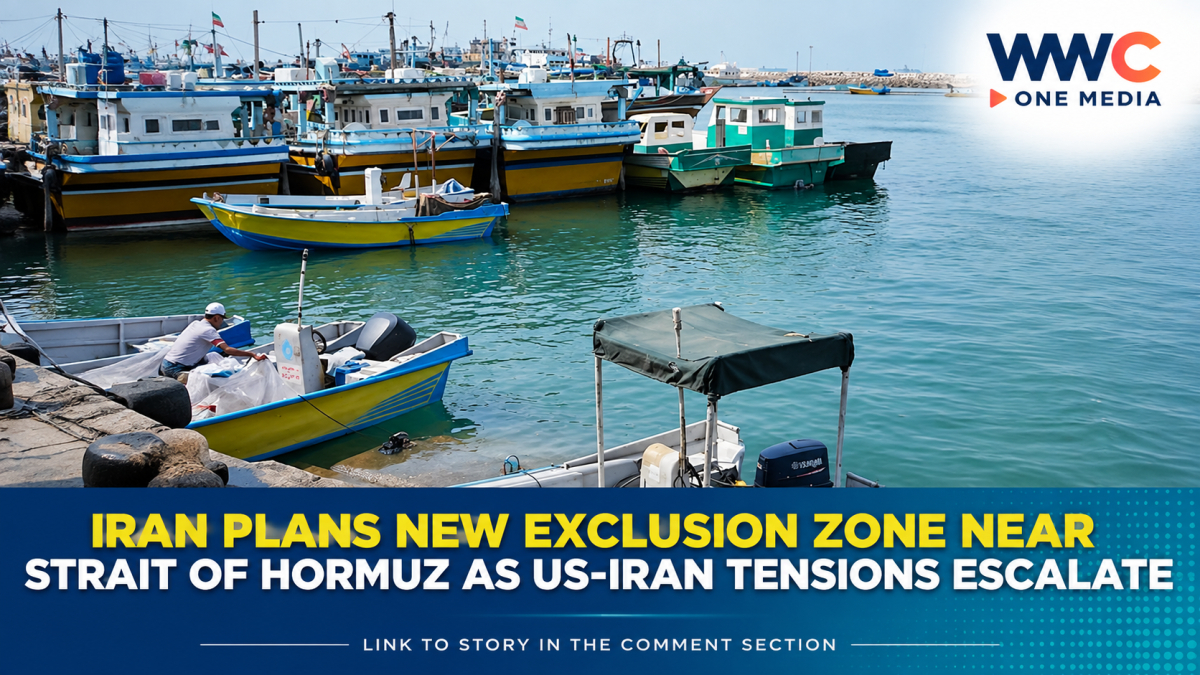
TEHRAN — Iran is preparing to announce a new “exclusion zone” near the Strait of Hormuz, adding another layer of tension to an increasingly dangerous confrontation with the United States in one of the world’s most important shipping corridors.
Iran’s new Supreme National Security Council chief, Mohsen Rezaei, said Sunday that Tehran plans to establish the restricted area outside the Strait of Hormuz and target vessels it believes are attempting to pass through the strategic waterway without authorization.
The announcement comes after a sharp escalation in military activity around the Gulf, including U.S. strikes on Iranian oil tankers and Iranian attacks on U.S. warships.
The proposed exclusion zone could further complicate commercial shipping through a waterway that normally carries a significant share of the world’s oil supplies.
Iran Says New Zone Will Target Ships Near Hormuz
According to Rezaei, the new zone is expected to be announced in the coming days.
Iranian officials said the restricted area would begin around the existing U.S. naval blockade and extend toward the Strait of Hormuz.
Tehran has warned that vessels entering the designated area could face sanctions or other restrictions.
The precise geographic boundaries of the proposed zone and the mechanisms Iran intends to use to enforce it have not yet been fully detailed publicly.
That uncertainty is likely to be closely watched by shipping companies, insurers and governments whose economies depend on uninterrupted energy supplies.
Tensions Exploded After Attacks on Ships
The announcement follows a major escalation between Washington and Tehran over the weekend.
The United States struck three Iranian oil tankers, according to Reuters, in what Washington described as retaliation for Iranian ballistic-missile attacks against U.S. Navy warships.
Iran has also threatened a stronger response as the confrontation intensifies.
The latest exchanges have raised fears that military activity could spread further into commercial shipping lanes.
The Strait of Hormuz is particularly sensitive because of its role as a narrow maritime passage connecting the Persian Gulf with the Gulf of Oman and the Arabian Sea.
Any sustained disruption can quickly affect energy markets well beyond the Middle East.
Iran and US Dispute What Happened to an American Vessel
The latest confrontation was also accompanied by conflicting claims about an American unmanned vessel.
Iran said it had successfully struck an American military vessel near the Strait of Hormuz.
The U.S. military rejected that claim, calling it false.
Because the two sides have issued contradictory accounts, the alleged Iranian strike should not be treated as independently confirmed.
The disagreement illustrates the growing difficulty of establishing facts in real time as military operations intensify around the waterway.
Shipping Traffic Has Already Fallen Sharply
The proposed exclusion zone comes at a time when commercial traffic through the Strait of Hormuz has already been heavily disrupted.
Reuters reported that only around 10 commodity-carrying ships a day had been passing through the waterway over the previous 10 days — the lowest level reported since May.
Before the latest escalation, the strait was one of the world’s busiest energy routes.
The sharp reduction in shipping has raised concerns about a larger supply shock if the disruption continues.
For shipping companies, the danger is not limited to whether vessels can physically pass.
War-risk insurance, freight costs, rerouting expenses and the possibility of attacks can all make a voyage through the region considerably more expensive.
Oil Prices Rise as Hormuz Fears Return
Financial markets have already reacted to the latest escalation.
Reuters reported that Brent crude rose to around US$97 a barrel, while U.S. West Texas Intermediate crude climbed above US$92 on Monday.
The increases came as traders assessed the possibility of prolonged disruptions to oil shipments through the Gulf.
The Strait of Hormuz is particularly important to global energy markets because enormous volumes of oil and other energy products traditionally pass through the waterway.
Even if supplies are not completely cut off, a prolonged reduction in tanker traffic can put upward pressure on prices.
That could eventually affect transportation, manufacturing and consumer prices in countries far from the conflict.
Iran Threatens to Tighten Its Control
Iran has repeatedly demonstrated that it considers the Strait of Hormuz a crucial strategic asset.
The latest proposal for an exclusion zone suggests Tehran may be seeking to formalize or expand restrictions on maritime traffic while confronting the U.S. naval presence in the region.
Iran has also indicated that it wants to establish a new shipping corridor through the Strait in coordination with Oman, according to Reuters.
The competing moves highlight the increasingly complex situation: Tehran is threatening restrictions while simultaneously discussing mechanisms for controlled maritime passage.
Washington Wants to Keep the Waterway Open
For the United States, maintaining access through the Strait of Hormuz remains a major strategic priority.
American officials have described the waterway as vital to global energy supplies and have emphasized the role of U.S. naval forces in protecting shipping.
The U.S. has also imposed a naval blockade aimed at restricting Iranian oil exports, further increasing the likelihood of confrontations with vessels attempting to move through the region.
The opposing strategies have created a dangerous situation in which military and commercial shipping are increasingly operating in the same contested environment.
A New Flashpoint for Global Energy Markets
The proposed Iranian exclusion zone could become one of the most consequential developments in the latest phase of the U.S.-Iran confrontation.
If Tehran establishes a large restricted area and attempts to enforce it, commercial shipping could face even greater uncertainty.
But the ultimate impact will depend on several factors, including the zone’s final boundaries, how Iran enforces it, whether the United States challenges the restrictions and whether diplomatic efforts can prevent further military escalation.
For now, shipping companies are facing an increasingly unpredictable environment.
Every additional restriction around Hormuz increases the risk that vessels will be delayed, diverted or forced to accept higher insurance and security costs.
Diplomacy Faces Another Test
The announcement also comes as diplomatic efforts between Washington and Tehran struggle to regain momentum.
Iran has indicated that it wants stronger guarantees before returning to negotiations, while the United States continues to demand major concessions from Tehran.
The latest military escalation makes a diplomatic breakthrough even more difficult.
Yet the economic consequences of a prolonged confrontation could provide both sides with incentives to find a way back to negotiations.
For the countries that depend on Gulf energy supplies, the stakes are much higher.
Why the Strait of Hormuz Matters
The Strait of Hormuz is one of the world’s most strategically important maritime chokepoints.
A prolonged disruption does not have to involve a complete closure to create economic consequences.
Even a substantial reduction in tanker traffic can push up oil prices, increase transportation costs and create uncertainty throughout global supply chains.
That is why Iran’s proposed exclusion zone is being watched far beyond the Middle East.
The immediate question is not simply whether Iran will announce the zone.
It is how large it will be, how it will be enforced and how the United States and commercial shipping operators respond.
With military forces already exchanging attacks around the Gulf, another confrontation at sea could rapidly turn the Strait of Hormuz into an even more dangerous flashpoint.
For global energy markets, the next move in the Gulf could matter just as much as the last one.
WWC ONE MEDIA J.M.D




Leave a Reply