
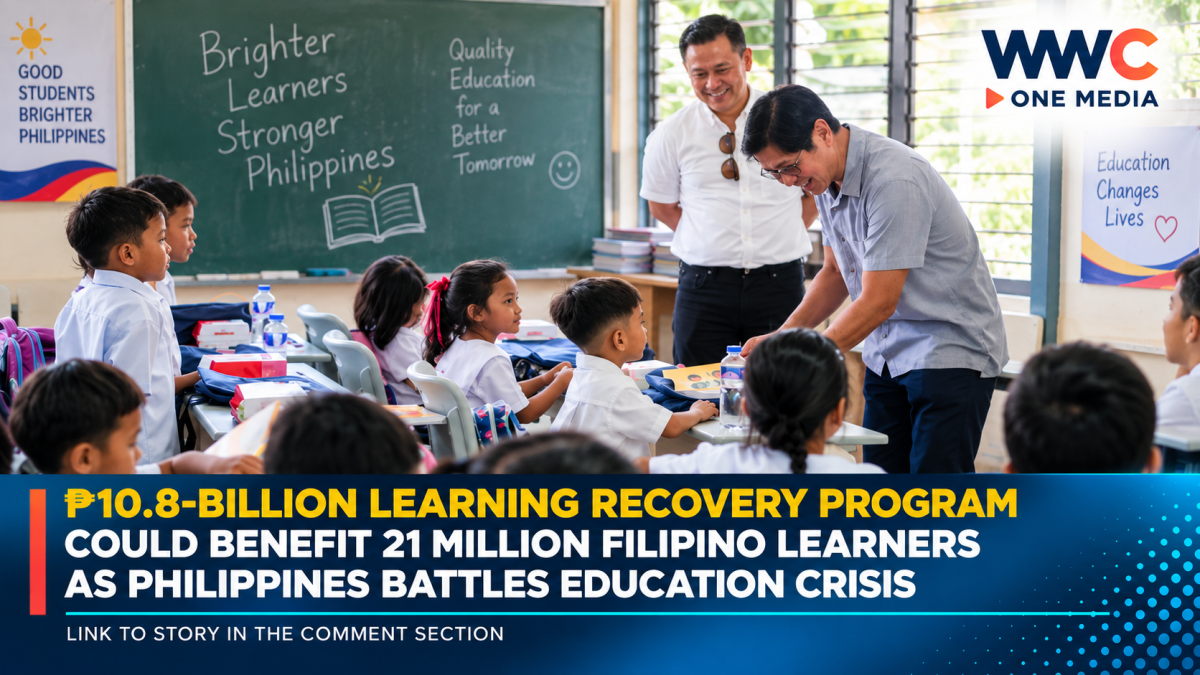
MANILA — More than 21 million Filipino learners could be reached by a proposed ₱10.8-billion learning recovery program, as the Philippine government intensifies efforts to address persistent gaps in reading, mathematics and other foundational skills.
The proposed funding is part of the government’s continuing effort to reverse years of learning losses and weak academic outcomes, with the Department of Education (DepEd) placing learning recovery among its major priorities.
But officials face a daunting challenge: despite recent improvements in some areas, a large share of Filipino students continue to perform below expected grade-level standards.
The latest proposal therefore comes at a critical moment for the country’s education system.
₱10.8 billion proposed for learning recovery
The proposed ₱10.8-billion allocation is intended to support a broad learning-recovery push that could reach more than 21 million learners, according to the latest PNA report.
The program is aimed at helping students recover competencies they have failed to master and strengthening the foundational skills needed for later schooling.
Rather than focusing only on students who are already severely behind, the scale of the proposal reflects the government’s attempt to address learning gaps across a much wider portion of the basic-education system.
That includes interventions related to reading, numeracy, mathematics, teaching support and learning materials.
The proposal comes as the government prepares its education priorities for the next budget cycle.
The number 21 million tells only part of the story
The 21-million figure is particularly significant because it is also associated with the Philippines’ much larger learning-reform effort backed by the World Bank.
In April, the World Bank approved a US$600-million project called the Project for Learning Upgrade Support and Decentralization (PLUS-D).
That project is expected to benefit about 21 million learners from kindergarten through Grade 10, including learners in DepEd’s Alternative Learning System, as well as approximately 777,000 teachers.
PLUS-D is designed to improve foundational literacy and numeracy in primary education and reading and mathematics outcomes in lower secondary education.
It will also support teacher development, school leadership, learning materials, assessment systems, digitalization and decentralization.
The World Bank says the project will provide grants and tailored support to 10 DepEd regional offices and more than 11,100 schools.
That means the proposed ₱10.8-billion domestic learning-recovery push should be viewed within a much broader national education-reform effort, rather than as a standalone program.
Why learning recovery has become an urgent issue
The Philippines has struggled for years with poor learning outcomes.
A recent analysis by the Second Congressional Commission on Education (EDCOM 2) found that Filipino learners made measurable improvements in reading proficiency during School Year 2025–2026.
However, nearly half of learners still failed to meet grade-level expectations in literacy by the end of the school year.
That finding underscores why simply increasing enrollment is not enough.
The challenge now is ensuring that students actually acquire the skills expected at their grade level.
Reading and numeracy are particularly important because weaknesses in these areas can follow students into higher grades, making more advanced subjects increasingly difficult.
DepEd’s recovery strategy goes beyond textbooks
The government’s learning-recovery approach is not limited to distributing educational materials.
DepEd’s existing 2026 budget includes ₱5.67 billion for curriculum reform and learning recovery, supporting initiatives including the Academic Recovery and Accessible Learning (ARAL) Program. That funding was expected to benefit more than 12 million learners from Kindergarten through Grade 10.
The broader education budget also includes substantial allocations for classrooms, school feeding, computerization and learning materials.
For 2026, DepEd received a record ₱1.015 trillion budget, with billions allocated for infrastructure, nutrition, digital equipment, textbooks and curriculum reform.
The strategy reflects a growing recognition that learning cannot be fixed by classroom instruction alone.
Students also need adequate learning materials, properly supported teachers, functioning classrooms and access to technology.
Teachers will be critical to whether the plan succeeds
One of the biggest questions surrounding the learning-recovery effort is how effectively teachers will be supported.
The World Bank’s PLUS-D project includes evidence-based training and coaching for teachers and school leaders, recognizing that simply giving schools additional resources will not automatically translate into better learning outcomes.
The project is also expected to support around 59,000 school leaders and 300 DepEd personnel through capacity-building activities.
This matters because teachers are ultimately responsible for translating recovery programs into classroom practice.
If interventions are poorly implemented, overly bureaucratic or added on top of already heavy workloads, additional funding may have less impact than expected.
Learning crisis remains bigger than the pandemic
The COVID-19 pandemic worsened learning disruptions in the Philippines, but education officials and researchers have increasingly stressed that the country’s learning crisis predates the pandemic.
The World Bank has described the current challenge as one involving inadequate teaching and learning conditions, limited teacher capacity, infrastructure problems and shortcomings in the availability and quality of learning materials.
That is why the current push combines learning recovery with longer-term education reform.
The objective is not simply to help students catch up after lost learning.
It is to improve the education system so students are less likely to fall behind in the first place.
A record education budget faces a major test
The scale of government spending means scrutiny will likely intensify.
DepEd’s record 2026 budget demonstrates that the government has increased financial support for education, but the ultimate measure of success will not be the size of the appropriation.
It will be whether students actually become better readers, stronger in mathematics and more capable of meeting grade-level expectations.
The challenge is particularly important because the Philippines is trying to strengthen its workforce and improve long-term economic competitiveness.
The World Bank has linked stronger foundational skills to human-capital development, employment and sustained economic growth.
What happens next?
The proposed ₱10.8-billion learning-recovery program still needs to pass through the government’s budget process before it becomes final funding.
That distinction matters.
The money is proposed — not yet a completed payout to schools or students.
If approved and implemented effectively, however, the program could become one of the Philippines’ largest efforts to directly confront learning gaps affecting millions of children.
For Filipino families, the real question is no longer simply how much the government plans to spend.
It is whether that money will finally translate into something parents can see inside the classroom: children who read better, calculate better and learn at the level expected for their age.
And with 21 million learners potentially in the program’s reach, the stakes could hardly be higher.




Leave a Reply