
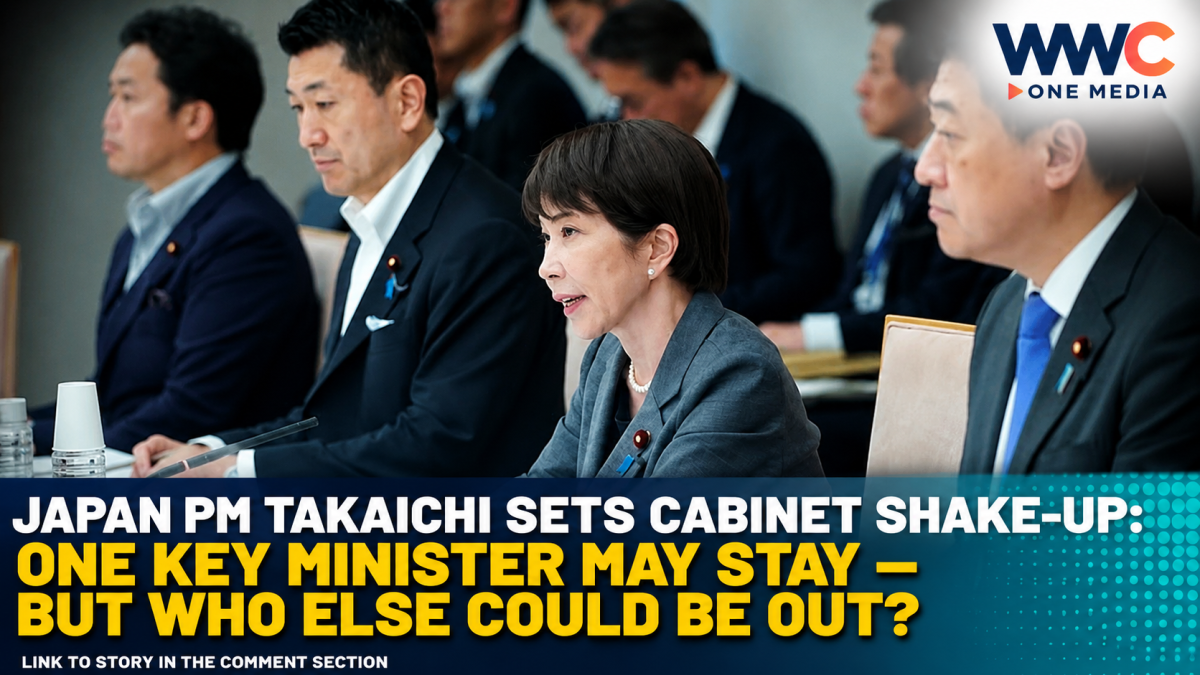
TOKYO — Japanese Prime Minister Sanae Takaichi is preparing to reshuffle her Cabinet and the ruling Liberal Democratic Party’s leadership lineup later this month, in a move that could become a major test of her political authority as she seeks to strengthen her government ahead of the next phase of her administration.
The reshuffle is expected to take place in mid-to-late September, according to Japanese media reports, although the final timing and personnel decisions have yet to be formally announced. It would be Takaichi’s first Cabinet reshuffle since taking office in October 2025.
One of the clearest signals emerging from Tokyo is that Chief Cabinet Secretary Minoru Kihara is likely to remain in his post. As the administration’s central coordinator and principal government spokesman, Kihara’s continued presence would indicate that Takaichi wants to preserve continuity even as she changes other parts of her government.
The bigger political calculation
The reshuffle is about more than simply replacing ministers.
Takaichi is also expected to reorganize the LDP’s executive leadership as she prepares for the party’s 2027 leadership election. Japanese media have reported that maintaining support inside the ruling party will be a key consideration as she decides who remains in influential positions.
Among the questions attracting attention is whether LDP Secretary-General Shunichi Suzuki will retain his position. Some reports have suggested that Koichi Hagiuda, currently serving as acting executive secretary-general, could be considered for a more prominent party role.
The reshuffle could also determine how Takaichi handles several senior politicians who previously competed against her for the party leadership, including Defense Minister Shinjiro Koizumi, Foreign Minister Toshimitsu Motegi and other prominent LDP figures. Their treatment could offer clues about whether the prime minister intends to consolidate power, accommodate rivals or prepare the party for another leadership contest.
Coalition politics could add another twist
Takaichi is also considering bringing members of the Japan Innovation Party (Ishin) into Cabinet, according to reports.
That possibility would deepen cooperation between the ruling LDP and its coalition partner while potentially giving Takaichi additional political support as she attempts to push through major economic policies.
Japanese broadcaster NHK has reported that the government and ruling parties are looking toward the second half of September for the party appointments and Cabinet changes, following decisions related to a tax-reform package that includes a proposed reduction in the consumption tax on food.
Why the reshuffle matters to Japan’s economy
Takaichi is making the personnel changes at a particularly sensitive moment for Japan’s economy.
Her government has pursued an aggressive spending strategy aimed at boosting growth and easing the impact of higher living costs. But investors have become increasingly concerned about Japan’s fiscal position, inflation and the direction of monetary policy.
The benchmark 10-year Japanese government bond yield recently moved above 3% for the first time since 1996, according to Reuters, highlighting the growing pressure facing Tokyo’s economic policy.
The weak yen is another major concern. The currency has traded around the psychologically important ¥160-per-dollar level, prompting renewed speculation about possible intervention and increasing pressure on policymakers to address inflation and import costs.
At the same time, Bank of Japan Governor Kazuo Ueda has signaled that the central bank will consider another interest-rate increase this month, with markets increasingly focused on the BOJ’s September 17–18 policy meeting.
That creates a delicate balancing act for Takaichi: her government wants to support economic growth and household incomes through fiscal measures, while financial markets are demanding greater confidence in Japan’s fiscal discipline and monetary stability.
Approval ratings add to the pressure
The political backdrop is also becoming more complicated.
A July Yomiuri poll reported by Reuters and CNA put Takaichi’s approval rating at 57%, down from 69% in June. The decline was linked in part to public dissatisfaction with the government’s handling of the rising cost of living.
That makes the coming reshuffle particularly important.
A carefully selected Cabinet could allow Takaichi to bring in popular or politically influential figures, strengthen party unity and demonstrate a clearer economic direction. But choosing the wrong combination could instead expose divisions within the LDP or intensify investor concerns about her spending policies.
Japan is therefore heading toward a potentially consequential September.
The question is no longer simply who Takaichi will remove or retain — it is whether the reshuffle will give her the political strength needed to push ahead with her economic agenda while keeping markets and her own party onside.
What to watch next
- Exact date of the Cabinet reshuffle
- Whether Minoru Kihara remains Chief Cabinet Secretary
- The fate of LDP Secretary-General Shunichi Suzuki
- Possible Cabinet appointments for Japan Innovation Party lawmakers
- How Takaichi handles potential rivals within the LDP
- The government’s food-consumption-tax proposal
- The Bank of Japan’s September rate decision
- The yen and Japanese government bond yields
WWC ONE MEDIA MJE




Leave a Reply