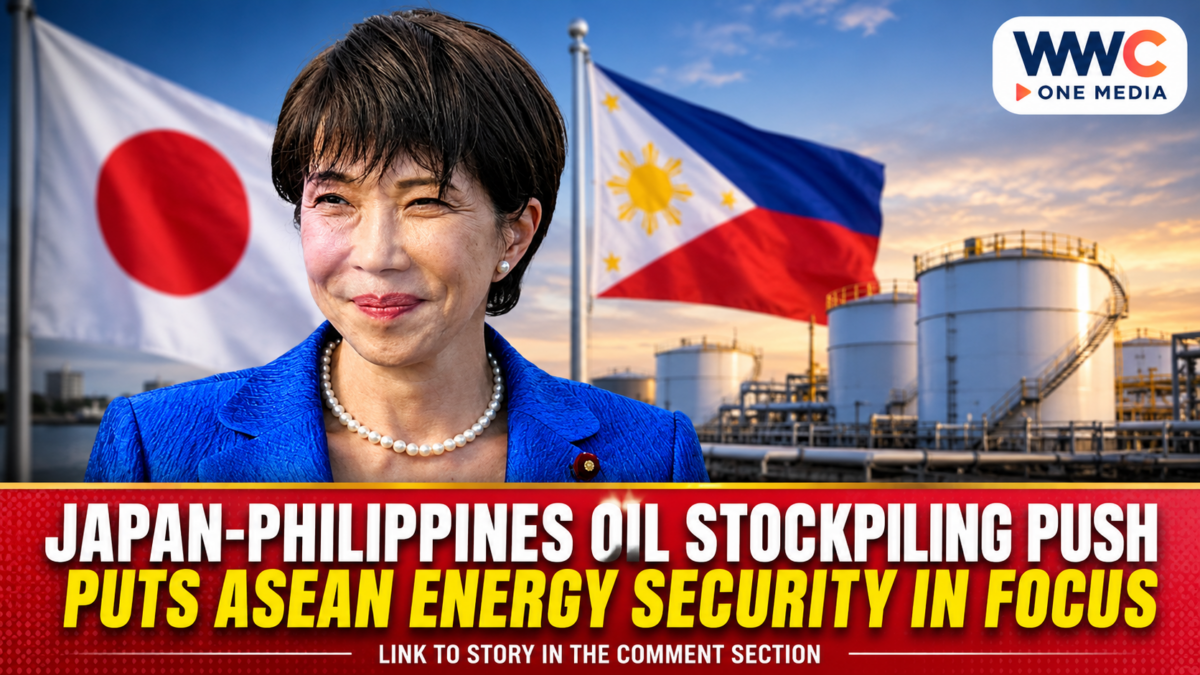
The Philippines and Japan are advancing cooperation on petroleum reserves and regional energy resilience as both countries seek stronger protection against disruptions to international fuel supplies. The November 16 meeting between President Ferdinand R. Marcos Jr. and Japanese Prime Minister Sanae Takaichi added fresh diplomatic momentum to an existing stockpiling partnership.
The development matters beyond the two countries. For ASEAN economies dependent on imported petroleum, the challenge is not simply obtaining fuel during normal trading conditions but establishing arrangements that can help maintain access when international supply routes face disruption.
The two governments already have an official framework for cooperation. Their May 28 joint statement covers the Philippines’ strategic national petroleum reserve programme and ASEAN-wide joint stockpiling under Japan’s Partnership on Wide Energy and Resources Resilience Asia, known as POWERR Asia. Ministry of Economy, Trade and Industry+1
Japan and the Philippines already have a petroleum cooperation framework
The partnership did not begin with the November summit.
On May 28, Japan’s Ministry of Economy, Trade and Industry and the Philippine Department of Energy released a joint statement outlining cooperation on strengthening petroleum stockpiles.
The document covers two connected areas: the Philippines’ strategic national petroleum reserve programme and the possibility of broader stockpiling cooperation across ASEAN.
This distinction is important.
A national petroleum reserve is intended to strengthen a country’s own capacity to manage supply disruptions. Regional stockpiling, meanwhile, introduces another layer of cooperation involving participating countries and arrangements for accessing stored petroleum products.
Japan’s contribution is particularly relevant because it has decades of experience operating a national petroleum stockpiling system.
In a May 29 press conference, Japanese Economy, Trade and Industry Minister Ryosei Akazawa discussed the country’s experience and the potential contribution Japan could make to regional energy-resilience efforts.
He also identified the Economic Research Institute for ASEAN and East Asia, or ERIA, as an institution through which a roadmap for joint stockpiling cooperation could be developed. Ministry of Economy, Trade and Industry+1
Marcos and Takaichi reinforce the wider economic relationship
The November 16 meeting between Marcos and Takaichi provides additional political context for the cooperation.
Japan’s Ministry of Foreign Affairs recorded that the leaders met for approximately 20 minutes, beginning at 5:40 p.m. Philippine local time.
Their discussions covered economic resilience, regional cooperation and the development of Japan’s relationship with the Philippines.
The Japanese government statement specifically records Takaichi’s intention to strengthen POWERR Asia and enhance economic and energy resilience through the Asia Zero Emission Community framework.
Marcos expressed support for Japan’s initiatives.
The meeting also covered the broader bilateral relationship, including the Luzon Economic Corridor and the Japan-Philippines Economic Partnership Agreement.
These discussions show that energy cooperation forms part of a wider economic relationship rather than an isolated petroleum arrangement. Ministry of Foreign Affairs of Japan
For Philippine businesses, the distinction matters because fuel security affects more than transport and gasoline prices.
Petroleum products and their derivatives are used across logistics, manufacturing, agriculture and other industries. Supply disruptions can therefore create pressures that extend beyond the energy sector.
WWC previously examined the country’s efforts to develop regional energy cooperation and strengthen fuel-security arrangements.
Why ASEAN needs more than individual national reserves
Energy security is difficult to manage when countries approach emergencies independently.
Even if one country maintains substantial petroleum inventories, neighbouring economies may still face shortages if commercial supply routes are interrupted or access to available products becomes constrained.
A regional arrangement could help participating governments coordinate information, procurement and access to stored supplies.
However, cooperation does not automatically mean that every country can immediately draw fuel from another country’s reserves.
The practical arrangements would need to establish ownership, payment responsibilities, storage agreements, transportation logistics, release conditions and emergency priorities.
These questions will determine whether regional stockpiling becomes a usable emergency mechanism or remains primarily a policy commitment.
ASEAN’s existing energy cooperation provides a foundation for further discussions.
The Philippines has also published previous policy coverage concerning joint regional fuel-sharing arrangements.
For the region, the next challenge is translating broad commitments into operating procedures that participating governments and energy companies can actually use.
POWERR Asia gives Japan a wider regional role
Japan’s POWERR Asia initiative provides the wider policy framework for its energy-resilience activities.
The Partnership on Wide Energy and Resources Resilience Asia is designed to strengthen regional supply chains and cooperation involving energy and critical resources.
The framework is relevant to Japan because its economic interests are closely connected to production and supply networks throughout Southeast Asia.
The May 28 Japan-Philippines joint statement places petroleum stockpiling cooperation within this broader initiative.
That connection gives the two governments an established policy channel through which to continue discussions.
It also creates an opportunity for the Philippines to connect its national petroleum reserve objectives with wider regional cooperation.
The country’s petroleum-security strategy should therefore be considered alongside its broader energy-development priorities, including infrastructure, electricity supply and investment.
WWC has previously examined the Philippines’ efforts to secure petroleum reserves beyond its domestic storage arrangements.
What the cooperation could mean for Philippine businesses
The potential benefits extend across several sectors.
For transport operators, more reliable petroleum access could help reduce exposure to supply interruptions. Manufacturing companies could benefit from more predictable access to petroleum-based industrial inputs.
Agriculture is another important consideration because fuel is used in farm machinery, distribution and the movement of food products.
However, stockpiling should not be confused with a guarantee against higher fuel prices.
International petroleum prices, exchange-rate movements, shipping costs, insurance premiums and domestic distribution expenses can still influence the prices paid by Philippine consumers and businesses.
A reserve arrangement may improve supply resilience, but it does not automatically eliminate these market pressures.
The effectiveness of any future system will depend on how quickly supplies can be accessed, how much product is available and whether participating countries have clear procedures for responding to emergencies.
This is why the details of implementation matter more than the announcement of cooperation itself.
What happens next
The immediate priority is translating the existing bilateral framework into specific arrangements.
The May 28 joint statement provides the foundation for cooperation, while the November 16 summit reinforces the broader political commitment to economic and energy resilience.
Further developments should clarify the responsibilities of participating governments, the role of ERIA, the possible storage arrangements and the conditions under which petroleum products could be accessed during supply emergencies.
A separate development concerning a proposed Asia Oil Security Task Force has also emerged in the November 17 summit news cycle. However, WWC has not independently verified its formal establishment through an accessible official summit outcome document. It is therefore not presented here as an established institution.
For the Philippines, the larger policy question is whether its national petroleum reserve programme can become part of a practical regional system that provides meaningful support during supply disruptions.
The answer will depend on financing, infrastructure, agreements and implementation.
The direction of cooperation is clear. Its operational results remain to be demonstrated.
Frequently asked questions
1. What is POWERR Asia?
POWERR Asia stands for the Partnership on Wide Energy and Resources Resilience Asia. It is a Japanese initiative intended to strengthen energy and critical-resource supply-chain resilience in Asia.
2. What did Japan and the Philippines agree to on petroleum stockpiling?
Their May 28, 2026 joint statement covers cooperation involving the Philippines’ strategic national petroleum reserve programme and ASEAN-wide joint stockpiling.
3. What is the Philippine strategic petroleum reserve?
It is a national programme intended to strengthen the country’s capacity to maintain petroleum supply during disruptions. Its practical implementation requires appropriate storage, financing and supply arrangements.
4. Will regional oil stockpiling automatically lower Philippine fuel prices?
No. Stockpiling can potentially improve supply resilience, but retail prices remain affected by international oil prices, exchange rates, transportation and domestic distribution costs.
5. Has the Asia Oil Security Task Force already been formally established?
WWC has not independently verified a formal establishment document. Its proposed creation should be distinguished from the existing Japan-Philippines petroleum stockpiling cooperation framework.