
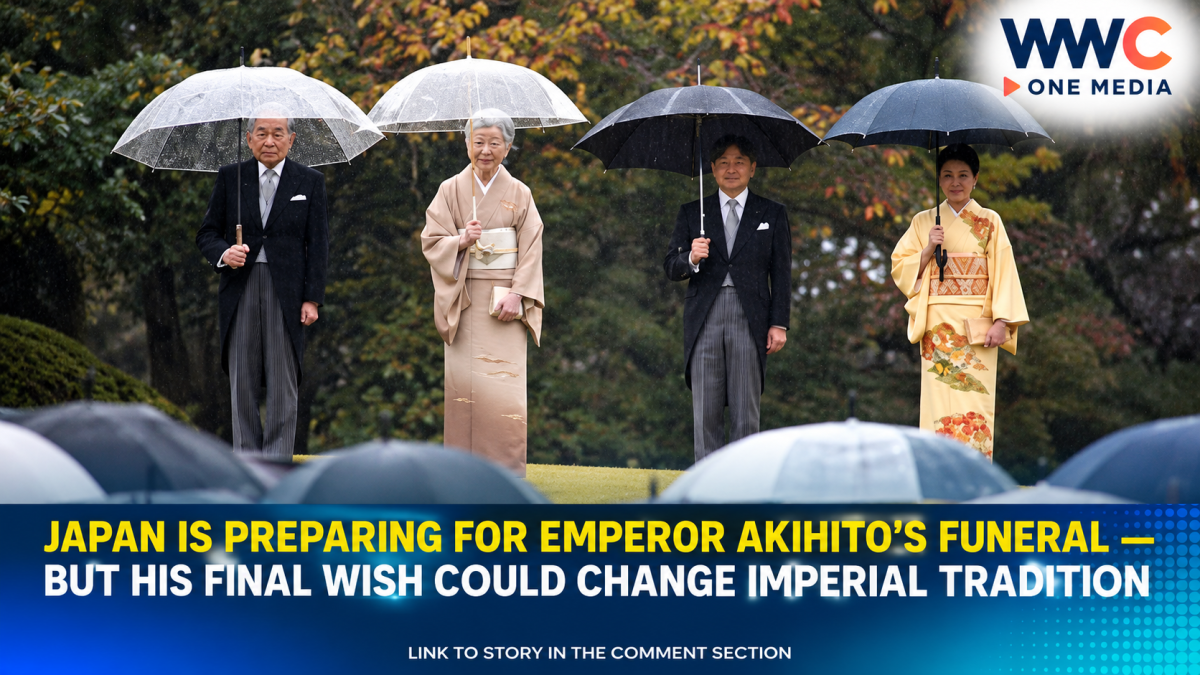
Japan is preparing for a major change in one of its most sensitive imperial traditions.
The Imperial Household Agency is considering a significantly smaller funeral ceremony for Emperor Emeritus Akihito, following his long-standing wish to minimize the disruption his funeral could cause to ordinary people.
Akihito, 92, is not reported to have any major health problems. The discussions are therefore advance planning, not an announcement of an imminent funeral. Japanese media reports say the agency is considering holding the principal funeral rite, known as the Sojoden-no-Gi, inside the Imperial Palace rather than at a large outdoor venue.
The proposed change could mark a striking departure from the enormous state ceremonies held after the death of his father, Emperor Hirohito, in 1989.
A Funeral Designed to Minimize the Burden on the Public
At the heart of the plan is a remarkably personal request.
Akihito has expressed the view that his funeral should have as little impact as possible on people’s lives. The Imperial Household Agency has consequently been examining a ceremony that would be smaller, simpler and less disruptive than the funeral arrangements for his father.
Japanese broadcaster TV Asahi reported that officials are considering holding the Sojoden-no-Gi in the Matsu-no-Ma, or “Pine Room,” inside the Imperial Palace.
The indoor venue would not simply reduce the scale of the event. It could also address concerns about sudden changes in weather and the safety of people attending the ceremony.
That makes the proposal about more than cost or ceremony.
It reflects Akihito’s long-standing preference for an imperial funeral that causes less inconvenience to the public and places less pressure on the environment and those involved.
The Difference Could Be Dramatic
The contrast with the funeral of Emperor Showa is enormous.
When Hirohito died in January 1989, his funeral ceremonies were held at Tokyo’s Shinjuku Gyoen National Garden. The state ceremony, known as the Taiso-no-Rei, drew roughly 10,000 people from Japan and overseas, including numerous foreign dignitaries.
The security operation was also massive.
TV Asahi reported that police deployed about 32,000 officers in a single day during the 1989 funeral arrangements.
The proposed arrangements for Akihito could reduce attendance to several thousand, with FNN reporting that officials are considering a figure of roughly 2,500 people if the ceremony is moved inside the palace. That number remains part of the current planning and is not a finalized attendance figure.
In other words, Japan could be preparing for an imperial funeral that looks dramatically different from the massive national event seen in 1989.
Akihito Has Been Preparing for This Change for Years
The idea is not new.
In 2013, the Imperial Household Agency announced that Akihito and Empress Emerita Michiko wanted smaller mausoleums and simpler funeral rituals than those used for previous emperors and empresses.
Their approach also included a departure from the traditional practice of burial.
Reports have said that the couple chose cremation, another significant change in imperial funeral traditions.
The broader philosophy was consistent: reduce the burden placed on the public while preserving the essential traditions of the Imperial Household.
Why the Venue Matters
Moving the ceremony indoors may sound like a logistical adjustment, but it carries wider implications.
The 1989 ceremony required the closure and extensive preparation of a major public space. The proposed palace ceremony could significantly reduce disruption to Tokyo residents and visitors.
It would also provide greater protection from increasingly unpredictable weather conditions.
Japanese media reports say Akihito has been concerned about protecting attendees from extreme heat, cold and sudden weather events such as torrential rain.
That concern is particularly notable because the emperor emeritus has repeatedly emphasized the relationship between the Imperial Family and ordinary citizens.
His Reign Changed the Image of Japan’s Monarchy
Akihito became emperor in January 1989, following the death of his father.
His reign, the Heisei era, lasted more than three decades before he became the first Japanese emperor in modern history to abdicate when he stepped down on April 30, 2019. His son, Emperor Naruhito, succeeded him the following day.
His decision to abdicate was itself historic.
In a 2016 televised message, then-Emperor Akihito indicated that advancing age made it increasingly difficult for him to fulfill his duties and suggested that he wanted to avoid becoming unable to carry them out.
The eventual funeral arrangements now being considered appear to follow the same philosophy: the institution should adapt to human limitations rather than place an ever-growing burden on society.
A Different Kind of Imperial Legacy
Akihito’s proposed funeral may therefore become symbolic in its own right.
His father’s death ushered Japan into the Heisei era through a highly visible national ceremony involving thousands of officials, dignitaries and members of the public.
Akihito, by contrast, has indicated a preference for something much quieter.
Japanese scholar Hideya Kawanishi, quoted by TV Asahi, said the approach reflects the Heisei-era image of an emperor who did not want to impose hardship on the public and sought to remain close to ordinary people.
That could make the eventual ceremony more than simply a smaller version of a traditional imperial funeral.
It could become a final expression of the kind of monarchy Akihito sought to represent.
What Happens Next?
For now, nothing has been finalized.
The Imperial Household Agency is still considering the details, including the venue, number of attendees and structure of the ceremonies. Reports indicate that the plans have been communicated to the current Emperor Naruhito and Crown Prince Akishino.
The important point is that Japan is planning ahead while Akihito remains alive and, according to the reports, without major health concerns.
That distinction matters.
This is not news of Akihito’s death or a warning that his death is imminent. It is a discussion about how Japan wants to handle an eventual imperial funeral when that time comes.
The bigger picture
Akihito’s proposed funeral could ultimately represent one of the clearest examples of how Japan’s monarchy has evolved.
Less spectacle.
Less disruption.
Fewer people.
A smaller physical footprint.
And behind all of it is the former emperor’s apparent belief that even an imperial farewell should not become an excessive burden on the people he spent decades serving.
Japan may therefore be preparing for an imperial funeral unlike the one it witnessed in 1989 — and the reason begins with Akihito himself.
WWC ONE MEDIA M.J.E

Leave a Reply