
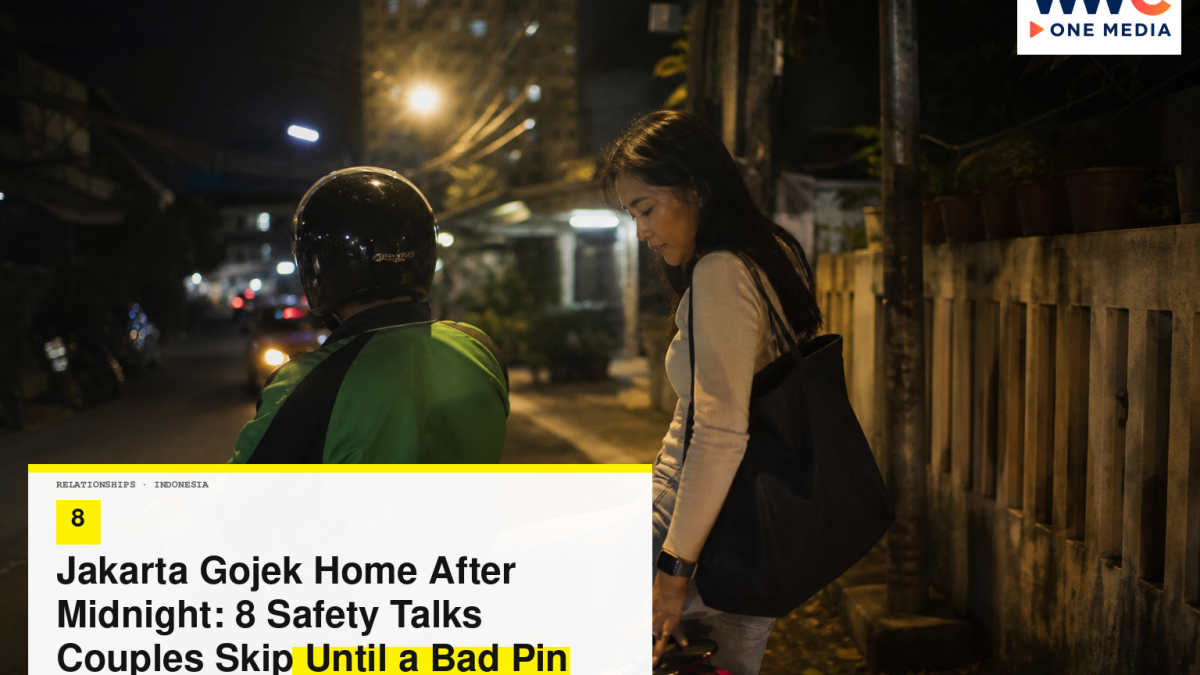
JAKARTA, Indonesia — Kemang looks finished. Senopati looks finished. The last plate at a warung on Jalan Barito is stacked and the street has that South Jakarta quiet that is not actually quiet: a generator, a guard radio, a motorbike that does not belong to anyone you know. Jakarta Gojek home after midnight is not a vibe. It is a pin, a plate, a live location, and a person who either waits downstairs or does not. Couples skip the safety talks until a bad pin puts one of them on a street that looks like the map and is not the door.
This is practical couple safety. Not a crime briefing. Not a lecture about the city. Eight talks you have on a Sunday afternoon in Cipete, in a mall food court at Pondok Indah, on a bench after MRT Blok M, while you still have daylight and two phones that are not dying. Write them once. The ride will still be late. The pin does not have to be a fight, and it does not have to be a guess.
1. The pin is the plan for a Jakarta Gojek home after midnight
South Jakarta eats vague pins. “Kemang” is not a door. “Near Senopati” is a corridor of one-ways, valets, and gates that look identical after the streetlights flatten them. “Fatmawati” is a station, a hospital gravity, a long road, and several clusters that all tell a driver they are “here.” A Jakarta Gojek home after midnight starts as a dropped pin on the actual gate, the actual lobby driveway, the actual kos warung that the driver can see without calling you twice.
Do this before you leave the table, not in the lobby while the driver is already circling. Open the map. Drop the pin on the curb you will actually stand on. Screenshot it into the chat. If you live in a cluster off TB Simatupang, the pin is the cluster gate, not the office park three turns back that Google still loves. If you live in a kos along Cipete Utara, the pin is the Indomaret or the warung with the red awning, not the middle of the gang where a car cannot enter and a bike has to guess.
Couples skip this talk because it feels fussy. It is not fussy. It is how you stop one person from walking toward a moving dot that is on the wrong side of a divider. Jakarta dividers after midnight are not a jog. They are a committed relationship with a concrete wall. If the pin is on the opposite carriageway, you do not “just cross.” You move the pin. You tell the driver in the in-app chat: gate on the south side, white security post, not the Alfa.
Name your default pins in Notes, both phones:
- Weeknight mine: [gate photo] [what3words or a landmark the driver will recognize] [“car can enter / bike only”]
- Weeknight yours
- Backup if the gate is closed: the 24-hour mini market on the main road, not a dark side street “because it’s closer”
A bad pin is usually not a stranger with a plot. A bad pin is you standing in the wrong driveway in Gandaria while the driver is in the right driveway according to a mall pin you dropped at lunch. The talk is: we never send a neighborhood name as a pickup. We send a photo of the gate and a pin on the gate. If the building has two lobbies — SCBD towers do this, so do apartments off Kuningan — you say which lobby. North. Podium. The one with the 7-Eleven, not the one with the mosque.
What not to do: drop a pin on the restaurant you just left and walk “toward the main road” while the driver hunts the restaurant. You are now two moving targets. Stand still or walk, not both. If you walk, you move the pin as you walk, and you say so in one line: walking to the Fatmawati MRT drop-off, new pin.
The first safety talk is boring on purpose. Boring pins get people home.
2. Share live location is not clingy. It is the ride.
WhatsApp live location for the length of the trip is the second talk. Couples skip it because it sounds like surveillance, or like you do not trust Gojek, or like you are performing fear in a city you both claim to know. You can know South Jakarta and still share a live location after midnight. Those are not opposites. One is geography. The other is a person in a vehicle you are not in.
Rule: if either of you is riding alone after midnight, live location goes on before the driver arrives, not after the bike has already turned onto Simatupang. Duration: until you type “inside.” Not “until I feel safe.” Inside. Door. Kos. Lobby turnstile. Then you stop it. The share is a window, not a lifestyle.
Who receives it: the person you are dating, and one other person if you have one — a sibling in Bekasi, a roommate in Tebet, a friend who is still awake because they also live like this. If you do not want a parent watching a dot at 1 a.m. in Depok, do not send it to a parent. Send it to the person who will actually call if the dot stalls on a flyover for too long.
What “too long” means is the sentence couples never write. Write it. If the dot is still for fifteen minutes and you have not texted “macet” or “driver stopped for petrol,” the other person calls. Not a paragraph. A call. If you do not pick up, they call again. If you still do not pick up, they use the in-app safety tools and the plate you already sent. This is not a movie. This is a protocol you agreed to when you were eating soto in a well-lit place in Blok M.
Live location also stops a smaller fight: the “I’m five minutes away” that is a lie because the driver took the toll and you are still in the unit. After midnight, five minutes is a person standing outside a gate that a satpam will not love. Share the dot. The person downstairs can wait with information instead of with a mood.
What not to do: share live location and then go silent on purpose to “see if they care.” That is not safety. That is a test, and tests after midnight make people do stupid things with phones in moving vehicles. Care is the call you agreed on. Care is not a trap.
If your phone is at 8 percent, that is part of the talk. Charge at the table. Borrow a cable in the cafe. Buy a tiny power bank in a minimarket in Fatmawati before you ride, not as a personality. A dead phone is a pin that cannot move and a location that cannot share. The ride does not care that your day was long.
3. Who waits downstairs
This is the talk South Jakarta kos life and cluster life both get wrong, in opposite directions. In a walk-up kos off Cipete, “downstairs” is a fluorescent corridor, a row of motorbikes, a door that slams. In a gated cluster off Pondok Indah or Lebak Bulus, “downstairs” is a satpam, a boom gate, a street that looks empty because it is designed to look empty. In an apartment in Kuningan or Sudirman, “downstairs” is a lobby with a receptionist who has seen every version of this night.
Who waits downstairs is not romance. It is coverage. If one of you is arriving by Gojek after midnight, the person already home does not “go to sleep, just text me.” They stay reachable. They watch the live location. They go downstairs if the gate requires a resident, if the kos door is locked from inside, if the cluster satpam will not open for a name they do not know. They do not have to stand in the road like a film. They have to be a human who can open a door.
Write the default by housing type:
- Kos with a locked front door: the person inside is awake and at the door when the pin is two minutes away. Not when the driver has already left you in the gang.
- Cluster: you send the guest name to the satpam in the group chat or you go to the gate. Drivers should not have to argue with a boom in Bahasa they are too tired to perform.
- Apartment lobby: you wait in the lobby, not “I’ll come down when you arrive,” which is how someone stands outside a glass door with a security guard watching them like a problem.
- Family house in a gang in Tebet or Menteng: you meet at the mouth of the gang, not at the house, unless the household knows this person is coming. After midnight, a bike in a residential gang is a story for the neighbors. Decide if you want that story.
If both of you are going to the same place, the first one in still waits. Not forever. Until the second pin says arrived and the second person is through the door. Then you can be tired. Tired is allowed. Invisible is not.
The talk includes the no. If you cannot wait downstairs because a parent is asleep in the next room, because a kos has a curfew that is already a problem, because you are not ready for this person to be a downstairs fact — say that before the ride, not as a surprise at the gate. Then you pick a public drop: a 24-hour JCO, a hotel lobby you can sit in for ten minutes, an Indomaret on the main road. You do not drop someone in a dark gap between two clusters because the house is complicated. The house being complicated is exactly when the drop has to be public.
What not to do: watch the live location from bed and then take four minutes to find sandals while they are already at a gate that will not open. Put the sandals on when the pin is five minutes out. This is not dramatic. This is how buildings work.
4. Plate, photo, name: you check before you tap, every time
Gojek shows you a plate, a photo, a name, a vehicle type. Couples treat this as a tutorial they outgrew. After midnight you treat it as the door. You do not get in, on, or even walk toward a bike whose plate you have not matched with your mouth.
The talk is a ritual, not a feeling:
- Read the plate out loud to the person on live location, or type it into the chat before you approach.
- Match the photo. If it is a different person, you do not negotiate on the curb. You cancel, you move to a lit place, you order again.
- Match the vehicle. A car when you ordered a bike is not a free upgrade. It is a different ride. A bike when you ordered a car is the same problem in reverse.
- You say the name on the app. They say yours, or they show the app. Awkward is fine. Awkward is shorter than a story.
If you are two people splitting a GoCar after a late dinner in Senopati, both of you check. One of you being “the one who deals with ojol” is how the other person never learns the ritual and then one night they ride alone. Both phones. Both eyes. The person who did not order still looks at the plate.
Helmets on a GoRide are not optional manners. If there is no extra helmet, you do not perform toughness. You cancel and order a car, or you wait for a bike that has one. After midnight a helmet is not a look. It is the talk you had when you were sober in a food court: we do not ride without one. If your hair, your hijab, your glasses make the helmet annoying, you still wear it. You can be annoyed at home.
Two people on one bike after midnight is a separate decision. Some couples do it because the fare looks kinder and the night feels shared. The talk is: only if both of you actually fit, both helmets exist, and the driver agrees without a shrug that means they do not. If the driver hesitates, you order a second bike or a car. You do not squeeze because you do not want to look high-maintenance in Kemang. High-maintenance is a word people use to skip safety. Skip the word.
What not to do: get on while still arguing with your partner about whose apartment. Finish the apartment sentence on the sidewalk. A moving bike is not a meeting.
5. Bike, car, and the route you will not shame
After midnight in South Jakarta, bike versus car is weather, clothing, alcohol, bags, and how far into a gang you live. It is not a personality. Couples skip this and then one of them is on a bike in a dress and sandals on Simatupang because the car ETA was nine minutes and they wanted to look easy.
Write the default:
- Rain, or rain an hour ago with wet roads: car.
- One of you has been drinking: car, or you do not ride until you can speak a plate clearly. If the app is hard to read, you are not ordering yet. Sit. Water. Then order.
- Luggage, a cake, a laptop bag you cannot strap: car.
- Short hop inside a well-lit grid you both know, both helmets, both sober: bike can be the right tool.
- Anything that requires a toll at that hour: say it. Tolls change the fare and the time. Surprises about tolls are a money fight wearing a safety jacket.
The route talk is the cousin. You do not shame a driver for not taking “the fast way” you use in the daytime. You also do not stay quiet if the car is heading toward a direction that is not your pin and not a logical toll. You speak early, in a normal voice: Pak, pin is Cipete, not further south. If you freeze because you do not want to be rude, you text the live-location person: off route, stay on the line. Rudeness is not the risk. Silence is.
If you know your cluster only opens from one inner road, put that in the in-app notes before the driver starts. After midnight is when drivers follow the pin into a one-way and then you both invent a U-turn as a couple activity. Do not. Notes. Landmark. “Masuk dari Jalan X, bukan Y.”
Money is part of safety because a stalled argument about who pays GoPay versus cash is a stalled curb. Decide before the order: the person who lives farthest, or the person who invited the late night, or split in the app. Do not unpack a wallet fight in a dark drop-off. Pay the ride. Fight about fairness in the lobby with the lights on.
6. The “I’ll just walk to the main road” trap
This is the South Jakarta special. The kos is in a gang. The cluster is behind a maze. The apartment drop-off is a driveway a car can use but a bike prefers the main road. One of you says, to be helpful, “I’ll walk out to the main road, easier for the driver.” After midnight, easier for the driver can be worse for you.
The talk: you walk to a main road only if the walk is short, lit, and on a pavement that exists. Many South Jakarta “main roads” are a high kerb, a drainage gap, a stretch with no walking space, and bikes moving like they own the night, because at that hour they do. If your walk to TB Simatupang or to Fatmawati Raya is a shoulder, you do not do it to be polite. You keep the pin at a place a human can stand: the guard post, the mini market, the MRT entrance if it is still staffed and lit, the hotel drop-off that will tolerate five minutes of waiting.
If you do walk, you walk with the phone in a pocket you can reach, not in a bag under a jacket. You share live location before you leave the gang, not after you are already on the big road. You do not put on earphones. You do not take a “shortcut” between two fences because it is how you walk in the afternoon. Afternoon has aunties and ojek bases. After midnight has neither.
Couples skip this because they have done the walk a hundred times. A hundred daytime walks are not a midnight walk. The talk is not “Jakarta is dangerous.” The talk is “our street has no pavement and we will not pretend it does at 1 a.m.”
If one of you is in heels, or a uniform, or carrying food that occupies a hand, the other person comes out further. Meet at the better light. The person with the easier shoes walks the extra two minutes. That is the relationship. Not a speech about independence on a road with no sidewalk.
What not to do: wait on a blind corner because the pin looks central. Central on a map can be a merger. Stand where a driver can stop without becoming a problem for traffic, and where you can see them before they see you as a blur.
7. The abort script for a bad pin
A bad pin is several species. The driver cannot find you. You cannot find the driver. The pin put you in a service lane behind a closed mall in Pondok Indah. The car arrived but the feeling in your body said no. The bike asked you to move to a darker spot “because polisi.” The route went strange and your voice did not work.
You need a script when your voice shrinks. Write it in Notes. Both phones. Practice it once out loud so it is not the first time you hear yourself say it.
On the sidewalk, if the match is wrong: “Sorry, wrong order.” You walk back to the light. You cancel in the app. You do not explain your life.
If the pin is a dead place: you walk toward people and light — a hotel, a 24-hour restaurant on a main road, a well-lit SPBU, a convenience store — and you move the pin there. You tell the live-location person: moving to [name]. You do not stay to “make it work” with a pin that already failed.
If you are already in the car or on the bike and you want out: “Pak, stop at the next Indomaret / SPBU / hotel.” You do not wait for a perfect sentence. You pick a public, lit, staffed place. You get out. You cancel the rest of the night if you have to. You can be wrong about the feeling and still be right to stop. The talk with your partner is: we do not debate a stop. We stop. We talk after we are standing.
If your partner is the one in the vehicle and they text “this is weird”: you stay on the call. You do not reply “haha maybe.” You ask where they are. You ask for the next lit place. You stay on the line until they are out. If they cannot talk, they send a pin. If they send a pin, you do not go back to sleep.
Couples skip the abort script because they think it is dramatic. Drama is improvising at 1:20 a.m. on a one-way in Cilandak with a dying battery. A script is the opposite of drama. It is a sentence you already agreed is allowed.
Also write the social abort: if the date itself went bad and you still need a ride, you do not have to share a GoCar to be polite. Separate rides. Separate pins. You can be civil and still not get in the same car with someone you no longer want to be in a car with. The app will charge you twice. That is cheaper than a trapped courtesy.
8. Arrival is a last message, not a vibe
You are not home when the pin says you are home. You are home when you are inside. The last talk is the last message: “inside,” plus anything the other person needs — gate stuck, satpam asked for KTP, driver was fine, I am eating leftover nasi. Then live location off. Then you can drop the phone.
Who watches you go in: if you live in a kos, the person who waited downstairs walks you to the door or watches from the corridor until the door shuts. If you live in a tower, they wait until you are in the lift lobby, not until the car pulls away from the canopy. If you live in a cluster, they wait until you are past the boom and the house light is on. Then they leave. This is not a lack of trust in the street. This is how two people close a loop.
If you are the one who was already home, you do not send “ok” from a half-sleep and then fail to hear the gate. You stay up for the loop. Ten minutes. You can be annoyed about sleep. You still close the loop. Tomorrow you can negotiate whose turn it is to be the late one. Tonight you finish the ride you are already in.
A second last message exists for the driver rating and the forgotten bag. Do it inside, not on the street with your head in a trunk. If you left a charger in a GoCar, you deal with it through the app from a locked door. You do not run back out into the road.
Parents and kos ibu will have their own arrival rules — curfew, guest log, no boys past the gate. Those rules are part of the couple talk because they change the pin. If you cannot bring someone to the door, the public drop and the “inside” text still happen. You do not skip safety because the household is strict. Strict households are extra reason for a public, lit last ten metres.
What not to do: start a relationship argument in the last two minutes of the ride so that the arrival message never comes. If you are angry, you are still inside first. Angry and on the street is two problems. Pick one at a time. Inside. Then the argument at a table, or the argument tomorrow, or the argument never if it was only the fare. The fare can be a Gopay screenshot. It does not need a yellow line.
South Jakarta pins that keep failing unless you name them
Kemang: multiple one-ways, valet pockets, restaurants that share a drop with a club and a kos. Pin the specific gate. If you are on Jalan Kemang Raya, say which side. If you are in Kemang Dalam, say so. Drivers who only got “Kemang” will stop where the lights are, which may not be you.
Senopati and SCBD: office-by-day, different traffic at night. Towers with two drop-offs. A GoCar that enters the wrong basement will eat twenty minutes and a security conversation. Meet at a street-level canopy you can photograph.
Fatmawati: MRT is a good public pin when the area around it is lit and you can stand without blocking the motorbike flow. It is a bad pin if your kos is a long unlit walk from the exit and you are performing independence. Combine: driver to the well-lit point, partner meets you there, you walk the last gang together.
Pondok Indah and Lebak Bulus: mall gravity, cluster mazes, streets that look the same. Cluster name plus gate color plus “dekat masjid / dekat taman” beats a pin in the centre of the compound.
TB Simatupang: fast road, bad walking, office parks that go dead. Do not be a pedestrian on Simatupang after midnight to save a driver two minutes. Pin a place a vehicle can stop.
Tebet and Menteng: gangs, one-ways, houses without numbers a stranger can see. Mouth of the gang plus a landmark. Partner at the mouth.
Blok M: still alive later than people think, which is useful. A busy pin is a feature. Use it as a transfer if your final street is sleepy.
Kuningan–Setiabudi: hotels are legal, boring waiting rooms. If a pin goes bad, a hotel drop-off is a better restart than a dark office driveway.
What not to do after a bad pin
Do not keep the original pin out of stubbornness. The pin already failed. Make a new one.
Do not split up so one of you “finds the driver” while the other “stays with the bags.” After midnight, you are one unit until you are inside. Bags can sit on a well-lit kerb with both of you.
Do not argue with a satpam as a couple performance. One person talks. The other watches the street and the phone. Then you leave the argument if it is not your building.
Do not post the plate in a group chat of twenty people as entertainment. Send it to the one person on the protocol. A pile of stickers is not help.
Do not shame your partner for cancelling a ride. Shame is how they will not cancel the next one.
Do not use alcohol as proof that you “know the way.” If you cannot read a plate, you are not the navigator.
Do not follow a driver into a second location because they need to “pick up a friend.” Cancel. Light. New order.
The two-phone Notes checklist
Copy this. Change the brackets. Send it.
- Default pins: mine, yours, backup mini market. Photos of gates.
- After midnight, live location on before the vehicle arrives. Off after “inside.”
- Plate, name, photo matched out loud. Helmet or we switch to a car.
- Who waits downstairs, by housing type, including the honest no.
- We do not walk a pavement that does not exist. We move the pin to light.
- Abort sentence: stop at the next Indomaret / SPBU / hotel. No debate in the vehicle.
- Separate rides if the date is over. Polite is not a shared back seat.
- Last message is “inside.” Loop closed. Then sleep, then the fare screenshot if it matters.
If one of you hates Notes, put it in the pinned chat. Same words. The app does not grade your filing system. It grades whether you had a pin when the street went blank.
Practice once on a not-late night. Order a short ride from Blok M to a well-known gate in Cipete in the early evening. Run the plate out loud. Run the live location. Run the downstairs wait. You will feel slightly silly. Silly is the point. You want the muscle memory before you need it on a Monday that ran too long in Senopati.
Objections couples use to skip the talks
“We’ve done this a thousand times.” Then the checklist takes four minutes and you still get the thousand-and-first ride. Frequency is not a protocol. Frequency is why you need one.
“I don’t want to live scared.” You are not living scared. You are dropping a better pin. A better pin is the least scared object in this city.
“It’s only Gojek.” Only is doing a lot of work. It is still a stranger, a vehicle, a street, a phone battery. Treat the brand as a tool. Tools get checklists.
“My kos ibu will be angry if someone waits.” Then the wait happens at the public drop, not in her stairwell. Household rules change the pin. They do not delete the loop.
“I don’t want to share my location. It’s private.” After midnight, privacy is the locked door. Until the locked door, a trusted person having the dot is the deal. If you do not have a trusted person, that is a different talk: you build one, or you do not do late solo rides you cannot close.
“We’ll just stay over.” Staying over is a visitor policy, a toothbrush, a parent, a kos rule, a condom, a morning TransJakarta. It is not a safety shortcut you invent at 12:40 because the pin is annoying. If staying over is on the table, it was on the table at dinner. If it was not, order the ride.
If one of you refuses every talk — pin, location, downstairs, abort — notice that. A partner who thinks your arrival is none of their business is telling you the relationship is a daytime activity. Believe them before a bad pin forces the lesson.
If one of you is in Bekasi or Depok and the night was in South Jakarta
The ride is longer. The fare is bigger. The live location matters more because the stall on a toll is a different stall than a stall on Cipete Raya. Who waits downstairs might be a parent who does not know you yet. The abort places change: rest areas are not Indomarets, and a toll is a bad place to improvise.
Say the true destination at the start. Do not “see how we feel” in Kemang and then add a city. Drivers and partners both deserve the real pin. If the real pin is a kos in Depok, the night in Senopati ends earlier. That is not a killed vibe. That is how the last ride stays a ride and not a sunrise.
Split the long fare on purpose. Long silent rides after a nice dinner are where people rewrite the date into a bill. Screenshot. Gopay. Then the last message from a door in a different city.
Bottom line
Jakarta Gojek home after midnight is eight talks, not a feeling: a South Jakarta pin on the real gate, live location until “inside,” who waits downstairs, plate and helmet every time, bike versus car without shame, no pavement-that-isn’t, an abort script for a bad pin, and a last message that closes the loop. Write them in Notes while the lights are still on in Blok M. The street after midnight will not become kinder. Your pin can.




Leave a Reply