
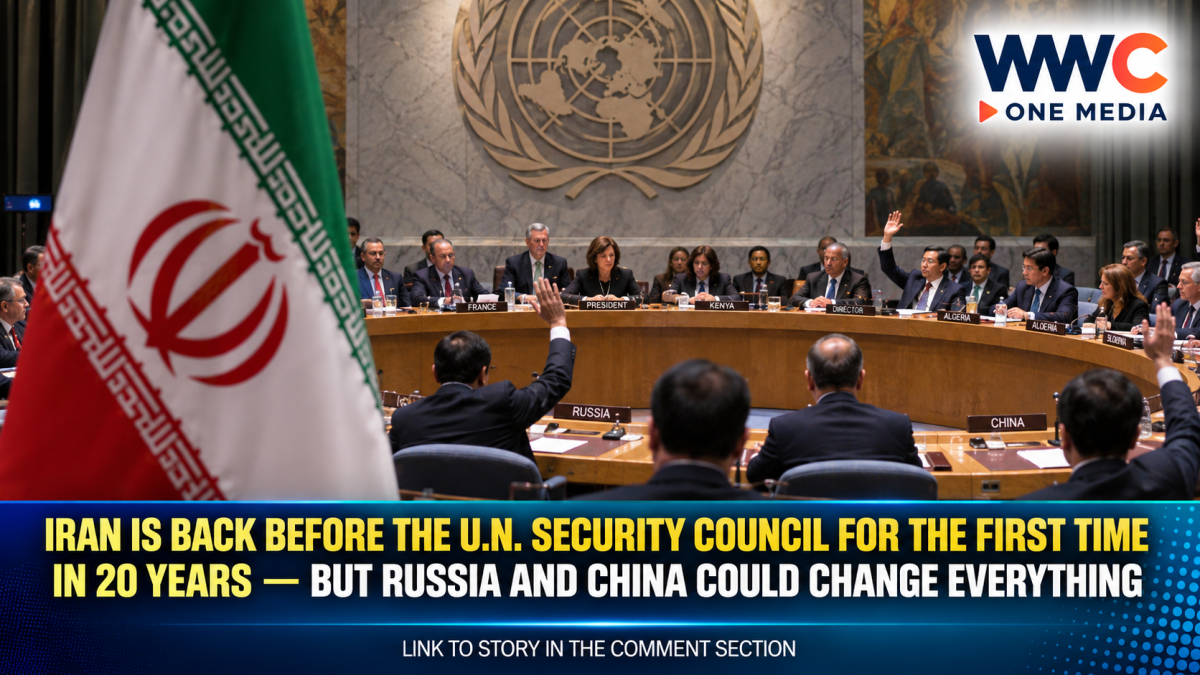
VIENNA — Iran has been formally reported to the United Nations Security Council over its nuclear program for the first time in two decades, dramatically escalating the international standoff as tensions between Tehran and Western powers continue to intensify.
The International Atomic Energy Agency’s 35-member Board of Governors voted on Wednesday to refer Iran to the U.N. Security Council over what the agency and Western governments describe as Tehran’s failure to comply with its nuclear nonproliferation obligations.
The resolution passed with 23 votes in favor, while Russia, China and Niger voted against it. Eight countries abstained, and one member did not vote. The United States, Britain, France and Germany backed the measure.
But while the vote marks a major diplomatic escalation, one critical question remains:
Can the Security Council actually do anything about it?
Why Was Iran Referred to the Security Council?
The latest move centers on Iran’s long-running dispute with the IAEA over uranium traces discovered at several undeclared locations inside the country.
Western officials believe those traces could provide evidence of a previously concealed nuclear weapons program that may have existed until 2003. Iran, however, has repeatedly denied seeking nuclear weapons and insists its nuclear activities are entirely peaceful.
The diplomatic dispute has been building for more than a year.
In June 2025, the IAEA Board of Governors formally found Iran to be in noncompliance with its nuclear nonproliferation obligations. Wednesday’s resolution took the next major step by asking IAEA Director General Rafael Grossi to report the agency’s concerns to both the U.N. Security Council and the U.N. General Assembly.
The resolution also calls on Iran to urgently address its noncompliance and provide the assurances required to demonstrate that nuclear material is not being diverted for military purposes.
First Referral in 20 Years Raises the Stakes
The referral is particularly significant because it is the first time in 20 years that the IAEA’s governing board has sent Iran’s nuclear case to the Security Council.
A Security Council referral can potentially open the door to further international action, including sanctions or asset freezes.
However, major punitive action is far from guaranteed.
Iran’s key partners, Russia and China, are both permanent members of the Security Council and have veto power. Their opposition could make it extremely difficult for Western powers to secure strong new measures against Tehran.
That means the vote may be more immediately significant as a political and diplomatic escalation than as a guarantee of new sanctions.
Iran Says the Vote Is Politically Motivated
Tehran sharply rejected the resolution.
Iranian Ambassador Reza Najafi described the measure as a political tool and argued that it undermined confidence in the IAEA’s independence and impartiality.
Iran has also argued that the continuing military conflict with the United States and Israel has made nuclear inspections impossible at some locations.
Since Iranian nuclear sites were attacked during the June 2025 conflict, the IAEA has been unable to regain access to facilities affected by the strikes. The agency has also been unable to verify the current status of Iran’s stockpile of highly enriched uranium.
Iranian officials argue that the international community is demanding inspections while military conditions continue to prevent safe access.
“They attack Iran’s safeguarded nuclear facilities, disrupt the normal verification process, and then use that very disruption as a pretext” for action against Iran, Deputy Foreign Minister Kazem Gharibabadi said in comments reported by the Associated Press.
The Uranium Stockpile at the Center of Global Concern
One of the biggest concerns surrounding Iran’s nuclear program is its stockpile of uranium enriched to 60% purity.
According to the IAEA, Iran has maintained a stockpile of approximately 440.9 kilograms of uranium enriched to 60%.
While 60% enriched uranium is not the same as weapons-grade material, it is much closer to the roughly 90% level generally associated with nuclear weapons.
IAEA chief Rafael Grossi has previously warned that, if Iran chose to weaponize its nuclear program, such material could theoretically provide enough nuclear material for multiple bombs.
However, the IAEA and international reports have stressed an important distinction: having enough enriched material to potentially produce weapons is not the same as possessing a nuclear weapon. Iran continues to deny that it is building one.
U.S. and European Powers Increase Pressure
The resolution was introduced with the support of the United States, Britain, France and Germany.
For Washington and its European allies, the vote sends a clear message that Iran’s nuclear dispute is moving back to the center of international diplomacy.
Reuters reported that the resolution followed a previous finding of Iranian noncompliance and that the Security Council is unlikely to take immediate concrete action because Russia and China can use their veto power. Still, the referral represents a significant escalation in the broader diplomatic confrontation between Tehran and Western governments.
The timing is also critical.
The nuclear dispute is unfolding against the backdrop of continuing military tensions between Iran, the United States and Israel, making international efforts to restart inspections and diplomacy even more complicated.
What Happens Next?
Iran’s referral to the Security Council does not automatically mean new sanctions or immediate punishment.
The next stage will depend heavily on diplomatic maneuvering among the Security Council’s major powers.
The United States and European governments could push for additional pressure on Tehran. But Russia and China are expected to resist measures they see as excessive or politically motivated.
That leaves the world facing a new and potentially dangerous diplomatic deadlock.
The IAEA wants answers about uranium traces and access to Iranian nuclear sites.
Western governments want greater transparency and stronger guarantees.
Iran says its nuclear program is peaceful and insists that ongoing military threats make compliance and inspections difficult.
And now, for the first time in 20 years, the dispute has been pushed back to the U.N. Security Council.
The vote may not immediately trigger new sanctions — but it has reopened one of the world’s most dangerous nuclear standoffs at a time when diplomacy is already under enormous strain.



Leave a Reply