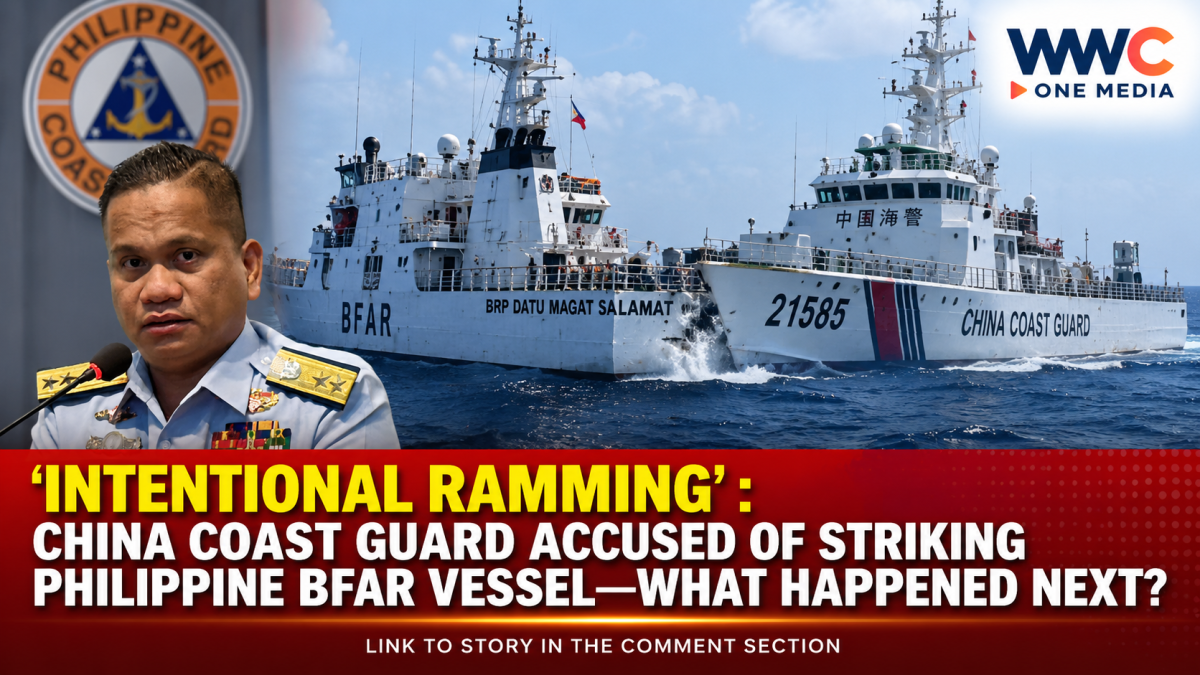
MANILA, Philippines — A fresh maritime confrontation between the Philippines and China has erupted in the West Philippine Sea after the Philippine Coast Guard (PCG) accused a China Coast Guard vessel of deliberately ramming a Philippine fisheries vessel during a mission to deliver fuel assistance to Filipino fishermen.
The incident happened on September 18, 2026, involving the Bureau of Fisheries and Aquatic Resources (BFAR) vessel BRP Datu Magat Salamat and China Coast Guard vessel CCG-21585, according to Philippine officials and multiple reports.
PCG spokesperson for the West Philippine Sea Rear Admiral Jay Tarriela described the incident as an intentional ramming rather than an accidental collision. The Philippine side said the BFAR vessel was carrying out a maritime patrol and fuel-subsidy mission for Filipino fishermen when the Chinese vessel made contact with it.
Philippine Coast Guard: Chinese vessel made repeated maneuvers
According to the Philippine account, CCG-21585 first passed behind the BFAR vessel at about 11:04 a.m., coming within roughly 10 meters of the Philippine ship.
About nine minutes later, Tarriela said, the Chinese vessel repeated the maneuver and this time struck the BRP Datu Magat Salamat. CNA and Reuters also reported the same sequence based on statements from the Philippine Coast Guard.
The collision reportedly damaged portions of the BFAR vessel, including railings, metal supports and deck structures. Reuters reported that no injuries were reported, while photographs released after the incident showed damaged and detached sections of the ship.
Video released by the Philippine Coast Guard reportedly captured the Chinese vessel close to the stern of the Philippine ship, with a crew member heard warning of a collision. CNA noted that the actual moment of impact was not visible in the footage it reviewed.
China gives a sharply different account
Beijing has disputed the Philippine version of events.
China Coast Guard spokesperson Jiang Lue said the Philippine vessel ignored repeated warnings, changed course and accelerated across the bow of the Chinese vessel. China said the Philippine side was responsible for the collision and accused Manila of threatening the safety of Chinese coast guard personnel and vessels.
That means the central question surrounding the incident—who caused the collision and whether the contact was deliberate—remains contested between the two governments.
BFAR vessel was on a fuel mission for Filipino fishermen
The BRP Datu Magat Salamat was reportedly operating about 54 nautical miles off Palawan while delivering fuel assistance to Filipino fishermen.
The mission forms part of the Philippine government’s effort to provide livelihood assistance to Filipino fishing communities operating in contested waters. Reuters described the vessel as being on a resupply mission, while the PCG characterized the operation as a humanitarian and livelihood mission.
The latest confrontation comes amid renewed tensions between Manila and Beijing in the South China Sea.
Earlier reports on September 18 also said Chinese maritime forces were present around Bajo de Masinloc, or Scarborough Shoal, while Philippine authorities were distributing fuel subsidies and food packs to Filipino fishermen. GMA News reported that the PCG had observed a People’s Liberation Army Navy warship, three China Coast Guard vessels and three Chinese maritime militia vessels in the area.
A wider pattern of maritime confrontations
The latest incident is not isolated.
Philippine authorities and Chinese maritime forces have repeatedly faced off in contested areas of the South China Sea, with previous incidents involving water-cannon attacks, dangerous maneuvers and physical contact between vessels.
The Philippines has invoked the 2016 South China Sea arbitral ruling, which rejected the legal basis of China’s sweeping historic-rights claim over the disputed waters. China has rejected the ruling and continues to assert extensive claims in the South China Sea.
The confrontation involving the BRP Datu Magat Salamat adds another potentially dangerous episode to the continuing maritime dispute.
For now, the two sides remain divided over the crucial question of what happened immediately before the collision: Manila says the Chinese vessel deliberately struck the BFAR ship, while Beijing says the Philippine vessel caused the encounter by cutting across its path.