
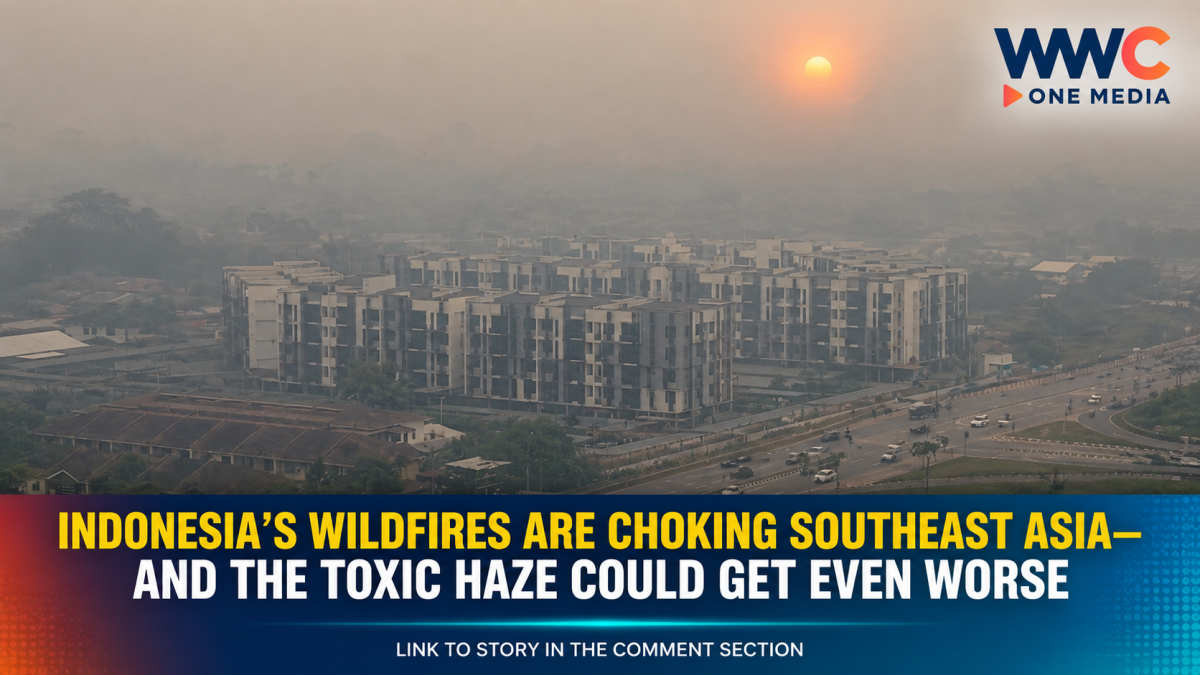
JAKARTA, Indonesia — A worsening wildfire crisis in Indonesia is sending thick, toxic haze across Southeast Asia, disrupting schools, threatening public health and pushing parts of neighboring Malaysia into emergency measures as smoke travels hundreds of kilometers beyond the Indonesian archipelago.
Fires burning across parts of Sumatra and Kalimantan have intensified during one of Indonesia’s harshest dry periods in years, with hot and dry conditions linked to a powerful El Niño pattern helping flames spread across forests and fire-prone peatlands.
The result is a familiar but increasingly alarming regional crisis: transboundary haze.
Smoke from the Indonesian fires has reached neighboring countries including Malaysia, Singapore, Brunei and the Philippines, raising concerns about deteriorating air quality for millions of people across Southeast Asia.
Malaysia takes emergency action as haze worsens
Malaysia has been among the countries hit hardest by the drifting smoke.
Authorities declared emergency measures in the Serian district of Sarawak after air pollution reached hazardous levels, as thick haze blanketed parts of Malaysian Borneo. The deteriorating conditions have also disrupted outdoor activities and raised concerns over respiratory illnesses.
Recent reports described the haze crisis in parts of Borneo as among the region’s most serious in years, with authorities monitoring pollution levels and urging residents to reduce outdoor exposure.
The crisis highlights how fires in Indonesia can quickly become an international problem once seasonal winds begin carrying smoke across national borders.
Singapore and the Philippines also feel the impact
The haze has not stopped at Indonesia and Malaysia.
Air quality in Singapore has also deteriorated as smoke from Indonesian fires spread across the region.
Meanwhile, haze linked to the Indonesian wildfires has reached parts of the Philippines, prompting authorities and health experts to advise the public to monitor air-quality conditions and limit unnecessary exposure when pollution levels worsen.
Air-quality monitoring company IQAir earlier reported poor conditions across parts of Southeast Asia, including areas of Malaysia, Indonesia and the Philippines, as forest-fire smoke and peatland burning affected the region.
The crisis demonstrates the enormous reach of Indonesia’s wildfires: smoke generated in Sumatra and Borneo can cross seas and national boundaries, turning a local environmental disaster into a regional public-health emergency.
1.4 million Indonesian students pushed into remote learning
Indonesia itself is bearing the heaviest burden.
Around 1.4 million students in six Indonesian provinces were shifted to online learning because of poor air quality caused by the fires and resulting haze.
The move underscores the scale of the crisis, which is affecting not only forests and communities near the fires but also schools, transportation, businesses and public services.
Indonesian authorities have deployed firefighting aircraft, water-bombing operations and other emergency measures in an effort to contain the blazes.
But the battle has become increasingly difficult.
Government officials have warned that efforts to control the fires could remain challenging as dry conditions intensify and El Niño reaches a critical period.
Why Indonesian fires create such dangerous haze
Indonesia’s wildfire problem is particularly dangerous because many fires burn in or near peatlands.
Unlike ordinary surface fires, peat fires can smolder underground and continue burning for long periods. They also produce enormous amounts of smoke and particulate pollution, making them especially difficult to extinguish.
Dry weather compounds the problem.
A recent Reuters analysis found that Indonesia’s fires have surged amid exceptionally dry conditions, with thousands of hotspots detected and large areas of land affected.
The fires are also linked to human activity, including land clearing. Indonesian officials have acknowledged that human actions remain a major factor behind many of the country’s forest and land fires.
A regional problem with no borders
The latest crisis has once again exposed one of Southeast Asia’s most persistent environmental challenges: a fire in one country can quickly affect the health and economy of several others.
Indonesia, Malaysia, Singapore and other ASEAN countries have long struggled to address transboundary haze through regional cooperation.
But recurring fires — especially during severe dry seasons — continue to test those efforts.
Experts warn that the current conditions could worsen before meaningful relief arrives, particularly if dry weather persists and more fires break out.
The crisis is also putting renewed pressure on governments and companies to address the underlying causes of Indonesia’s annual fire problem, including land management, peatland degradation and illegal burning.
The haze crisis could get worse
Indonesia is continuing firefighting operations as authorities race to prevent the fires from spreading further.
But the danger extends far beyond the flames.
As long as fires continue burning across Sumatra and Kalimantan, shifting winds could carry hazardous smoke to more communities across Southeast Asia.
For millions already living under polluted skies, the biggest question is no longer simply when the fires will end.
It is whether the region’s governments can stop the haze from becoming an even bigger cross-border disaster.
WWC ONE MEDIA J.M.S



Leave a Reply