
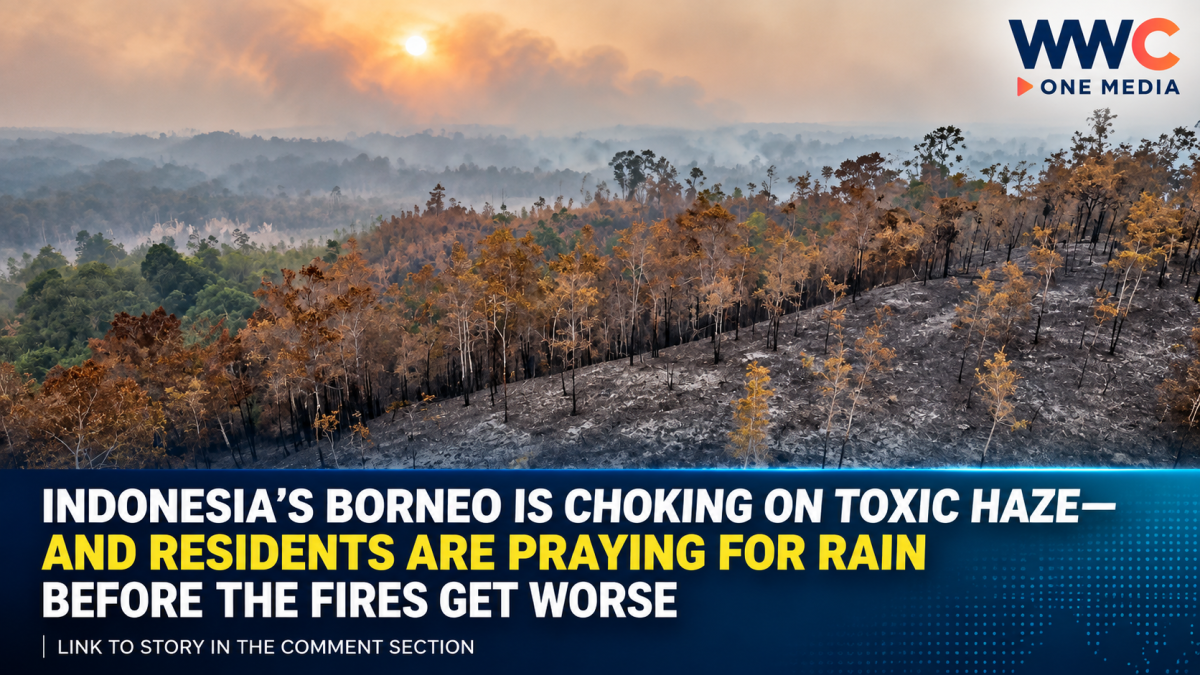
Residents of Indonesia’s Borneo island are desperately praying for rain as devastating wildfires continue to burn across Kalimantan, sending thick toxic haze into communities and across international borders in what is becoming one of Southeast Asia’s most serious environmental crises of 2026.
The fires have engulfed forests and peatlands across parts of Indonesian Borneo, with smoke spreading beyond Indonesia and affecting neighboring countries including Malaysia. The crisis has also raised wider concerns across Southeast Asia as authorities race to contain the fires before conditions deteriorate further.
According to an AFP report published by ABS-CBN News, communities in Indonesian Borneo are struggling with choking haze as wildfires continue to ravage the region. The disaster has put enormous pressure on residents and emergency workers, with many hoping that rain could provide desperately needed relief from the flames and hazardous smoke.
Fires Turn Borneo Skies Into a Toxic Blanket
The scale of the crisis has become increasingly alarming.
Reuters reported that Indonesia has intensified firefighting operations across six of the country’s hardest-hit provinces in Sumatra and Borneo. Authorities have deployed measures including cloud seeding and water-bombing operations as prolonged dry conditions create ideal conditions for fires to spread.
Wildfires have also spread near Indonesia’s under-construction new capital, Nusantara, prompting authorities to call for stronger emergency measures.
The fires are being fueled by extreme drought conditions linked to an intensifying El Niño weather pattern, according to multiple reports. Dry vegetation and vulnerable peatlands have made the fires especially difficult to control.
Unlike ordinary forest fires, peat fires can burn underground and continue smoldering for extended periods, making them difficult to detect and extinguish.
The Smoke Is No Longer Just Indonesia’s Problem
The consequences of the Indonesian wildfires are now being felt far beyond Borneo.
Haze from the fires has spread into neighboring Malaysia, prompting serious concerns about air quality and public health. The ASEAN Specialized Meteorological Centre activated its highest Level 3 transboundary haze alert for parts of Southeast Asia amid increasing hotspots and prolonged dry weather.
Reuters reported that Malaysia temporarily declared an emergency in the Sarawak district of Serian as air quality deteriorated because of haze linked to fires on the Indonesian side of Borneo. Although conditions later improved enough for the emergency declaration to be lifted, authorities warned that poor air quality and health risks remained.
The crisis demonstrates how quickly Indonesia’s annual fire problem can become a regional emergency.
Smoke and haze have also been reported across other parts of Southeast Asia, with recent reporting indicating that the effects have reached countries including Singapore, Brunei and the Philippines.
More Than 1.4 Million Students Hit by Haze Crisis
The environmental disaster is also disrupting education on a massive scale.
Reuters reported that wildfire haze forced around 1.43 million Indonesian students into remote learning, with more than 1.1 million of those students located in West Kalimantan alone. Schools were affected as authorities attempted to protect children from exposure to dangerous air pollution.
Associated Press also reported that worsening haze has forced widespread school closures across Indonesia, with more than 1.4 million students nationwide affected by remote-learning measures.
In Palembang alone, more than 250,000 students were affected as schools shifted away from in-person classes because of hazardous air conditions.
The crisis is now affecting not only the environment but also children’s education, public health and daily life.
Wildfire Emissions Surge to Alarming Levels
New data has added another alarming dimension to the disaster.
Reuters reported that carbon dioxide emissions from Indonesian wildfires between September 1 and September 7 reached an estimated 19.7 million metric tons, according to the European Union’s Copernicus climate monitoring service.
The figure reportedly accounted for more than one-third of global wildfire emissions during that period, placing Indonesia’s wildfire emissions above those of any other country. The surge has been linked to extreme drought and intense fire activity, particularly in Kalimantan and eastern Sumatra.
Experts have also warned that the true impact could be even greater because underground peat fires are difficult to monitor from satellites.
International Help Arrives as Firefight Intensifies
Indonesia’s battle against the fires is increasingly becoming an international effort.
Japan has deployed a disaster relief mission to Indonesian Borneo to assist firefighting operations. Associated Press reported that the mission includes approximately 300 personnel, the Japanese transport ship JS Kunisaki and three CH-47 Chinook helicopters.
The deployment marks the first international firefighting mission involving Japan’s Self-Defense Forces.
Indonesia has also received assistance and support from several international partners as authorities attempt to contain fires across remote and difficult terrain.
But despite aircraft, helicopters, cloud-seeding operations and thousands of emergency personnel, the situation remains heavily dependent on weather conditions.
Residents Pray for Rain as the Crisis Continues
For many communities living under the haze, the answer may ultimately come from the sky.
Rain could help suppress fires, reduce smoke pollution and bring temporary relief to areas where clean air and water have become increasingly difficult to access.
But authorities face a difficult reality: prolonged drought and El Niño conditions could continue to create dangerous fire conditions in the weeks ahead.
The crisis is also reviving painful memories of Indonesia’s devastating 2015 wildfire disaster, one of the worst haze crises in Southeast Asian history.
With fires continuing to burn, millions exposed to polluted air and smoke crossing international borders, Indonesia’s Borneo wildfire emergency is rapidly becoming a regional test of disaster preparedness and cooperation.
For residents trapped beneath the thick haze, however, the immediate hope remains much simpler:
Rain.
And they are still waiting.




Leave a Reply