
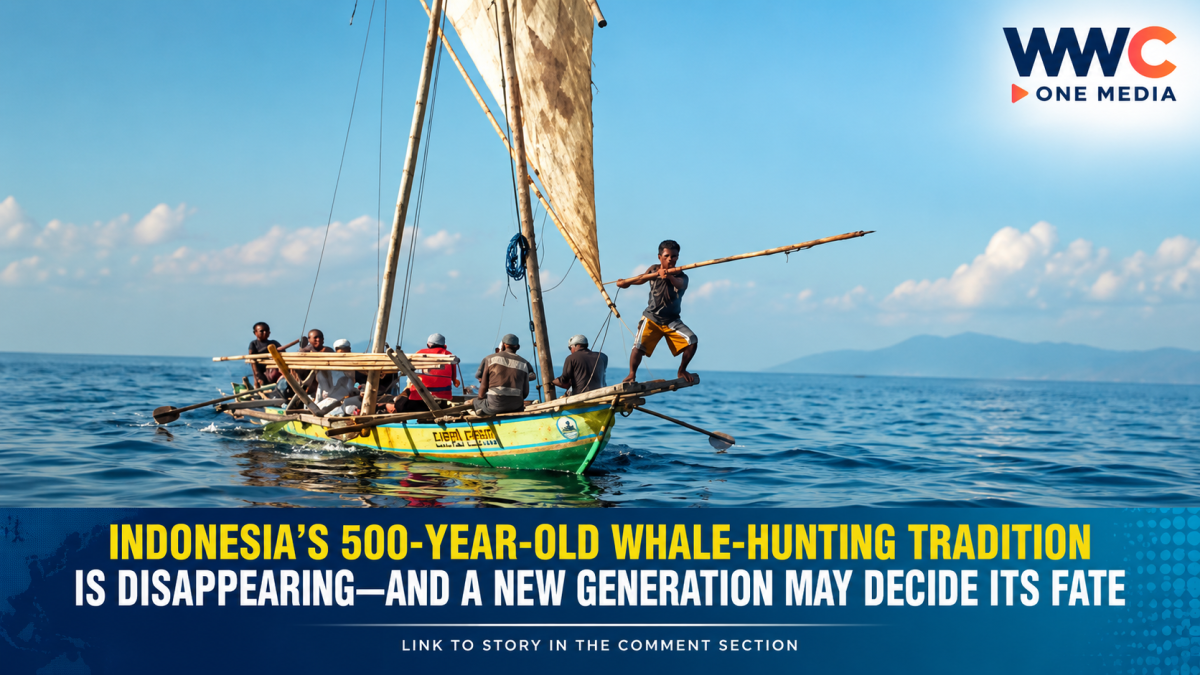
LAMALERA, Indonesia — On the remote island of Lembata in Indonesia’s East Nusa Tenggara province, an extraordinary tradition has survived for centuries: fishermen setting out in small wooden boats to hunt whales using little more than hand-crafted equipment and generations-old knowledge.
But the future of the practice is increasingly uncertain.
For the people of Lamalera, traditional whale hunting is not primarily a commercial industry. It has historically been part of a subsistence economy and cultural system, providing food for the community while also supporting an intricate tradition of sharing and bartering with neighboring communities.
Now, however, modernization, changing economic opportunities, conservation concerns and a generational shift are raising a difficult question: Can a centuries-old way of life survive in a rapidly changing Indonesia?
A tradition measured in centuries
Lamalera’s whale-hunting culture is believed to be more than 500 years old, with historical records documenting the community’s hunts centuries ago. Indonesia’s tourism authorities describe the tradition as a longstanding cultural practice that has been passed from generation to generation.
The annual hunting season is surrounded by religious and traditional rituals. In this predominantly Catholic community, the season begins with a Mass and customary ceremonies seeking protection and good fortune before fishermen head into the sea.
The fishermen traditionally use paledang, wooden boats propelled without modern industrial fishing equipment. At the front stands the lamafa, the designated harpooner, who uses a traditional spear to attempt to strike the whale.
It is an extremely dangerous form of fishing.
CNA reported that the fishermen can face serious injury or death when confronting whales in the open sea, with skills and techniques handed down through generations.
Not every whale can be hunted
One of the most important aspects of the tradition is that the community has its own customary restrictions.
Indonesian tourism authorities say Lamalera’s traditional rules prohibit hunting certain whales, including blue whales, while local rules also prohibit taking pregnant or young whales and whales that are mating. The community traditionally targets sperm whales, locally known as koteklema.
The Indonesian government’s tourism office has highlighted these customary rules as part of the community’s effort to maintain its relationship with the marine environment.
But that does not eliminate the broader conservation debate.
Researchers have pointed to tensions between traditional whaling practices, modern conservation policies and international efforts to protect marine biodiversity. A 2026 academic study found that Lamalera’s customary ecological rules can come into conflict with national and international conservation frameworks.
A conservation debate with no easy answer
Lamalera’s situation is particularly complicated because the community’s traditional hunting grounds are located in the Savu Sea, an important marine ecosystem that was designated a national conservation area in 2014. Researchers have documented concerns among Lamalera residents that conservation measures could eventually restrict their traditional access to the sea.
At the same time, researchers have argued that conservation policy needs to recognize indigenous and customary systems rather than treating all forms of whaling as identical.
A recent study of Lamalera described the community’s customary system as a form of moral and ecological law governing whale harvesting, highlighting the gap that can emerge when standardized conservation policies collide with local traditions.
That makes Lamalera’s future less straightforward than a simple choice between “save the whales” and “save the tradition.”
For the community, both the marine environment and the cultural system are intertwined.
The biggest threat may not come from the sea
Perhaps the greatest challenge is not simply conservation rules.
It is modern life.
CNA’s reporting highlights how younger generations are increasingly facing opportunities outside traditional whaling, while changes in the local economy and aspirations are making the centuries-old occupation harder to sustain.
Indonesian tourism authorities have similarly acknowledged concerns that younger people may increasingly choose modern livelihoods over the demanding traditions of their ancestors.
That creates a striking possibility: the tradition could disappear not because it is formally banned, but because fewer young people choose to continue it.
UNESCO recognition could change the conversation
Indonesia is now seeking UNESCO recognition for the Lamalera tradition as an important element of cultural heritage, according to CNA.
The effort could give greater international visibility to a community whose way of life is rarely understood outside Indonesia.
But recognition alone cannot guarantee the tradition’s survival.
Lamalera also needs a future in which younger residents can see cultural heritage as compatible with education, employment and economic security.
Indonesian tourism officials have proposed developing sustainable cultural and ecological tourism around Lamalera, including cultural education, whale watching, marine ecology activities and other forms of ecotourism.
A tradition caught between two worlds
For generations, Lamalera’s fishermen have gone to sea using methods that appear almost unchanged by modern technology.
But the world around them has changed dramatically.
Conservation standards are evolving. Economic opportunities are expanding. Young people have more choices. Tourism is growing. And the community itself must decide how much of its ancestral way of life it wants — and is able — to carry forward.
The question facing Lamalera is therefore not simply whether whale hunting will continue.
It is whether the knowledge, rituals, community relationships and identity surrounding the tradition can survive even as the role of whale hunting itself changes.
After hundreds of years, the future of Lamalera’s whale hunters may ultimately depend on whether the next generation believes the tradition still has a place in the modern world.
WWC ONE MEDIA J.M.S

Leave a Reply