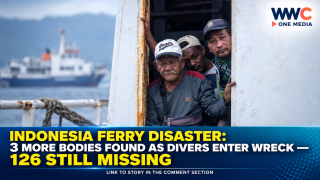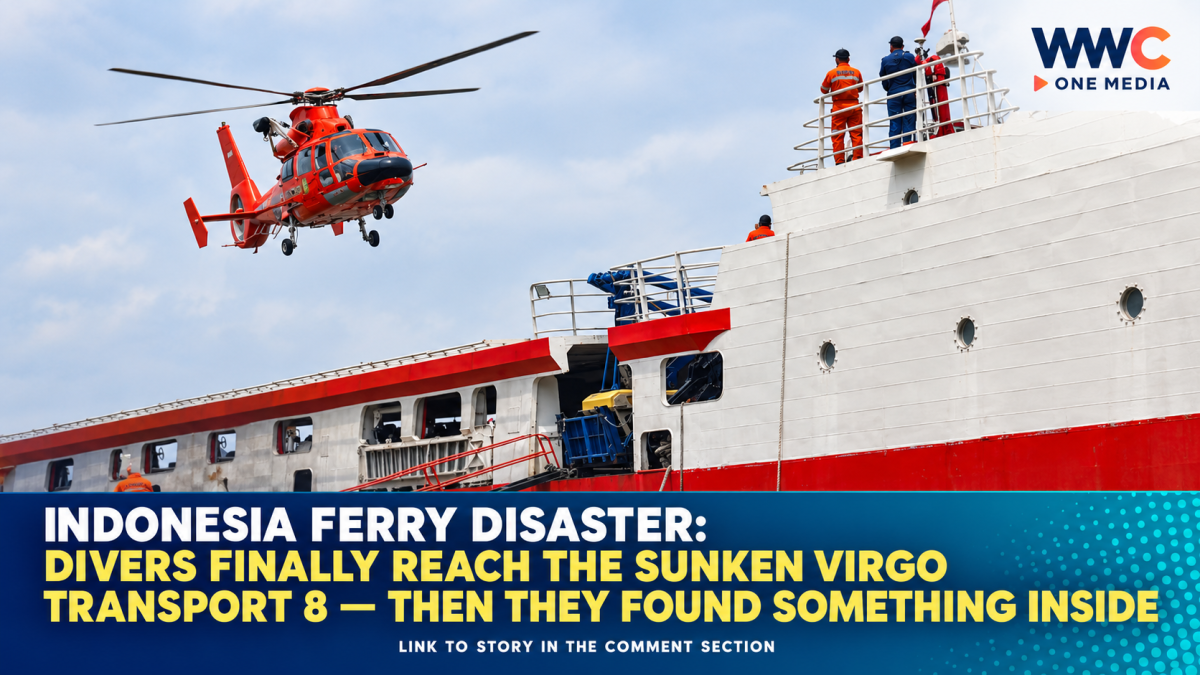
JAKARTA — Indonesia’s search-and-rescue operation entered a critical new phase on Friday after Navy divers managed to enter the sunken Virgo Transport 8, recovering three bodies as authorities began an operation to right the capsized ferry in the Java Sea.
The latest figures reported by Reuters put the confirmed death toll at nine, while 108 people have been rescued and 126 remain unaccounted for out of the 243 people aboard the vessel.
The ferry capsized early Sunday, September 13, while making a roughly 20-hour journey from Surabaya in East Java to Banjarmasin in South Kalimantan. The vessel was carrying passengers, crew and vehicle-related personnel when severe weather struck.
Divers face dangerous conditions underwater
The search has been complicated by strong currents, high waves, wind and the structure of the ferry itself.
According to Reuters, currents at the wreck site initially reached nearly 7 knots, well above the reported 1.5-knot safety limit for diving. Conditions later eased to between 1.8 and 2 knots, allowing Navy divers to approach the wreck during a limited operating window. Waves of up to 2.5 metres have also hampered the operation.
The vessel, a 119-metre roll-on/roll-off ferry, eventually sank to the seabed. Government data cited by Reuters puts the surrounding Java Sea at roughly 40 to 50 metres deep.
Its design presents another major obstacle. Unlike conventional passenger vessels with easily accessible rows of windows, the Virgo Transport 8 has high hull sections designed for transporting vehicles. Rescuers say this makes access to the passenger areas particularly difficult.
Three bodies recovered inside the wreck
In a significant development Friday, three Navy divers entered the vessel during a salvage operation and recovered three bodies — two men and one woman, according to a Navy official cited by Reuters.
The first body was spotted through a ship window. Divers broke the glass and recovered it before finding two additional bodies. The underwater operation was subsequently suspended because currents became too strong. Officials said diving would resume when conditions improve.
The recovery represents a breakthrough after several days in which divers struggled to reach the wreck.
Earlier reporting had said roughly 60 divers from Indonesia’s Navy and national rescue agency were involved in the effort. Overall, about 1,100 personnel have been working in shifts, supported by ships and aircraft.
Authorities begin effort to right the ferry
Authorities have also started an operation to reposition the sunken vessel.
The plan is to move the ship toward shallower water and then attempt to right it, potentially giving rescuers better access to compartments that remain difficult or impossible to reach in its current position. The operation is being led by the vessel’s owner, with support from Indonesia’s rescue agency, Navy and maritime police.
Eight ships and two helicopters were deployed on Friday for continued surface and aerial searches, although strong winds, waves and currents remained a major challenge.
Why entering the ferry is so dangerous
Even reaching the wreck does not guarantee that divers can immediately search its interior.
Maritime expert Marcellus Jayawibawa told Reuters that divers entering flooded compartments could face near-zero visibility and unfamiliar internal layouts.
Another concern is the possibility of trapped air inside sealed compartments. If a watertight compartment contains air while surrounded by seawater, opening it can create a sudden pressure and water-flow hazard, potentially endangering both rescuers and anyone who might still be inside.
Authorities have therefore continued treating the operation as a rescue effort rather than solely a recovery mission.
Search continues as families wait for answers
The tragedy has left families waiting for news of relatives who remain missing.
The ferry disaster has also highlighted the severe operational challenges of conducting underwater rescue operations in the Java Sea, where weather and currents can change rapidly.
Indonesian officials have said the search will continue, with Reuters reporting that the operation is legally required to continue for at least a week.
For now, rescuers face a race against difficult sea conditions as they work to reach more sections of the wreck and determine whether anyone remains inside.
With 126 people still unaccounted for, the next phase of the operation — including efforts to right the vessel — could prove crucial in determining what happened inside the sunken ferry and whether more victims can be located.