
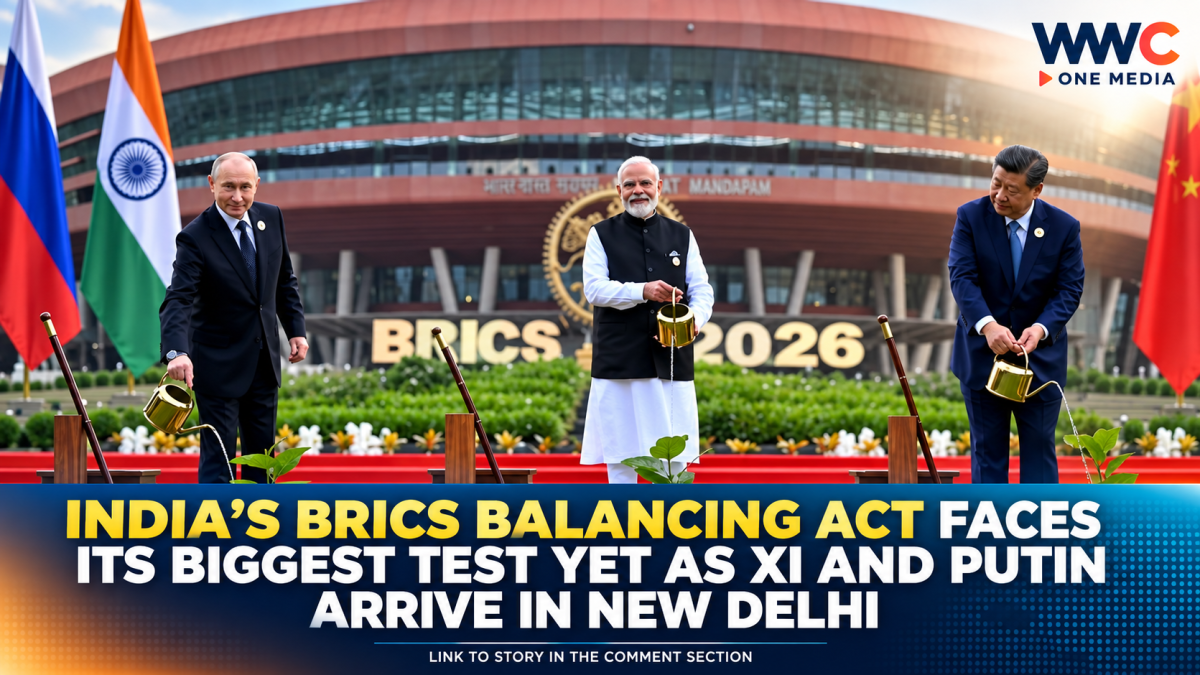
NEW DELHI — India’s carefully crafted strategy of maintaining strong ties with both Western and non-Western powers is facing one of its biggest diplomatic tests yet as Chinese President Xi Jinping and Russian President Vladimir Putin converge on New Delhi for the BRICS summit.
Prime Minister Narendra Modi is attempting a delicate balancing act: strengthening India’s role in BRICS and the Global South while preserving strategic partnerships with the United States and other Western powers.
The challenge has become even more significant as geopolitical tensions, wars, trade disputes and rivalries threaten to expose deep divisions within the expanded BRICS bloc.
According to the original report by the Philippine Daily Inquirer, India has pursued what analysts describe as an increasingly complex foreign policy strategy — deepening engagement with China and Russia while resisting efforts to transform BRICS into an openly anti-Western alliance.
Xi’s First India Visit in Seven Years Signals a Cautious Reset
Xi’s visit to India is particularly significant.
It marks his first trip to the country in seven years and comes after relations between Asia’s two largest powers were severely damaged by the deadly 2020 military clash along their disputed Himalayan border.
During their meeting on the sidelines of the BRICS summit, Modi and Xi pushed for stronger business connections, greater mobility and improved people-to-people exchanges.
But Modi also made clear that lasting peace along the disputed border remains crucial to any deeper improvement in India-China relations.
Reuters reported that bilateral trade between India and China reached a record $155.6 billion in 2025, highlighting the economic importance of the relationship despite continuing political and security tensions. India, however, continues to face a major trade imbalance with China.
The Associated Press reported that the leaders also discussed market access and trade concerns while attempting to stabilize relations after years of mistrust. Yet unresolved border issues, military deployments and broader strategic competition remain major obstacles.
For Modi, the challenge is clear: improve relations with Beijing without appearing to compromise India’s security interests.
Putin Visit Reinforces India-Russia Ties
Putin’s presence in New Delhi presents another major test for India’s diplomatic strategy.
India and Russia have maintained close political, defense and energy ties for decades, and the two leaders used their latest meeting to reaffirm their strategic partnership.
Reuters reported that Modi and Putin discussed expanding cooperation in trade, energy and defense, while setting an ambitious target of increasing bilateral trade to $100 billion by 2030.
India has also continued purchasing Russian oil despite pressure from Western governments, arguing that energy security remains critical for its massive and growing economy.
The relationship gives India an important strategic connection with Moscow — but it also complicates New Delhi’s relationship with Washington and its Western partners.
That balancing act is now becoming increasingly difficult as conflicts in Ukraine and the Middle East continue to reshape global alliances.
Can India Stop BRICS From Becoming an Anti-Western Bloc?
Perhaps the biggest question hanging over the summit is the future direction of BRICS itself.
China and Russia have often pushed for BRICS to play a larger role as an alternative to Western-led institutions and systems.
India, however, has taken a more cautious position.
New Delhi wants BRICS to become more influential in global governance and give developing countries a stronger voice — but India has resisted defining the bloc primarily as an anti-U.S. or anti-Western alliance.
Modi emphasized at the summit that BRICS should help the Global South become a “rule-shaper” rather than simply challenge existing powers. He also called for reforms in global institutions, including greater representation for developing countries.
Analysts say this approach reflects India’s broader strategy of strategic autonomy.
India wants to work with the United States and Europe while maintaining strong relationships with Russia, China, the Gulf states and other emerging powers.
That strategy gives New Delhi flexibility — but it also places India in the middle of some of the world’s most difficult geopolitical rivalries.
Middle East Crisis Adds Pressure to BRICS Unity
The summit is also taking place against the backdrop of escalating tensions in the Middle East.
Reuters reported that the conflict involving Iran has created additional strains within BRICS, particularly as the bloc’s expanded membership brings together countries with competing interests and regional rivalries.
Xi called on BRICS to play a greater role in promoting peace and diplomacy in the Middle East, arguing that the group should act as a force for stability during a period of growing global uncertainty.
The Associated Press reported that BRICS leaders raised concerns over conflicts and unilateral sanctions while pushing for greater influence for developing nations in global affairs.
But reaching consensus is becoming more difficult.
The expanded BRICS bloc now brings together countries with very different political systems, strategic priorities and relationships with the United States and other Western powers.
That diversity increases the group’s global influence — but it also makes unity harder to achieve.
India Walks a Diplomatic Tightrope
For India, hosting Xi and Putin at the same summit is about far more than symbolism.
It is an opportunity for Modi to demonstrate that New Delhi can remain an independent global power capable of talking to rivals and partners across geopolitical divides.
India wants stronger relations with the United States.
It wants to preserve its historic partnership with Russia.
It wants to stabilize relations with China without ignoring security concerns.
And it wants BRICS to become a stronger voice for developing nations without turning the organization into a rigid geopolitical alliance against the West.
That is an extraordinarily difficult balancing act.
The Guardian noted that India increasingly sees itself as a bridge between Western powers and the developing world, while China has promoted BRICS more aggressively as a counterweight to the U.S.-led global order.
Meanwhile, the expanded BRICS group represents a major share of the world’s population and economy, giving its internal debates increasing global importance.
The Real Test for Modi Is Only Beginning
The images of Modi standing alongside Xi and Putin may project diplomatic strength.
But behind the handshakes are difficult questions that no summit can easily solve.
Can India and China genuinely rebuild trust after years of border tensions?
Can India maintain its close relationship with Russia while expanding strategic ties with the West?
Can BRICS remain united despite conflicts involving its own members?
And perhaps most importantly, can Modi keep India at the center of multiple competing power blocs without eventually being forced to choose?
For now, New Delhi appears determined to avoid that choice.
India’s message is clear: it does not want to belong exclusively to one geopolitical camp.
But as Xi and Putin’s visits place India at the center of global diplomacy, Modi’s strategy of balancing competing powers is entering its most difficult phase yet.
The summit may demonstrate India’s growing influence — but what happens after the leaders leave New Delhi could reveal whether India’s ambitious BRICS strategy can truly survive the pressure.



Leave a Reply