
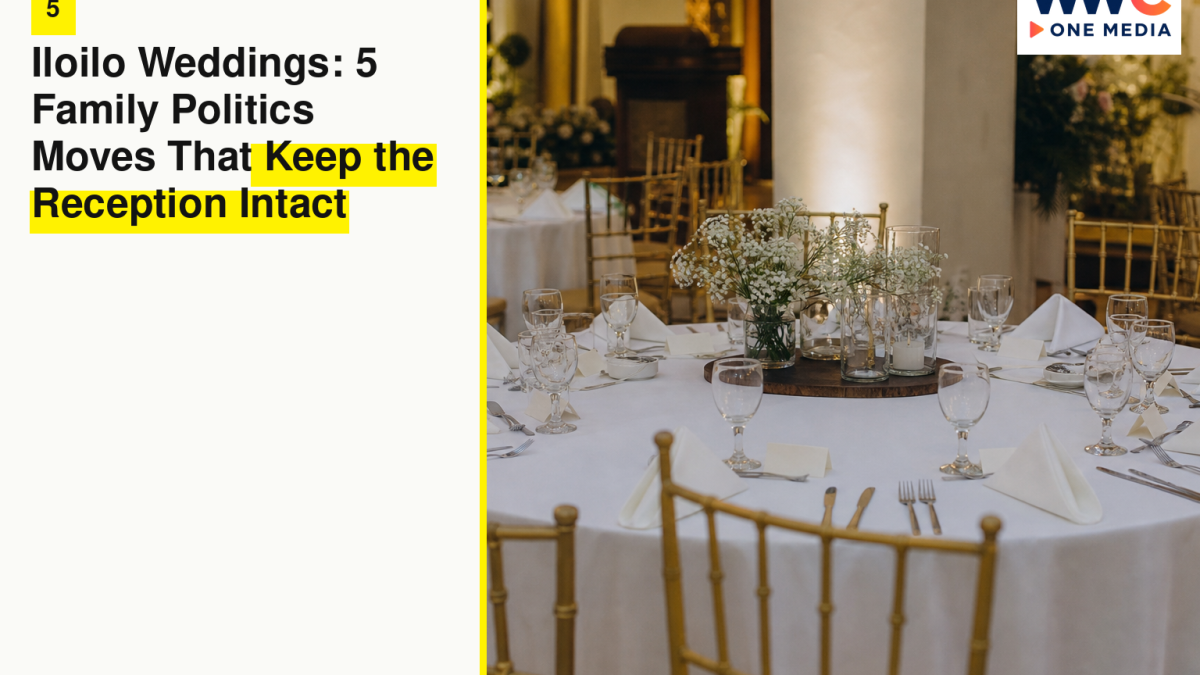
ILOILO CITY, Philippines — A wedding in this city can look calm in the morning: Jaro traffic slower than Manila, a church that your family has opinions about, a hall that is either near the old streets or out toward a hotel that thinks it is elsewhere. Then the families arrive. Iloilo weddings do not usually collapse because the food was late. They collapse because nobody ran family politics to keep the reception intact: seating that puts the wrong uncles together, godparents listed like a ranking, a walk down the aisle that skipped the person who actually raised you, a La Paz cousin who treats the reception as their living room, and a videoke machine that turns a toast into a turf war.
Five moves. They will not make everyone happy. They will keep the reception intact. Intact is the job. Happy is a bonus you do not promise a tito who came to win.
This is not a guide to Catholic law. Parishes in Iloilo will tell you their own requirements, documents, schedules, what the church allows in the rite. Ask them. What follows is the family layer: who sits, who is asked, who walks, who speaks, who gets the microphone after the program. That layer is where receptions break.
1. Seating that does not start a war in Jaro — family politics at Iloilo weddings
Seating is the first family politics move because it happens before anyone has eaten. Put two people who have not spoken since a land argument in 2014 at the same round table and the soup becomes a trial. Iloilo is not uniquely vicious. It is uniquely small in the way cities with long memories are small. People know. People remember a slight from a fiesta. People brought that slight to Jaro in a pressed barong.
Draw the room before you draw the flowers. Columns: parents’ siblings, the godparents, work friends who should not have to referee a clan, the Manila cousins who need to be near an exit, the older relatives who need not to walk far from a toilet. Then the red list: pairs who do not sit together. You do not need to write why on a sheet that a coordinator might flash. You need the pairs. If you cannot name them, ask one calm sibling on each side, privately. They know.
Principal table versus round tables: do not invent a ranking that will be photographed and forwarded. If your families expect a presidential table, ask the venue what they can actually fit. A crowded principal table that leaves a grandmother at a distant seat is a politics failure even if it looks symmetrical. Put the people who cannot walk far where they can walk far. Put the people who will make a speech where they can get to a mic without climbing over a cake. Put the barkada far enough that their jokes do not land on a priest’s cousin.
Jaro logistics matter. If the church is in Jaro and the hall is a drive, seating also means cars. Who rides with whom after the rite is a continuation of the table. A relative stuffed into a van with the person they are in a freeze-out with will arrive at the reception already loud. Assign vans like you assign tables. Write names on a paper the driver can hold. Drivers are not mind readers, even when they are cousins.
Place cards help if your families will honor them. If they will not — if uncles sit where they want because they “always have” — you need ushers who are not shy. Hire that energy or deputize a cousin with a neck and a smile. A seating plan with no enforcement is a suggestion. Suggestions lose to a tito.
What not to do: put all the “problems” at one table and call it the far table. They will notice. They will make a toast about it. Mix, buffer with neutrals, keep the true freeze-outs apart. Neutrals are the people who like both and like food more than history.
If a parent wants to reseat the room the night before, you hold a meeting, you do not hold a surprise. Night-before reseating is how Iloilo weddings start the reception in a group chat argument. Freeze the chart forty-eight hours out unless someone is in hospital.
2. Godparents — the list, the order, the people you cannot skip
Godparents at Iloilo weddings are family politics with programs. Who is asked, whose name is printed first, whose photo is on a slide, who was asked last-minute because a richer person said maybe. None of that is doctrine you should invent. It is social heat. Handle it as heat.
Start with the people you cannot skip without a wound: the ones who raised a parent, the ones who paid a school year, the ones who have been in the house every Holy Week. Then the people you want. Then, maybe, the people a parent wants for peace. If the list is getting long, it is already a budget and a seating problem. Cap it. A cap is a politics move. “We are asking eight, we love the others, we cannot print a phone book” is a sentence you can use in a living room in La Paz.
Order on a printed program will be read like a ranking even if you meant alphabetical. If you can avoid a ranking, do. If the culture of your families requires a principal pair, agree that pair with both sides in the room, not in two separate phone calls that diverge by Tuesday. Diverged lists are how a ninang arrives and cannot find her corsage, then cannot find her patience.
Gifts and envelopes stay off the printed ranking. Do not seat godparents by estimated peso. Seat them where they can see, where they can walk, where they are not stuck beside a freeze-out. If someone helps with money, thank them in a way you would thank them if they had not. Public gratitude that sounds like a receipt will be remembered as a receipt.
If you skip someone who expected to be asked, do it early, in person or in a call, with a reason that is about cap and closeness, not about their divorce, their job, their politics, their drink. You can skip. You cannot skip and then let them hear from a cousin at a Jaro bakery. Early is respect. Gossip is how receptions crack at 8 p.m.
Parish process: follow the church. If they have a form, a seminar, a way names are submitted, that is the process. Your family politics cannot rewrite a parish office. If a relative insists on a ritual detail the parish does not do, the answer is the office, not a debate at the rehearsal. Rehearsals are for walking. They are not for inventing rules.
3. Who walks who — parents, step-parents, the aunt who raised you
The walk is short and it is the clip everyone keeps. Iloilo weddings go still in a bad way when the walk ignores the actual household. A parent who left, a parent who stayed, a step-parent who paid the bills, an aunt in La Paz who did the mornings. You will not please all of them. You can still avoid a public erasure.
Ask the people who will be in the photos what they can live with, separately, before you announce a formation. Some want to walk. Some would rather be seated and honored another way. Some will say they do not care and then care in the aisle. Believe the history, not the first shrug. Offer two dignified options: walk, or a reserved place and a mention that does not sound like a consolation prize.
If there is a fight between biological and the person who raised you, this is the move: you do not hold that trial in a church aisle in Jaro. You hold it in a house, weeks out, with one sibling as a witness if it helps. The reception stays intact when the aisle was already negotiated. If someone threatens not to come unless they walk, that is information. You can choose the household that raised you and live with the empty seat. You can try a double walk if the parish and the space allow it. You cannot do a surprise swap at the door.
Entrances at the hall are a second walk. Same politics, looser music. Keep the list short. A long entrance is how uncles start drinking before you have arrived, and how the videoke lobbyists start their campaign. You, parents, the people who stood for you if that is your pattern, then food. Friends can be in the room without being a parade.
What not to do: let a parent privately promise a walk to someone you already said no to. One list. Couples who allow two lists will perform a contradiction in front of a photographer. The photographer will not save you. They will capture it.
If a person who should walk cannot — health, a flight, a feud they will not enter — name a substitute they choose, if they want one. Do not invent a substitute to keep a symmetry. Symmetry is not a family.
4. Uncles and videoke — containing the reception without shaming the table
There will be uncles. There will be a request for videoke, a band that “can also do,” a cousin who brought a speaker because they did not trust the hall. Iloilo receptions, like a lot of Visayan receptions, can tilt from program into a house party with better chairs. That tilt is fun until it is a fight: volume over a grandmother, a song that is a jab at an ex in the room, a toast that becomes a sermon about a land title.
The move is a container, not a ban if a ban will start the war you are trying to avoid. Set a time: program until this hour, open floor after, videoke after the old people who hate it have a way to leave without walking through a speaker. Set a place: a second room, a foyer, a karaoke that is not beside the cake. Set a person: one relative on each side who can take a mic away without making it a dare. If you cannot name that person, you do not have videoke. You have a hostage situation.
Songs: you can laugh, you can still keep a short list of no-songs if your families have a known grenade — a political anthem, a love song that belongs to a feud, a parody of a sibling. Tell the host. Tell the band. Do not post the no-list. Posting it is a challenge.
Toasts get a order and a clock. Parents, maybe one friend, maybe a sibling. Then food. Open mic is how an uncle reviews your partner’s family in Ilonggo that half the Manila cousins do not speak, and the half who do wish they did not. If an uncle is going to speak no matter what, put him early, give him two minutes, have a host who can clap and cut. Clapping is a politics tool. Use it.
Alcohol is family politics. A dry hall will offend some. An open pour will offend the people who have to drive back through the city, and the people who have a history you already know. Cap it. Tickets, a time, a switch to coffee. You know which uncles. If you pretend you do not, the reception will remind you.
What not to do: shame a table for singing. Contain the machine, not the people. Shaming is how a La Paz table walks out and takes three other tables with them because kinship is a web. A web is why you seated them with buffers in the first place.
5. La Paz logistics and the relatives who treat the hotel as their house
La Paz is a real part of the city, a real set of households, a real pride, a real set of cousins who will arrive early and stay late. So is the rest of Iloilo City. The fifth move is logistics as politics: who uses which room, who can enter the couple’s hotel, who is allowed to bring extra people “because they were already in the van,” who thinks the preparation suite is a reunion.
Write a guest policy for the morning. Getting-ready rooms are small. Aunts will still come. Cap the room. A coordinator or a sibling at the door is not rudeness. It is how you get dressed. If someone needs to give a gift or a blessing, they can do it in a lobby at a time you name. They cannot camp.
Extra guests: the invitation is the list. Iloilo weddings grow by vans. A van arrives with two names you do not have plates for. The move is a person at the hall door with the list, extra plated meals only if you budgeted a buffer, and a kind no that does not happen in front of fifty people if you can help it. Pull the uncle aside. “We can seat two, we cannot seat six.” If he explodes, he explodes in a corridor, not on the dance floor. That is intact.
Hotels: if you booked a room so you could sleep, that room is not a storage unit for relatives’ luggage unless you said so. If a family home in La Paz is the rest area, say what time it closes. Old people need a bed. Children need a bed. A reception that assumes everyone can last until videoke is a reception that will lose the people you actually wanted to keep.
Transport between Jaro, La Paz, the hall, the airport side of a guest’s life: one person owns the spreadsheet. Drivers, times, who is in which car after the rite, who takes the cake, who takes the gifts so they are not left for a stranger. Family politics loves a missing envelope. Put envelopes in a bag with two names on it. Photograph the bag. Boring. Intact.
If a relative wants to host a second event — a breakfast, a after-party, a “real” cooking at the house — you can bless it as unofficial. You cannot let it kidnap your photographers, your timeline, or your old people. Official is the church and the reception you paid for. Everything else is optional and cannot start before you arrive unless you like cutting a cake in an empty hall.
The week-of script for both mothers
Sit once, midweek, not the morning of. Bring the seating chart, the godparent list as printed, the walk order, the program with toast times, the van list, the door person, the videoke rule. Let them object. Take the objections that prevent a scene. Reject the ones that are rankings in disguise.
Script: “We can move Tita X away from Tita Y. We cannot add a sixth speech. We cannot reprint the program. We can tell the band no to that one song. We cannot dry the whole bar without telling people who already traveled. We will have coffee at ten.” Then you stop. A long defense invites a longer case.
If the two mothers cannot be in the same sitting, you do two sittings and you do not let them rewrite each other by text at midnight. You are the merge. That is the job of a couple at Iloilo weddings. If you cannot merge, pick the version that keeps the reception intact, not the version that wins a childhood.
What not to do with Catholic details you do not actually know
Do not tell a priest how their rite works because a relative in Manila saw a video. Do not invent a requirement about sponsors, dress, timing, or who may enter which part of the church. Ask the parish. Write it down. Repeat it to relatives as the parish’s word, not as your preference, when that is true. When it is your preference — songs, a cap on sponsors, no aisle surprises — own it as yours so you can be argued with like an adult, not like a fake canon lawyer.
Do not use religion as a weapon in a seating fight. It gets ugly in a room that is already hot. Seating is courtesy. Godparents are relationships. The walk is household truth. Videoke is volume. Logistics are safety. Keep those in their lanes.
Do not surprise a relative with a ritual role they did not agree to. Surprise is not honor. It is a trap with a candle.
Objections that arrive with the first catering tasting
“In our family we always…” Always is how rooms get reseated. Always can have a smaller version: a toast, a song, a walk. It cannot always have a veto.
“If we don’t invite X, the whole barangay will talk.” They may talk. They are talking anyway. Invite the people you can feed and seat. A reception that is a rumor-management device will not be intact. It will be a crowd.
“Videoke is the point.” Then put it after, in a container, with a way for people who hate it to leave. The point of the reception is that people still like you at dessert.
“You’re too Manila.” One of you may have lived in Manila. The seating still has to work in Jaro. Listen to the sibling who knows the feud map. Do not let “too Manila” be the end of a cap on extra van guests. Caps are Iloilo too. Halls have a fire count. Plates have a number.
“Just let them sit anywhere.” Anywhere is the war. You have the chart. Use it.
If the reception still tilts
Someone will cry. Someone will drink. Someone will leave. Intact does not mean perfect. It means the program finishes, the old people get home, the couple gets a plate, the envelopes are in a bag, the fight — if there is a fight — is in a corridor with a sibling, not on a microphone.
Have an exit for yourselves. A time you leave even if an uncle is mid-chorus. A car that is not the van full of relatives. A room that is not a reunion. Iloilo weddings eat couples who stay to manage the last song. Hire or deputize managers. Go.
After, do not recap the politics in a group chat that includes the problem uncles. Recap with each other, once, the next afternoon, with food. Decide what you will never repeat. File the seating chart. You will need it for a baptism, a death, a next fiesta. The map does not disappear because the hall was cleared.
City notes: Iloilo City, Jaro, La Paz
Iloilo City is the frame: airport guests, hotels, halls, the way people say they will “just drop by” from a nearby town and then bring a household. Budget the drop-by as if it is real.
Jaro: cathedral gravity, traffic that still clumps, families who treat the district as the proper stage. If your church is there, your timeline is walk, van, hall. Build shade, water, chairs for old people who will not admit they need them. Politics in Jaro often wears formality. Meet it with a list, not with a bigger flower.
La Paz: households, pride, the relative who wants the after at the house, the batchoy opinions that will happen whether you serve it or not. Use La Paz as a rest plan if that is where the beds are. Do not use it as an unplanned second reception that steals your day.
None of these notes are history lectures. They are where the vans go. Vans are family politics on wheels.
Bottom line
Iloilo weddings stay intact with five family politics moves: seating that keeps freeze-outs apart in Jaro, godparents listed as people with a cap rather than a ranking, a walk that honors the household that raised you without holding a trial in the aisle, uncles and videoke put in a time and a room so the microphone does not become a court, and La Paz-to-hall logistics that stop extra vans and hotel camping from eating the night. Ask the parish for the rite. Write the family map yourselves. The reception is a room full of memory. Give the memory a chart, then leave while the chart still holds.




Leave a Reply