
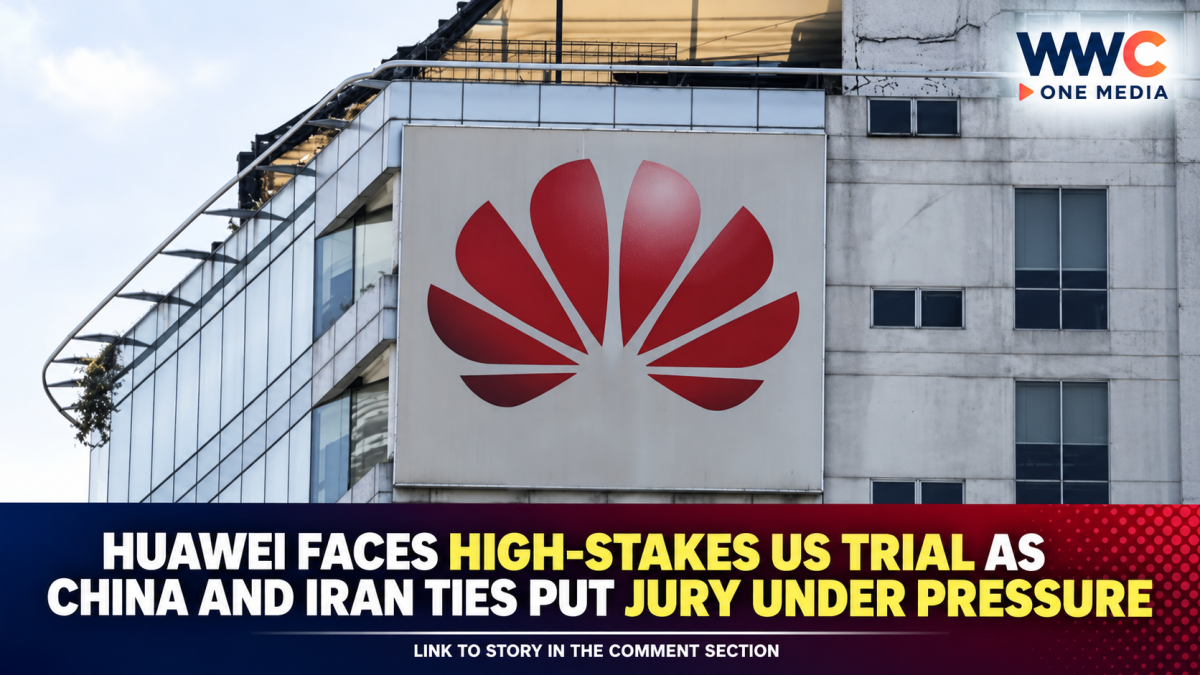
Huawei Technologies is facing one of the most consequential criminal trials in its history as a US jury begins weighing allegations that the Chinese telecommunications giant stole American technology, deceived banks and violated sanctions through its dealings with Iran.
The trial, which began in federal court in Brooklyn after nearly eight years of legal battles, comes at a particularly sensitive moment in US-China relations, with President Donald Trump and Chinese President Xi Jinping expected to meet later this month.
The case places not only Huawei but also the broader relationship between Washington and Beijing under intense scrutiny.
Jury asked to separate politics from the evidence
Potential jurors were presented with more than 80 questions designed to identify possible biases involving China, Iran, Huawei and the US government’s policies toward both countries.
US District Judge Ann M. Donnelly has instructed jurors to focus on the evidence rather than geopolitical tensions.
The unusually broad questionnaire reflects the political sensitivity of the case.
Huawei is one of China’s most important technology companies, while the United States has treated the company as a national-security concern for years.
The trial is therefore unfolding against the backdrop of a much larger technology and strategic rivalry between the world’s two biggest economies.
Prosecutors accuse Huawei of a two-decade criminal scheme
US prosecutors allege that Huawei operated a criminal enterprise for roughly two decades, using theft, deception and sanctions violations to expand its global telecommunications business.
The indictment contains 14 counts involving allegations including racketeering, bank fraud, wire fraud, money laundering, obstruction, trade-secret theft and violations of US sanctions against Iran.
Prosecutors say Huawei sought technology from several American companies, including Cisco Systems and T-Mobile, to accelerate its own development.
The government has also accused the company of using employees and other intermediaries to obtain proprietary information belonging to competitors.
Huawei has pleaded not guilty and rejects the allegations.
Iran dealings at the centre of the case
One of the most important parts of the prosecution’s case concerns Huawei’s business activities in Iran.
US authorities allege that Huawei used a Hong Kong-based company called Skycom to conduct business in Iran while attempting to conceal the relationship from financial institutions.
Prosecutors say the arrangement allowed Huawei to continue operating in Iran despite US sanctions and that the company misled HSBC about its relationship with Skycom.
The allegations became internationally significant after Huawei Chief Financial Officer Meng Wanzhou was arrested in Canada in 2018 at the request of US authorities.
Her arrest triggered a major diplomatic dispute involving Washington, Beijing and Ottawa.
Meng later reached a deal with US prosecutors and returned to China in 2021. The United States subsequently dropped its extradition request and said it would dismiss the fraud charges against her.
Allegations extend beyond Iran
The trial is broader than Huawei’s Iran operations.
Prosecutors also accuse the company of conspiring to steal trade secrets from US technology companies and of conducting business involving North Korea despite US sanctions.
Another major allegation concerns surveillance equipment supplied to Iran.
US authorities say Huawei equipment was used to help Iranian authorities monitor protesters during the 2009 anti-government demonstrations in Tehran.
The prosecution is expected to rely on testimony from former employees, technology experts and financial witnesses as it attempts to connect the various allegations into a single pattern of corporate conduct.
Huawei says prosecutors are misrepresenting its business
Huawei’s defence has rejected the government’s portrayal of the company as a criminal organisation.
Its lawyers argue that prosecutors are taking isolated incidents involving individual employees and presenting them as evidence of a coordinated corporate conspiracy.
The company maintains that its global success was built through innovation and competition rather than the systematic theft of intellectual property.
Huawei has also argued that the US government is attempting to extend American law beyond its proper reach by prosecuting conduct that occurred outside the United States.
The defence is expected to challenge the reliability and interpretation of the government’s evidence throughout the trial.
The case could last months
The trial is expected to last roughly three months, with the possibility of extending longer depending on the evidence and testimony.
That means proceedings could overlap with a planned meeting between Trump and Xi in Washington later this month.
The timing could make the case particularly uncomfortable for both governments.
For Washington, the prosecution reinforces longstanding claims that Huawei presents economic and national-security risks.
For Beijing, the case fits into a broader narrative that the United States is using legal and regulatory tools to restrict China’s technology companies and slow China’s technological rise.
Chinese officials have repeatedly rejected US actions against Huawei as economic bullying and discrimination.
Huawei has transformed despite US sanctions
The trial comes years after the United States placed Huawei under severe restrictions that cut the company off from many American technologies and components.
Those measures dramatically affected Huawei’s smartphone business and its access to advanced computer chips.
The company nevertheless expanded its domestic technology capabilities, including semiconductor development, as China seeks to reduce its dependence on US technology.
Huawei has also become increasingly important to China’s ambitions in artificial intelligence and advanced computing.
That makes the outcome of the trial potentially significant well beyond the company’s telecommunications business.
A verdict could have wider consequences
A conviction could expose Huawei to substantial financial penalties and further complicate its international operations.
It could also strengthen Washington’s argument for maintaining or expanding restrictions on the company.
For Huawei, a full acquittal would provide an important legal and political victory after years of US pressure.
But regardless of the verdict, the trial has already become a major test of how far the US government can pursue a Chinese technology company over alleged conduct spanning multiple countries.
The jury must ultimately decide whether prosecutors have proved their criminal allegations beyond a reasonable doubt.
But the stakes extend far beyond a Brooklyn courtroom.
The Huawei case has become a measure of the increasingly tense relationship between American technology power and China’s ambitions to build a global technology ecosystem independent of Washington.




Leave a Reply