
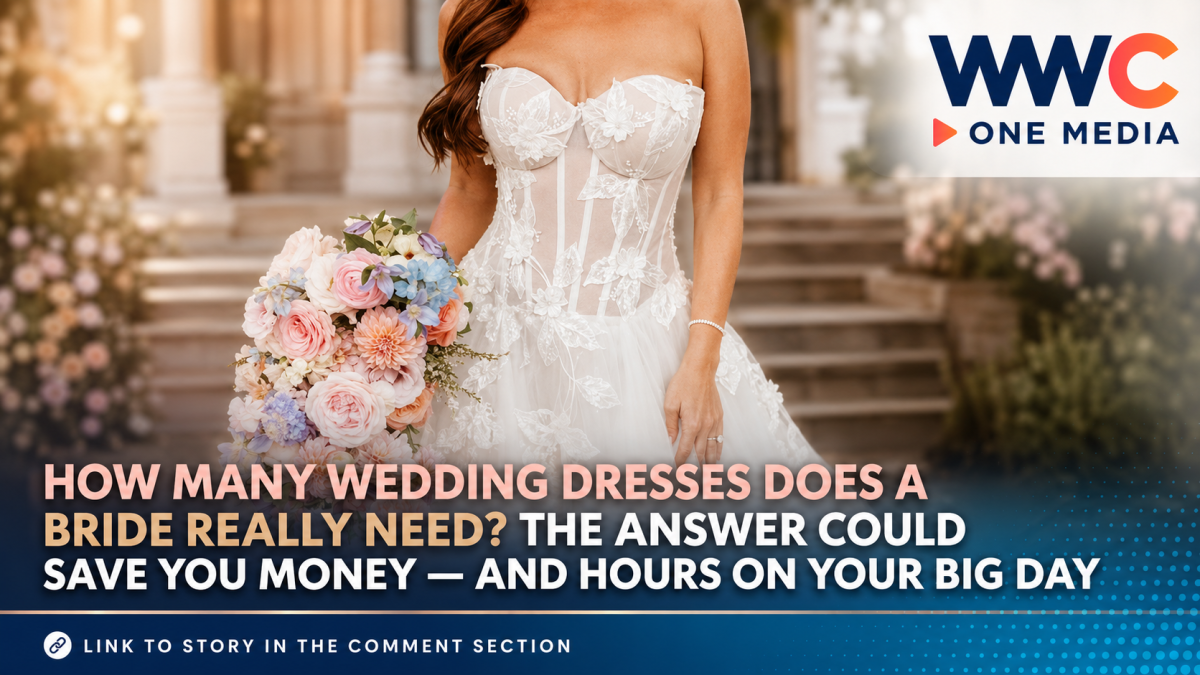
For generations, finding “the dress” was treated as one of the defining moments of wedding planning.
Now, for some brides, one dress is only the beginning.
From dramatic ceremony gowns to sleek reception dresses, traditional outfits, detachable overskirts and tiny after-party minis, the modern bridal wardrobe can easily stretch to two, three or even more looks.
But as multiple wedding outfits become increasingly visible on Instagram, TikTok and celebrity weddings, brides are facing a surprisingly practical question: How many wedding dresses do you actually need?
The answer, bridal experts say, may have much less to do with fashion than with your schedule, venue, budget — and how much of your own wedding you want to spend inside a changing room.
There Is No ‘Magic Number’ of Wedding Dresses
In a September 2 report by CNA Lifestyle, Ang Jin Yuan, founder of Singapore bridal boutiques The Ivory and Muse, said brides should stop thinking about a required number of gowns and instead consider the experience they want throughout their wedding day.
That distinction matters particularly in Singapore, where weddings can involve several distinct events in a single day — from tea ceremonies and solemnisation ceremonies to church services, receptions, hotel banquets and after-parties.
Each event can create a legitimate reason for a different outfit.
A bride might choose a traditional outfit for a tea ceremony, a formal white gown for the solemnisation or march-in and something lighter for the reception or dancing.
Singapore bridal businesses also commonly offer packages built around multiple gowns or outfits, reflecting how several wardrobe changes have become part of some local wedding formats.
But “possible” does not mean “necessary”.
For some brides, one well-chosen dress could actually produce the better wedding experience.
Why the Second Wedding Dress Became So Popular
The multi-look bride is hardly just a Singapore phenomenon.
Brides has described reception “second looks” as having evolved from an occasional extravagance into a lasting feature of contemporary bridal fashion, driven partly by social media, cultural traditions, comfort and the desire for greater personal expression.
Vogue has likewise chronicled the rise of second and third bridal outfits, particularly for after-parties, where shorter dresses, sequins, embellishments and more dance-friendly silhouettes give brides a dramatically different appearance after the ceremony.
The trend fits an even bigger shift in weddings.
Vogue’s reporting on the bridal market in 2026 noted how weddings have increasingly become multi-event fashion experiences, amplified by TikTok “get ready with me” videos, Instagram reels, fittings, pre-wedding events and after-party looks.
At the same time, the publication identified intentionality and personalisation as major themes shaping weddings in 2026 — couples increasingly want celebrations that reflect their actual personalities rather than blindly following traditions or viral aesthetics.
That creates an interesting contradiction.
Social media helped popularise the multi-dress wedding.
But the latest wedding philosophy may actually be telling brides they don’t need to follow it.
The Biggest Advantage of a Second Dress May Be Comfort
There is a practical argument for changing clothes.
A cathedral train, structured corset, heavily beaded gown or enormous skirt can look spectacular during a ceremony.
It may be considerably less spectacular when you’re attempting to weave between dinner tables or dance for three hours.
The Knot notes that reception dresses can give brides more freedom of movement while allowing them to shift the entire mood of their bridal look. A shorter or streamlined dress can also prevent a long train from becoming a problem on the dance floor.
Recent bridal trends have pushed that idea even further.
Micro-mini reception dresses, for example, have become increasingly visible as brides seek outfits that are easier to move in, more playful and potentially wearable again after the wedding.
But there is a downside.
Every transformation costs something besides money.
It costs time.
The Wedding-Day Cost Brides May Forget to Calculate
Changing a wedding dress isn’t always as simple as taking one gown off and putting another one on.
There may be shoes to replace, jewellery to change, hair to restyle, makeup to touch up, photographs to take and complicated dresses to button, lace or fasten.
CNA’s Ang warned that those minutes can quickly accumulate — meaning brides may ultimately spend part of their celebration away from the people they invited to share it with.
Brides has similarly reported expert guidance suggesting that individual bridal outfit changes can take roughly 15 to 30 minutes, depending on the complexity of the look.
Two elaborate changes could therefore potentially remove a substantial chunk of time from an already tightly scheduled wedding.
And unlike the pictures, that time cannot be recovered.
That may be the strongest argument for deciding what every outfit is actually supposed to accomplish.
A dramatic ceremony gown has a clear purpose.
A lighter reception dress may have one too.
But a third outfit included mainly because other brides on social media have one may be harder to justify.
The Alternative: Make One Wedding Dress Become Two
Brides who want multiple looks without multiple full outfit changes increasingly have another option: the convertible wedding dress.
Detachable overskirts can turn a large ceremony silhouette into a slimmer reception gown.
Removable sleeves can transform a conservative church or solemnisation look into a strapless or sleeveless evening outfit.
Capes, boleros, veils, gloves, statement jewellery and detachable straps can accomplish similar transformations.
Brides has also pointed to convertible designs as an increasingly practical solution for brides who want visual variety without buying several separate outfits.
Even changing a hairstyle, veil, shoes or jewellery can make the same dress appear substantially different in photographs.
In other words, brides may be able to achieve the coveted “second look” without actually owning a second gown.
Rent or Buy? That Depends on Which Dress Matters Most
Multiple outfits introduce another obvious question: Who is paying for all of them?
Wedding gown rental has long provided one solution, particularly in markets such as Singapore where bridal businesses offer packages covering several wedding events.
CNA notes that renting can make designer gowns more accessible and can be especially attractive to brides who want several looks without keeping each dress permanently.
Buying makes more sense when a bride wants a bespoke, heavily customised or made-to-measure gown — particularly if preserving the dress afterward carries sentimental value.
Another strategy is to spend heavily on one major ceremony gown while choosing less expensive fashion-label, rented, vintage or reusable pieces for secondary appearances.
The growing secondhand bridal market also gives brides another option. Vogue has reported rising interest in vintage and resale bridalwear, driven partly by affordability, sustainability and demand for more distinctive wedding looks.
So, How Many Wedding Dresses Do You Actually Need?
For some brides, the answer will be one.
For others, it might be two.
And for a wedding involving several ceremonies, cultural traditions and a long banquet, three or more outfits may make perfect sense.
What the available expert advice does not support is the idea that every bride needs multiple dresses simply because multiple outfit reveals have become fashionable online.
The more useful question is what each dress contributes.
Does it honour a tradition?
Does it make dancing easier?
Does it suit a different venue?
Does it give you a genuinely different look you’ve always wanted?
Or is it simply another expensive obligation added to an already expensive day?
A wedding wardrobe should ultimately serve the bride — not the algorithm.
Because after months of planning, fittings and spending, the most valuable thing on the wedding day may not be another dress at all.
It may be the extra hour you actually get to spend wearing one.




Leave a Reply